


Endless Article on Coilovers and Brakes

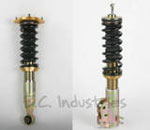

Endless Article on Coilovers and Brakes
Found this article by Kent Chen of Endless USA on things to consider when choosing your coilover or brake setups. He tries to stay as unbiased of possible in the article.
http://www.jtuned.com/content/templa...=286&zoneid=16
Excerpt:
"Just because you have a particular thingamajig on your coil over doesn't necessarily mean it's better. People always seem to always ask if so and so has camber-adjustable pillow-ball type upper mounts. What is your current suspension set-up? Strut-type? Multi-Link? Double wishbone? Pillow-ball type mounts can be harsh at times. Make sure you need it and find out what how to adjust camber, caster, and toe on your vehicle. Not everything needs to be adjusted by camber plates. Focusing just on camber plates for adjustment can actually cause unnecessary stress and tension since everything is connected and affected. This is just one aspect though.
Is the coil over system damping adjustable? Are they height-adjustable? Are they truly height-adjustable meaning is there a separate, lower adjustable bracket/cup that can be spun up or down over the threaded shock shell casing eliminating the problem of sacrificing stroke and altering spring tension?
Then we can get into other characteristics such as mono tube versus twin tube, regular mono tube versus inverted mono tube, aluminum versus steel shell casings, external remote reservoirs, piston and shaft diameters, independent rebound and compression, as well as the construction, weight, and machining of the product. Sometimes, numbers will just confuse you. But hopefully, total gathered data will help instead of hinder.
Believe it or not, springs also play a large role in the coil over system as well. Spring rates may just seem like a set of fixed numbers, but different brand springs with the same spring rates can actually differ in feel, performance, and life. How so? Different springs use different material and have a different number of coils amongst other things. It's to my knowledge that a spring that reaches a specific spring rate level quicker and with less spring stroke is superior. One with very little unwanted tendencies during expansion and contraction. A spring with a motion characteristic that is smooth and linear with the ability to catch road surface information directly. A spring with accurate levels of response and a smooth yet solid feeling is what we look for to accompany a shock absorber.
Numbers are usually always the factual determinants, but if you're comparing numbers, make sure to compare apples to apples and know what you're comparing, why you're comparing, and how you're comparing.
In the end, a lot of it really comes down to feel. Different companies have different philosophies of what they feel is the ultimate, tuned suspension system. Ultimately, for most Japanese aftermarket manufacturers, it is about progressing through advanced technology, but do you really need a ZEAL Damping-Rate Remote Controller (DRC) that will control damping force from within your cockpit with damping adjustment controlled by a remarkably, super miniature, Servo micro-motor inside the piston rod enabling remote control of damping adjustment with direct response accuracy at critical levels? Just because Endless Japan has future developments of developing this including 4-wheel automatic and ride-adjustability determined by such factors as vehicle speed and cornering force (without utilizing a large, bulky, head-unit) doesn't mean that you need it if you're looking to get more show trophies than circuit trophies (shameless plug). I'll be the first to admit that most of this has been taught to me (getting schooled in Japan for weeks on end is not fun) and to really know is to experience and feel the difference. Drive in as many different vehicles with as many different set-ups as possible. Always search and research and don't judge a magazine by its cover."
http://www.jtuned.com/content/templa...=286&zoneid=16
Excerpt:
"Just because you have a particular thingamajig on your coil over doesn't necessarily mean it's better. People always seem to always ask if so and so has camber-adjustable pillow-ball type upper mounts. What is your current suspension set-up? Strut-type? Multi-Link? Double wishbone? Pillow-ball type mounts can be harsh at times. Make sure you need it and find out what how to adjust camber, caster, and toe on your vehicle. Not everything needs to be adjusted by camber plates. Focusing just on camber plates for adjustment can actually cause unnecessary stress and tension since everything is connected and affected. This is just one aspect though.
Is the coil over system damping adjustable? Are they height-adjustable? Are they truly height-adjustable meaning is there a separate, lower adjustable bracket/cup that can be spun up or down over the threaded shock shell casing eliminating the problem of sacrificing stroke and altering spring tension?
Then we can get into other characteristics such as mono tube versus twin tube, regular mono tube versus inverted mono tube, aluminum versus steel shell casings, external remote reservoirs, piston and shaft diameters, independent rebound and compression, as well as the construction, weight, and machining of the product. Sometimes, numbers will just confuse you. But hopefully, total gathered data will help instead of hinder.
Believe it or not, springs also play a large role in the coil over system as well. Spring rates may just seem like a set of fixed numbers, but different brand springs with the same spring rates can actually differ in feel, performance, and life. How so? Different springs use different material and have a different number of coils amongst other things. It's to my knowledge that a spring that reaches a specific spring rate level quicker and with less spring stroke is superior. One with very little unwanted tendencies during expansion and contraction. A spring with a motion characteristic that is smooth and linear with the ability to catch road surface information directly. A spring with accurate levels of response and a smooth yet solid feeling is what we look for to accompany a shock absorber.
Numbers are usually always the factual determinants, but if you're comparing numbers, make sure to compare apples to apples and know what you're comparing, why you're comparing, and how you're comparing.
In the end, a lot of it really comes down to feel. Different companies have different philosophies of what they feel is the ultimate, tuned suspension system. Ultimately, for most Japanese aftermarket manufacturers, it is about progressing through advanced technology, but do you really need a ZEAL Damping-Rate Remote Controller (DRC) that will control damping force from within your cockpit with damping adjustment controlled by a remarkably, super miniature, Servo micro-motor inside the piston rod enabling remote control of damping adjustment with direct response accuracy at critical levels? Just because Endless Japan has future developments of developing this including 4-wheel automatic and ride-adjustability determined by such factors as vehicle speed and cornering force (without utilizing a large, bulky, head-unit) doesn't mean that you need it if you're looking to get more show trophies than circuit trophies (shameless plug). I'll be the first to admit that most of this has been taught to me (getting schooled in Japan for weeks on end is not fun) and to really know is to experience and feel the difference. Drive in as many different vehicles with as many different set-ups as possible. Always search and research and don't judge a magazine by its cover."

Make sure you need it and find out what how to adjust camber, caster, and toe on your vehicle. Not everything needs to be adjusted by camber plates. Focusing just on camber plates for adjustment can actually cause unnecessary stress and tension since everything is connected and affected. This is just one aspect though.
If you could adjust camber or caster without a plate easily and reliably then there would be no need for it.
I don't think his article was mentioned specifically towards Maximas. Afterall, a Maxima doesn't have full independent suspension, multi-link suspension
Most cars have enough factory tolerances to adjust camber to a relative degree without a plate (hence how most people do it also). If you notice in the FSM there is a range for camber settings on the vehicle.
Most cars have enough factory tolerances to adjust camber to a relative degree without a plate (hence how most people do it also). If you notice in the FSM there is a range for camber settings on the vehicle.

Senior Member
Joined: Jul 2001
Posts: 1,341
From: state of confusion
One has to be careful how the shop manual actually "reads" vs what the text only suggests. There is a difference between what constitutes an OE-acceptable range of caster/camber for the vehicle and the range over which you can actually adjust it using whatever OE adjustment exists.
As an example of strut suspension alignment vs tolerance (complete with numbers) that I can get to right away, my Mazda 626 lists allowable front camber as being -0°42', plus or minus 1°, and caster as 3°01', plus or minus 1°. But the OE adjustment mechanism is limited to adjusting both caster and camber at the same time to only four specific combinations where caster and/or camber move only 0.5° away from the basic value.
Norm
As an example of strut suspension alignment vs tolerance (complete with numbers) that I can get to right away, my Mazda 626 lists allowable front camber as being -0°42', plus or minus 1°, and caster as 3°01', plus or minus 1°. But the OE adjustment mechanism is limited to adjusting both caster and camber at the same time to only four specific combinations where caster and/or camber move only 0.5° away from the basic value.
Norm

Thread
Thread Starter
Forum
Replies
Last Post
BPuff57
Advanced Suspension, Chassis, and Braking
33
Apr 16, 2020 05:15 AM
HerpDerp1919
3rd Generation Maxima (1989-1994)
2
Sep 29, 2015 02:02 PM