


What's the easiest way to rotate the ring gear (flywheel) by hand?


Thread Starter
Banned
Joined: Apr 2008
Posts: 1,159
From: Ontario, Canada
What's the easiest way to rotate the ring gear (flywheel) by hand?
I'm trying to inspect the ring gear through the hole where the starter goes, to see if there is damage after this rebuilt starter burnt to a crisp.
Is there any easy way I can get that thing to move with my hand?
A mechanic recommended I put a socket on the crankshaft pully hex nut and turn it clockwise, but access seems tight, plus wouldn't that just tighten the nut more.
Another recommended I remove the spark plugs.
Any suggestions?
Is there any easy way I can get that thing to move with my hand?
A mechanic recommended I put a socket on the crankshaft pully hex nut and turn it clockwise, but access seems tight, plus wouldn't that just tighten the nut more.
Another recommended I remove the spark plugs.
Any suggestions?

Member
Joined: Jul 2007
Posts: 275
From: MO
I'm trying to inspect the ring gear through the hole where the starter goes, to see if there is damage after this rebuilt starter burnt to a crisp.
Is there any easy way I can get that thing to move with my hand?
A mechanic recommended I put a socket on the crankshaft pully hex nut and turn it clockwise, but access seems tight, plus wouldn't that just tighten the nut more.
Another recommended I remove the spark plugs.
Any suggestions?
Is there any easy way I can get that thing to move with my hand?
A mechanic recommended I put a socket on the crankshaft pully hex nut and turn it clockwise, but access seems tight, plus wouldn't that just tighten the nut more.
Another recommended I remove the spark plugs.
Any suggestions?
Before doing this you may want to disconnect the electrical harness to your fuel pump or pull the six spark plug wires from the distributor. You don't want the engine starting while you are turning it by hand because you are essentially mimicking the starter. Chances are low but still possible.
Go out and get a 27mm socket (Lowes). Try and get a socket that is 6 point if possible. That means the inside of socket should have six sides like a hexagon. This reduces the chances of stripping the bolt but in your case it shouldn't be an issue.
Attach it to a breaker bar (or your basic socket wrench if no breaker bar is available). Make sure the transmission is in neutral. Fit the socket over the crankshaft pulley bolt and start turning clockwise. You will essentially be turning the engine by hand. There is going to be pressure obviously but it should turn fairly easy. It will be even easier if the spark plugs themselves are pulled because you won't be building compression on each stroke but this is not required and I never do remove them when turning the crank.
You won't have to worry about overtightening the crankshaft pulley bolt. It is installed at 90 ft/lbs of torque (a s!@# load).
If it doesn't want to turn at all then stop and make sure you are in neutral. This will rotate the flywheel. You can turn it a little, inspect, and repeat.
Here is a picture looking through the passenger front wheel well with the splash cover off (if you still have it, I didn't):
...
...
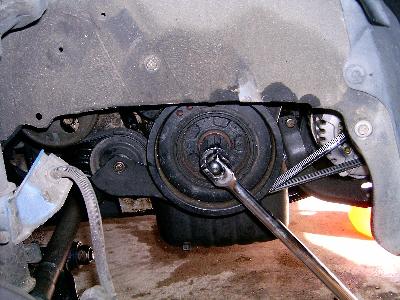 (picture is from a timing belt replacement guide posted recently by an org member)
...
...
The crankshaft pulley bolt is not hard to get to. If you have the shield still you will need to remove it. You'll need to remove the front passenger tire as well.
Last edited by AzureblueZ; Sep 4, 2008 at 07:14 AM.


I'm trying to inspect the ring gear through the hole where the starter goes, to see if there is damage after this rebuilt starter burnt to a crisp.
Is there any easy way I can get that thing to move with my hand?
A mechanic recommended I put a socket on the crankshaft pully hex nut and turn it clockwise, but access seems tight, plus wouldn't that just tighten the nut more.
Another recommended I remove the spark plugs.
Any suggestions?
Is there any easy way I can get that thing to move with my hand?
A mechanic recommended I put a socket on the crankshaft pully hex nut and turn it clockwise, but access seems tight, plus wouldn't that just tighten the nut more.
Another recommended I remove the spark plugs.
Any suggestions?
Thread Starter
Banned
Joined: Apr 2008
Posts: 1,159
From: Ontario, Canada
Thanks guys. Azure, thanks for your instructions. The part about my hand being potentially mauled is scary and thanks for warning me, safety always first.
Can you tell me what exactly I am looking for on the flywheel. Just from the visible portion, I see a leading edge that has a slight angle on it, to mesh with the starter gear easier. I also see slight burring, like sharp metal particle on a couple of the teeth, very tiny.
Is a certain amount of wear normal? Should I try and file the particles off?
I'm starting to wonder if this is what was preventing the starter from engaging intermittently, and is the source of the intermittent click sound. For instance, when the starter solenoid goes, the tooth gear in the starter pushes outward right? And tries to mesh with the flywheel.
Could those burred edges of the flywheel be preventing the gear from matching, and I get click, click, click as it hits metal to metal but doesn't mesh. Then sometimes the car will randomly start normally on other days because the burred edges aren't on every tooth of the fly wheel, so at times, it will mesh easy. Could this hypothesis be valid?
The 2nd refurb burnt to a crisp yesterday, and I'm picking up a brand new WPS starter tommorow, but could I be having other issues that CAUSED the 2nd refurb to run crazy and burn out?
I'm not sure if you read my other message, but basically, I turned the key the other night, it didn't start, then for 3 minutes (after I removed the key) the starter made a crazy motoring sound like something spinning, then loads of smoke came out of the engine bay, I thought my hoses were burning. The smoke was definately coming out of the tiny exhaust hose on the starter body at the bottom.
Can you tell me what exactly I am looking for on the flywheel. Just from the visible portion, I see a leading edge that has a slight angle on it, to mesh with the starter gear easier. I also see slight burring, like sharp metal particle on a couple of the teeth, very tiny.
Is a certain amount of wear normal? Should I try and file the particles off?
I'm starting to wonder if this is what was preventing the starter from engaging intermittently, and is the source of the intermittent click sound. For instance, when the starter solenoid goes, the tooth gear in the starter pushes outward right? And tries to mesh with the flywheel.
Could those burred edges of the flywheel be preventing the gear from matching, and I get click, click, click as it hits metal to metal but doesn't mesh. Then sometimes the car will randomly start normally on other days because the burred edges aren't on every tooth of the fly wheel, so at times, it will mesh easy. Could this hypothesis be valid?
The 2nd refurb burnt to a crisp yesterday, and I'm picking up a brand new WPS starter tommorow, but could I be having other issues that CAUSED the 2nd refurb to run crazy and burn out?
I'm not sure if you read my other message, but basically, I turned the key the other night, it didn't start, then for 3 minutes (after I removed the key) the starter made a crazy motoring sound like something spinning, then loads of smoke came out of the engine bay, I thought my hoses were burning. The smoke was definately coming out of the tiny exhaust hose on the starter body at the bottom.

... I'm not sure if you read my other message, but basically, I turned the key the other night, it didn't start, then for 3 minutes (after I removed the key) the starter made a crazy motoring sound like something spinning, then loads of smoke came out of the engine bay, I thought my hoses were burning. The smoke was definately coming out of the tiny exhaust hose on the starter body at the bottom.
Member
Joined: Jul 2007
Posts: 275
From: MO
Sounds like your 2 nd refurb starter was dead on arrival - its relay didn't disengage when it was supposed to. It didn't do so most likely because of the excessive current going into the starter which probably had a short. Anyway, try to check how the replacement works by applying battery voltage between casing and relay contact - you should hear loud 'click' and see starter gear moved forward. When you remove the voltage they both should come to initial positions. If they do so you can proceed with installation.
Member
Joined: Jul 2007
Posts: 275
From: MO

I usually wander in here with 20 questions looking like this =>

Can you tell me what exactly I am looking for on the flywheel. Just from the visible portion, I see a leading edge that has a slight angle on it, to mesh with the starter gear easier. I also see slight burring, like sharp metal particle on a couple of the teeth, very tiny.
Is a certain amount of wear normal? Should I try and file the particles off?
Is a certain amount of wear normal? Should I try and file the particles off?

It should look pretty uniform all the way around however. It should look consistent.
I'm starting to wonder if this is what was preventing the starter from engaging intermittently, and is the source of the intermittent click sound. For instance, when the starter solenoid goes, the tooth gear in the starter pushes outward right? And tries to mesh with the flywheel.
Could those burred edges of the flywheel be preventing the gear from matching, and I get click, click, click as it hits metal to metal but doesn't mesh. Then sometimes the car will randomly start normally on other days because the burred edges aren't on every tooth of the fly wheel, so at times, it will mesh easy. Could this hypothesis be valid?
The 2nd refurb burnt to a crisp yesterday, and I'm picking up a brand new WPS starter tommorow, but could I be having other issues that CAUSED the 2nd refurb to run crazy and burn out?
Could those burred edges of the flywheel be preventing the gear from matching, and I get click, click, click as it hits metal to metal but doesn't mesh. Then sometimes the car will randomly start normally on other days because the burred edges aren't on every tooth of the fly wheel, so at times, it will mesh easy. Could this hypothesis be valid?
The 2nd refurb burnt to a crisp yesterday, and I'm picking up a brand new WPS starter tommorow, but could I be having other issues that CAUSED the 2nd refurb to run crazy and burn out?
If indeed you did have to work on the flywheel, that can be a pain. You have to remove the transmission to get to the flywheel. Once the transmission is off, it's easy to get at and easy to remove. Don't start worrying about this unless you have to though...
Thread Starter
Banned
Joined: Apr 2008
Posts: 1,159
From: Ontario, Canada
So far so good Azure, I installed the 'new' starter tonight (not a refurb) and it seems to be working. This is the 3rd starter install, so lets see if it really was 2 crappy remans, or I have more serious issues.
Time will tell. I paid $200.00, and he wouldn't give me a part number but he told me it's WPS. I couldn't find anything on it, but it definately looks brand new - everything, including the metal housing. He claims it's from the US. I asked for the box but he wouldn't give it to me.
Time will tell. I paid $200.00, and he wouldn't give me a part number but he told me it's WPS. I couldn't find anything on it, but it definately looks brand new - everything, including the metal housing. He claims it's from the US. I asked for the box but he wouldn't give it to me.
Thread Starter
Banned
Joined: Apr 2008
Posts: 1,159
From: Ontario, Canada
Sounds like your 2 nd refurb starter was dead on arrival - its relay didn't disengage when it was supposed to. It didn't do so most likely because of the excessive current going into the starter which probably had a short. Anyway, try to check how the replacement works by applying battery voltage between casing and relay contact - you should hear loud 'click' and see starter gear moved forward. When you remove the voltage they both should come to initial positions. If they do so you can proceed with installation.
I don't want to burn out the brand new starter if a short is what could have appeared in the electrical system.
I didn't do this before I installed the brand new one today, but I will tell you something strange. After I bolted the starter on, I connected the positive spade connector to the starter, and as soon as I did that (even though both leads were REMOVED from the battery, I heard faint clicking sounds maybe from the starter...I couldn't tell. Could this be a short?
I don't want to burn out the brand new starter if a short is what could have appeared in the electrical system.
I don't want to burn out the brand new starter if a short is what could have appeared in the electrical system.
I didn't do this before I installed the brand new one today, but I will tell you something strange. After I bolted the starter on, I connected the positive spade connector to the starter, and as soon as I did that (even though both leads were REMOVED from the battery, I heard faint clicking sounds maybe from the starter...I couldn't tell. Could this be a short?
I don't want to burn out the brand new starter if a short is what could have appeared in the electrical system.
I don't want to burn out the brand new starter if a short is what could have appeared in the electrical system.
Thread Starter
Banned
Joined: Apr 2008
Posts: 1,159
From: Ontario, Canada
I'm going to do these tests, but the starter has been working for a week now, maybe 50 starts now. Maybe 1 out of 10 starts, I hear a brief grinding sound quick after the car starts. Maybe the short preventing the starter gear from disengaging fast enough? Is it normal to hear a bit of a grind some times? It's like the sound when your car is started and you try to start it again..but it's very brief.
This new starter hasn't given me the click and no start problem yet, so i'm keeping my fingers crossed.
Automar, I'm beginning to think that short you speak of may be somewhere, I'm also getting very strange behavior from the power door locks. Sometimes they work, sometimes they don't. This started a few days ago. Also, sometimes the keypad can open the power door locks, and sometimes it can't. Most of the time it can't now. The pad can still open the trunk though.
When the power door locks don't work, I hear a soft click(s) coming from behind the dashboard, but no movement at the doors.
This new starter hasn't given me the click and no start problem yet, so i'm keeping my fingers crossed.
Automar, I'm beginning to think that short you speak of may be somewhere, I'm also getting very strange behavior from the power door locks. Sometimes they work, sometimes they don't. This started a few days ago. Also, sometimes the keypad can open the power door locks, and sometimes it can't. Most of the time it can't now. The pad can still open the trunk though.
When the power door locks don't work, I hear a soft click(s) coming from behind the dashboard, but no movement at the doors.
Automar, I'm beginning to think that short you speak of may be somewhere, I'm also getting very strange behavior from the power door locks. Sometimes they work, sometimes they don't. This started a few days ago. Also, sometimes the keypad can open the power door locks, and sometimes it can't. Most of the time it can't now. The pad can still open the trunk though.
When the power door locks don't work, I hear a soft click(s) coming from behind the dashboard, but no movement at the doors.
When the power door locks don't work, I hear a soft click(s) coming from behind the dashboard, but no movement at the doors.
 . This was all intermittent, weather dependent, slowly getting worse. The single reason for that was bad electrical contact inside lock mechanism. It has a sensor with sliding contacts and those contacts get dirty with time driving control circuit completely nuts. If you have tools/patience/skills in soldering/desoldering you can fix it yourself otherwise it has to be replaced.

Thread
Thread Starter
Forum
Replies
Last Post
Pied
4th Generation Maxima (1995-1999)
0
Sep 26, 2015 03:29 PM