


Jut got my alignment and...


Jut got my alignment and...
Yesterday i went to get my alignment done digitally and these are the results for the front left driver side

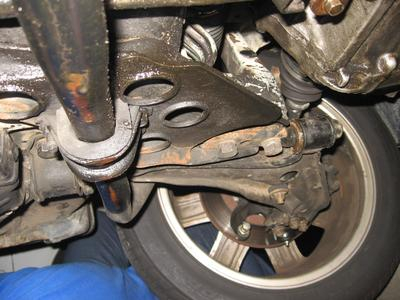
it looks like they haven't changed the Caster on this side and when i reach about 35mph i get a pull to the left, the faster the harder. The thing is about a year ago i have replaced the control arm bushings and the ball joints but i have stripped the 2 large bolts that hold up the largest bushing on the control arm. So the shop had to weld it on.
The thing that i dont understand is why the alignment shop left me with a negative caster and not telling me? but previously another shop done my alignment told me that since my bolts were welded on they couldn't get a proper alignment.

So the question is that can welding on these 2 bolts on the control arm Affect the caster?
it looks like they haven't changed the Caster on this side and when i reach about 35mph i get a pull to the left, the faster the harder. The thing is about a year ago i have replaced the control arm bushings and the ball joints but i have stripped the 2 large bolts that hold up the largest bushing on the control arm. So the shop had to weld it on.
The thing that i dont understand is why the alignment shop left me with a negative caster and not telling me? but previously another shop done my alignment told me that since my bolts were welded on they couldn't get a proper alignment.
So the question is that can welding on these 2 bolts on the control arm Affect the caster?


why on earth did you or anyone think welding that on think it was a good idea?
what happens when the bushings need to be replaced? bolts can be replaced, holes re-tapped.
welding requires meticulous grinding to remove properly, and then you are still stuck in the same place as before.
anyway, to answer your question: if the bracket was welded in the wrong spot, it might.
if it was welded in the right spot, it shouldn't.
what happens when the bushings need to be replaced? bolts can be replaced, holes re-tapped.
welding requires meticulous grinding to remove properly, and then you are still stuck in the same place as before.
anyway, to answer your question: if the bracket was welded in the wrong spot, it might.
if it was welded in the right spot, it shouldn't.

i think they saw the little part that was welded to the main plate of the gusset and ASSUMED that it wasn't supposed to be that way even tho it is. the first pic shows what they were most likely looking at... that's the way it comes STOCK. it's part of a larger assembly. the second pic shows the larger assembly on the car... the 2 bolts that are out in the open, plus the other 3 or 4 that are inside those "swiss cheese holes"

what you can do to increase your caster is to take the control arm back off and install a washer on the front stud before putting the control arm back on. more washers = more caster (caster = angle between the top pivot and bottom pivot. on doublewishbones that's the 2 balljoints. on macpherson struts that's between the lower balljoint and the upper strut mount). put about a 5mm thick one on for starters and see how much it changes the caster as per the spec sheet.
edit: i misread what you said had been welded on.. in that case... i wonder if the threads are directly into the body THRU the gusset, or on the gusset itself? if it is on the gusset itself, i might be able to supply a spare gusset.. maybe.
what you can do to increase your caster is to take the control arm back off and install a washer on the front stud before putting the control arm back on. more washers = more caster (caster = angle between the top pivot and bottom pivot. on doublewishbones that's the 2 balljoints. on macpherson struts that's between the lower balljoint and the upper strut mount). put about a 5mm thick one on for starters and see how much it changes the caster as per the spec sheet.
edit: i misread what you said had been welded on.. in that case... i wonder if the threads are directly into the body THRU the gusset, or on the gusset itself? if it is on the gusset itself, i might be able to supply a spare gusset.. maybe.
Last edited by CapedCadaver; Mar 23, 2010 at 08:58 PM.

why on earth did you or anyone think welding that on think it was a good idea?
what happens when the bushings need to be replaced? bolts can be replaced, holes re-tapped.
welding requires meticulous grinding to remove properly, and then you are still stuck in the same place as before.
anyway, to answer your question: if the bracket was welded in the wrong spot, it might.
if it was welded in the right spot, it shouldn't.
what happens when the bushings need to be replaced? bolts can be replaced, holes re-tapped.
welding requires meticulous grinding to remove properly, and then you are still stuck in the same place as before.
anyway, to answer your question: if the bracket was welded in the wrong spot, it might.
if it was welded in the right spot, it shouldn't.
i think they saw the little part that was welded to the main plate of the gusset and ASSUMED that it wasn't supposed to be that way even tho it is. the first pic shows what they were most likely looking at... that's the way it comes STOCK. it's part of a larger assembly. the second pic shows the larger assembly on the car... the 2 bolts that are out in the open, plus the other 3 or 4 that are inside those "swiss cheese holes"


what you can do to increase your caster is to take the control arm back off and install a washer on the front stud before putting the control arm back on. more washers = more caster (caster = angle between the top pivot and bottom pivot. on doublewishbones that's the 2 balljoints. on macpherson struts that's between the lower balljoint and the upper strut mount). put about a 5mm thick one on for starters and see how much it changes the caster as per the spec sheet.
edit: i misread what you said had been welded on.. in that case... i wonder if the threads are directly into the body THRU the gusset, or on the gusset itself? if it is on the gusset itself, i might be able to supply a spare gusset.. maybe.
what you can do to increase your caster is to take the control arm back off and install a washer on the front stud before putting the control arm back on. more washers = more caster (caster = angle between the top pivot and bottom pivot. on doublewishbones that's the 2 balljoints. on macpherson struts that's between the lower balljoint and the upper strut mount). put about a 5mm thick one on for starters and see how much it changes the caster as per the spec sheet.
edit: i misread what you said had been welded on.. in that case... i wonder if the threads are directly into the body THRU the gusset, or on the gusset itself? if it is on the gusset itself, i might be able to supply a spare gusset.. maybe.
eh, it shouldn't. the front bushing is what should set the caster since it is physically retained from the front and rear by the stud/bushing/washer/nut. the rear bushing just allows it to pivot, and also allows it to move front and back a little bit so that you can adjust the caster with washers if need be.
eh, it shouldn't. the front bushing is what should set the caster since it is physically retained from the front and rear by the stud/bushing/washer/nut. the rear bushing just allows it to pivot, and also allows it to move front and back a little bit so that you can adjust the caster with washers if need be.
and personally i would want to match the right front camber to the left front.. slight negative camber also adds stability and cornering grip, as it helps to counteract body roll and sidewall tuck-under. but too much will wear out the inside edge of the tire if you spend most of your time going straight.
Last edited by CapedCadaver; Mar 24, 2010 at 08:33 AM.
right, it will adjust the tilt of the strut when viewed from the side. (kingpin inclination is the angle of the strut when viewed from the front). positive caster makes the wheel lean to the left when it's turned to the left, and to the right when it's turned to the right, which adds stability and cornering grip without having to have the tires angled when you're going straight. this effect is much more visible on RWD cars (and on wheelbarrows and bicycles sort of) because they use 5-10* of caster but even FWD cars need some. so to add positive caster you just take the control arm off, and put a washer on the front bushing's stud, then reinstall the control arm. the further forward the control arm goes, the more caster you have.
and personally i would want to match the right front camber to the left front.. slight negative camber also adds stability and cornering grip, as it helps to counteract body roll and sidewall tuck-under. but too much will wear out the inside edge of the tire if you spend most of your time going straight.
and personally i would want to match the right front camber to the left front.. slight negative camber also adds stability and cornering grip, as it helps to counteract body roll and sidewall tuck-under. but too much will wear out the inside edge of the tire if you spend most of your time going straight.
right, it will adjust the tilt of the strut when viewed from the side. (kingpin inclination is the angle of the strut when viewed from the front). positive caster makes the wheel lean to the left when it's turned to the left, and to the right when it's turned to the right, which adds stability and cornering grip without having to have the tires angled when you're going straight. this effect is much more visible on RWD cars (and on wheelbarrows and bicycles sort of) because they use 5-10* of caster but even FWD cars need some. so to add positive caster you just take the control arm off, and put a washer on the front bushing's stud, then reinstall the control arm. the further forward the control arm goes, the more caster you have.
and personally i would want to match the right front camber to the left front.. slight negative camber also adds stability and cornering grip, as it helps to counteract body roll and sidewall tuck-under. but too much will wear out the inside edge of the tire if you spend most of your time going straight.
and personally i would want to match the right front camber to the left front.. slight negative camber also adds stability and cornering grip, as it helps to counteract body roll and sidewall tuck-under. but too much will wear out the inside edge of the tire if you spend most of your time going straight.

add washers behind the control arm bushing and caster WILL increase. it's literally that simple. the only hard part is going to be persuading the control arm to go back into the bushing that is stuck to the body of the car b/c you welded it. but with some lube it should be doable. a shop is gonna charge you a TON to fix your caster due to all the "special circumstances"
and as far as the camber on the right front being a tiny tiny bit positive, you can get a camber kit for $15 to make it adjustible so it can just adjust the right front until it matches the left front whose -0.6 is pretty spot-on. the closer both sides match, the straighter your car drives.
Last edited by CapedCadaver; Mar 24, 2010 at 07:57 PM.
i just TOLD you what to do
add washers behind the control arm bushing and caster WILL increase. it's literally that simple. the only hard part is going to be persuading the control arm to go back into the bushing that is stuck to the body of the car b/c you welded it. but with some lube it should be doable. a shop is gonna charge you a TON to fix your caster due to all the "special circumstances"
and as far as the camber on the right front being a tiny tiny bit positive, you can get a camber kit for $15 to make it adjustible so it can just adjust the right front until it matches the left front whose -0.6 is pretty spot-on. the closer both sides match, the straighter your car drives.
add washers behind the control arm bushing and caster WILL increase. it's literally that simple. the only hard part is going to be persuading the control arm to go back into the bushing that is stuck to the body of the car b/c you welded it. but with some lube it should be doable. a shop is gonna charge you a TON to fix your caster due to all the "special circumstances"
and as far as the camber on the right front being a tiny tiny bit positive, you can get a camber kit for $15 to make it adjustible so it can just adjust the right front until it matches the left front whose -0.6 is pretty spot-on. the closer both sides match, the straighter your car drives.
also how think of a washer do you think i need?
I'm just a first timer for everything, so things do get messed up when i rush through things
 lol
lol
as far as the washer.. if i knew how long the distance from the balljoint to the strut mount was i could calculate it using trig but i don't know that distance. so you're gonna have to make an educated guess. whatever you do, try and make sure that the stud still sits at least flush with the nut when everything is tightened.
My main concern would be making sure that the butt-end of the control arm that goes into the rear bushing can freely slide into the bushing (with or without lubrication)... if it comes off relatively easily then you should be OK but if it's a struggle to get it off then you might have to let the shop help b/c at least your car's driveable now, but if you can't get the control arm back on, it won't be.
Last edited by CapedCadaver; Mar 25, 2010 at 09:40 AM.
depends if you have stock front struts or aftermarkets. i think the stocks have purely circular holes on the strut, but some aftermarkets have an elongated top hole for adjustibility.
as far as the washer.. if i knew how long the distance from the balljoint to the strut mount was i could calculate it using trig but i don't know that distance. so you're gonna have to make an educated guess. whatever you do, try and make sure that the stud still sits at least flush with the nut when everything is tightened.
My main concern would be making sure that the butt-end of the control arm that goes into the rear bushing can freely slide into the bushing (with or without lubrication)... if it comes off relatively easily then you should be OK but if it's a struggle to get it off then you might have to let the shop help b/c at least your car's driveable now, but if you can't get the control arm back on, it won't be.
as far as the washer.. if i knew how long the distance from the balljoint to the strut mount was i could calculate it using trig but i don't know that distance. so you're gonna have to make an educated guess. whatever you do, try and make sure that the stud still sits at least flush with the nut when everything is tightened.
My main concern would be making sure that the butt-end of the control arm that goes into the rear bushing can freely slide into the bushing (with or without lubrication)... if it comes off relatively easily then you should be OK but if it's a struggle to get it off then you might have to let the shop help b/c at least your car's driveable now, but if you can't get the control arm back on, it won't be.

i have KYB-GR2 struts, i'll prob work on the camber later after i get the cast right. But camber doesn't effect pulling to the left that much right?(i got KYB)
Thanks for everything you are a great help
well.. normally if both tires are leaning the same way, the car will want to pull that way. and as it is now, both of your tires lean slightly to the right (negative on the left, positive on the right) so that's actually probably making your left-hand pull not as bad as it would be if your cross camber were neutral (both set to the same amount negative). once the caster is matched to the right front, your car MIGHT even develop a slight right-hand drift until you match the camber to the left front.
Last edited by CapedCadaver; Mar 25, 2010 at 09:51 AM.
well.. normally if both tires are leaning the same way, the car will want to pull that way. and as it is now, both of your tires lean slightly to the right (negative on the left, positive on the right) so that's actually probably making your left-hand pull not as bad as it would be if your cross camber were neutral (both set to the same amount negative). once the caster is matched to the right front, your car MIGHT even develop a slight right-hand drift until you match the camber to the left front.

Thread
Thread Starter
Forum
Replies
Last Post
Dennis Twohy
1st & 2nd Generation Maxima (1981-1984 and 1985-1988)
0
Oct 1, 2015 06:01 PM
DC_Juggernaut
7th Generation Maxima (2009-2015)
4
Sep 28, 2015 04:07 PM
carid
Group Deals / Sponsors Forum
0
Sep 17, 2015 05:00 AM