


down force for the track


Thread Starter
Junior Member
Joined: Aug 2009
Posts: 48
down force for the track
I was thinking, since max's are front wheel drive, we could really push the 1/4 mile up if we could just get going faster from the stop.
Has anyone tried putting smaller wheels up front compared to the back? Or if u have coilovers, adjusting them so that the back end rises up a little. Not as an everyday thing, just to see how fast it would go.. I figure since maxima's are a little backheavy the downforce would be good enough to get going faster.
Has anyone tried putting smaller wheels up front compared to the back? Or if u have coilovers, adjusting them so that the back end rises up a little. Not as an everyday thing, just to see how fast it would go.. I figure since maxima's are a little backheavy the downforce would be good enough to get going faster.






The only thing in that line I can see potentially shaving seconds off your time is if you were to build a full under-body diffuser...
By the way, someone somewhere did a write-up on how to make a homemade front splitter for the 5/5.5 gen out of fiberglass. I forget where I saw it, though.


I was thinking, since max's are front wheel drive, we could really push the 1/4 mile up if we could just get going faster from the stop.
Has anyone tried putting smaller wheels up front compared to the back? Or if u have coilovers, adjusting them so that the back end rises up a little. Not as an everyday thing, just to see how fast it would go.. I figure since maxima's are a little backheavy the downforce would be good enough to get going faster.
Has anyone tried putting smaller wheels up front compared to the back? Or if u have coilovers, adjusting them so that the back end rises up a little. Not as an everyday thing, just to see how fast it would go.. I figure since maxima's are a little backheavy the downforce would be good enough to get going faster.
Adding a spoiler to the rear would just add downforce to the rear, which would create more tire friction in the back which would slow you down, not to mention increase the drag coefficient of the car (which applies to a front spoiler as well). These negatives would greatly outweigh any benefits gained from downforce.

Aerodynamics on a car begin to work at around 50-60 mph. Well designed and properly placed splitters should yield some benefit though not to much at 50-60. Our cars are def fast enough for them to be effective, even stock, given enough road and maybe a hill lol, but how effective is determined by the amount of power. At lower speeds (50-70 mph) the car may feel just a little more stable or may not be noticible, but at higher speeds that, our cars are capable of reaching just not in the 1/4 mile lol, the car should feel more planted to the ground. Just because the car is FWD, doesnt mean that the rules of aerodynamics change. This is all assuming you have other suspension mods to complement, and your splitters are properly designed, and tested. Placement of splitters is key too. You just cant slap them on anywhere, the have to be placed in a certain spot, in a certain position to be effective. The faster you go, the more effective it becomes, and thats where the more power part comes in. To reach speeds of or above 140, more power is a MUST! But I think splitters will be effective for ours cars, but how effective depends on the owner. Drag racing down a track, wont see to much effect unless you are making a good amount of power, but road racing, or "spirited" street driving, you should see some improvement.
Last edited by Shift_Nismo; Mar 4, 2010 at 05:52 AM.

DO NOT DO BUSINESS WITH THIS MEMBER - OWES PEOPLE MONEY
iTrader: (7)
Joined: Jan 2008
Posts: 3,468
From: Greensboro, NC
I ground a little material off my brake calipers to fit 15" wheels, and currently use 24.5x8x15" M/T ET track slicks. Going to 22" or 23" slicks on an auto would likely be a very noticeable improvement over the stock 25.6ish" diameter.
IMO you are not going to start seeing quantifiable benefits from aero mods until you are trapping ~110+, and even then we're talking minuscule MPH increases moreso than ET.
Also, the kind of aero you would want is reduction in drag. IE no rear spoiler, lower to the ground, no side views, tape up front fascia while leaving a little for the rad, tape up body lines, rear diffuser, front splitter... Things like those would be small improvements.
One thing more effective than aero at the low speeds that we get to going down the strip would be weight reduction and parasitic loss. Pull out seats/spare/interior parts, lightweight battery, skinnies in the rear, lightweight wheels, remove PS belt, remove bumper supports... You can go much further but at some point it becomes very impractical.
Last edited by sparks03max; Mar 4, 2010 at 06:19 AM.
To bring this discussion away from aerodynamics, I think the OP had a different (although poorly phrased) idea in mind. I think he was thinking about lowering the front of the car to increase the front weight bias and available traction (aka weight jacking).
If this is the case, you can also use coilovers to simply raise the rear and/or lower the front to shift weight; or use larger diameter rear tires. Corner weighting scales would be able to measure differences in 'moving' weight. And some passes would tell if the method was effective; it should be.
If it were me, I would go after power increases (with products like those pictured below) and tire improvements before setting up a family with drag specific suspension settings.
 +
+
A (good) splitter is like a wing for the front, man.
If this is the case, you can also use coilovers to simply raise the rear and/or lower the front to shift weight; or use larger diameter rear tires. Corner weighting scales would be able to measure differences in 'moving' weight. And some passes would tell if the method was effective; it should be.
If it were me, I would go after power increases (with products like those pictured below) and tire improvements before setting up a family with drag specific suspension settings.
+A (good) splitter is like a wing for the front, man.
Last edited by 2slow; Mar 4, 2010 at 06:18 AM. Reason: comedy
To bring this discussion away from aerodynamics, I think the OP had a different (although poorly phrased) idea in mind. I think he was thinking about lowering the front of the car to increase the front weight bias and available traction (aka weight jacking).
If this is the case, you can also use coilovers to simply raise the rear and/or lower the front to shift weight; or use larger diameter rear tires. Corner weighting scales would be able to measure differences in 'moving' weight. And some passes would tell if the method was effective; it should be.
If this is the case, you can also use coilovers to simply raise the rear and/or lower the front to shift weight; or use larger diameter rear tires. Corner weighting scales would be able to measure differences in 'moving' weight. And some passes would tell if the method was effective; it should be.
Lowering the center of gravity of the car is a different story. You can do this by lowering just the front, but lowering front and rear would be better. Lowering the center of gravity reduces the overturning moment exerted on the car and results in less weight taken off the front wheels under acceleration.
Yeah....I realized that after looking up what a splitter is

The splitter will still increase the drag coefficient and increase the rolling friction of the wheels which i think will outweigh any benefits it will produce.
Lowering the center of gravity of the car is a different story. You can do this by lowering just the front, but lowering front and rear would be better. Lowering the center of gravity reduces the overturning moment exerted on the car and results in less weight taken off the front wheels under acceleration.
Nearly all aero additions (wings, et...) increase drag, it is up to the user to determine the value in trading drag (increase road load resistance, not rolling friction) for downforce. Although good splitters generally do not introduce drag; have you noticed hybrid trucks have much lower front end plastics?
Last edited by 2slow; Mar 4, 2010 at 08:35 AM.

all of the fast maximas run much smaller diameter tires up front.
for the back, mazda RX-7 spare wheels with motorcycle tires at 50 psi

for the back, mazda RX-7 spare wheels with motorcycle tires at 50 psi
Last edited by nalc; Mar 4, 2010 at 08:41 AM.

Senior Member
Joined: Jan 2007
Posts: 203
From: Long Island, NY
In a RWD car, the point is to transfer more wt to the rear wheels. Increasing its CG would help aid in that. Lowering the CG a great amount would indeed help a FWD car as the reducing the pendulum effect would help keep the wt up front during liftoff.
Simple well know drag concept.
Simple well know drag concept.
The outcome (shorter times) is more likely related to the change in gearing (and reduction in rolling resistance in the rear) than any weight distribution change.
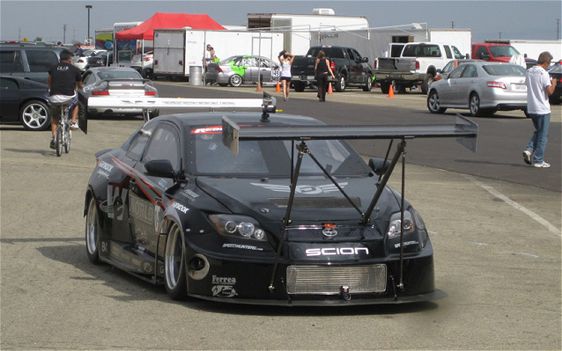
Not my car. Just digging through my Maxus pictures. afaik, Jime and Aaron92SE both use the aforementioned setup, and they're both very fast.

Force x Height of Center of Gravity / Distance between front and rear wheels
where force is the linear force between the tires and the road.
Thats exactly what I was picturing to get effects to the front wheels

Do you think we could get a group deal going on this kind of spoiler???
Last edited by vball_max; Mar 4, 2010 at 10:12 AM.
Not sure were folks are getting front slipper increase drag.They reduce turbulance (drag) under the car, allowing the air under the car to speed up more in relation to the air above the car. Downforce (anti-lift) is just a by product of the effect. A front splitter combined with a well thought out rear diffuser will reduce drag and produce down force. The idea is to reduce lift at high speed to a neutral state. The G35 coupe was availble with a zero lift underbody aero kit just for this; .26 vs .27 After the neutral force is reached you produce "real" downforce and then drag from the extra tire friction.
I agree if the car is standing still, but under acceleration, it absolutely affects the downward force on the wheels. The equation for the additional force to the rear wheels and subtracted force from the front is:
Force x Height of Center of Gravity / Distance between front and rear wheels
where force is the linear force between the tires and the road.
Force x Height of Center of Gravity / Distance between front and rear wheels
where force is the linear force between the tires and the road.
You sound like an engineer.
I would bet the added rolling resistance is minor compared to the reduced aerodynamic loads.
Last edited by 2slow; Mar 4, 2010 at 10:31 AM.
Not sure were folks are getting front slipper increase drag.They reduce turbulance (drag) under the car, allowing the air under the car to speed up more in relation to the air above the car. Downforce (anti-lift) is just a by product of the effect. A front splitter combined with a well thought out rear diffuser will reduce drag and produce down force. The idea is to reduce lift at high speed to a neutral state. The G35 coupe was availble with a zero lift underbody aero kit just for this; .26 vs .27 After the neutral force is reached you produce "real" downforce and then drag from the extra tire friction.
If you add a diffuser under the car, that will reduce the turbulence and allow the air to flow faster under the car.
, but the second you hit the gas you are accelerating......you hit your maximum acceleration at the top rpms in first gear.Yes sir. I am a structural engineer so I deal with forces all day long.
Last edited by vball_max; Mar 4, 2010 at 12:29 PM.
When you add the splitter, air that would normally flow under the car un-impeded, will now have to be directed over the car or around the car. So basically you're increasing the surface area of the front of the car. The force to accelerate the air upward over the car creates the down force in addition to the vacuum that is left behind the splitter under the car.
If you add a diffuser under the car, that will reduce the turbulence and allow the air to flow faster under the car.
If you add a diffuser under the car, that will reduce the turbulence and allow the air to flow faster under the car.
Yeah, at peak power engine speed; which is ~1000 rpm shy of redline for my Maxima. If this is the most traction limited event, and therefore the most important, I wonder how suspension tuning can alter the impacts (high low speed front rebound and rear compression with stiff rear springs). It should control body motion and the corresponding increases in CG and rearward 'roll'.
These are all design trade-offs. Where enhanced aerodynamic components (splitter, under trays, etc...) can reduced the drag coefficient, but may also increase frontal area which could result in no/minimal change the aerodynamic road load commponent.
That initial throttle application may be the most important event in drag racing; at least from my perspective as a non-drag racer.
Yeah, at peak power engine speed; which is ~1000 rpm shy of redline for my Maxima. If this is the most traction limited event, and therefore the most important, I wonder how suspension tuning can alter the impacts (high low speed front rebound and rear compression with stiff rear springs). It should control body motion and the corresponding increases in CG and rearward 'roll'.
That initial throttle application may be the most important event in drag racing; at least from my perspective as a non-drag racer.
Yeah, at peak power engine speed; which is ~1000 rpm shy of redline for my Maxima. If this is the most traction limited event, and therefore the most important, I wonder how suspension tuning can alter the impacts (high low speed front rebound and rear compression with stiff rear springs). It should control body motion and the corresponding increases in CG and rearward 'roll'.
I'm not so sure about the effects that the suspension would have. That gets a lot more into dynamics and spring constants etc. I would think a stiffer suspension would help get a more controlled and immediate response to the wheels and help keep the wheels planted.

DO NOT DO BUSINESS WITH THIS MEMBER - OWES PEOPLE MONEY
iTrader: (7)
Joined: Jan 2008
Posts: 3,468
From: Greensboro, NC
Fixed your first statement.
I'm not so sure about the effects that the suspension would have. That gets a lot more into dynamics and spring constants etc. I would think a stiffer suspension would help get a more controlled and immediate response to the wheels and help keep the wheels planted.
I'm not so sure about the effects that the suspension would have. That gets a lot more into dynamics and spring constants etc. I would think a stiffer suspension would help get a more controlled and immediate response to the wheels and help keep the wheels planted.
If you take a look at the stance of Jime's car on his track videos, you can see he does the same thing. It's slammed as low as possible front and rear, and his coilovers (afaik) are set as stiff as possible.
I'm no drag racer, but I did spend most of Maxus 09 hanging out with Aaron92SE and Jime, and asked a lot of questions about their setups.
Jime has steel cables on all four springs, significantly limiting his maximum suspension travel. The lowest his wheels go is about the stock ride height on a 4th gen. He's slammed all around.
Aaron92SE, though, jacks up the back of his car.


Jime has steel cables on all four springs, significantly limiting his maximum suspension travel. The lowest his wheels go is about the stock ride height on a 4th gen. He's slammed all around.
Aaron92SE, though, jacks up the back of his car.
When you add the splitter, air that would normally flow under the car un-impeded, will now have to be directed over the car or around the car. So basically you're increasing the surface area of the front of the car. The force to accelerate the air upward over the car creates the down force in addition to the vacuum that is left behind the splitter under the car.
If you add a diffuser under the car, that will reduce the turbulence and allow the air to flow faster under the car.
If you add a diffuser under the car, that will reduce the turbulence and allow the air to flow faster under the car.
Case in point I ran a Stillen lip before on my car with no under body plastics at all, they fell off long ago. Just drove like a regular car at beyond hwy speed. Slightly lighter steering feel from the usual lift. Then installed an underplanel from the front of the lip to about where the drain plug was. At beyond hwy speeds; planted. And more staple at hwy speeds.
Its nice to have a real discuss on here once in a while.
Sounds like your thinking of an air dam. Air splits and is directed up and under the car regardless of the inclusion of a splitter. The splitter just makes it more efficient. The flat surface accelerates the air under it compared to the slower air which must go around the shape of the car. ALOT more force is created by this than is created by passing more air above the car. They also don't create a vacuum behind them per se they create a low pressure zone directly underneath.
Case in point I ran a Stillen lip before on my car with no under body plastics at all, they fell off long ago. Just drove like a regular car at beyond hwy speed. Slightly lighter steering feel from the usual lift. Then installed an underplanel from the front of the lip to about where the drain plug was. At beyond hwy speeds; planted. And more staple at hwy speeds.
Its nice to have a real discuss on here once in a while.
Case in point I ran a Stillen lip before on my car with no under body plastics at all, they fell off long ago. Just drove like a regular car at beyond hwy speed. Slightly lighter steering feel from the usual lift. Then installed an underplanel from the front of the lip to about where the drain plug was. At beyond hwy speeds; planted. And more staple at hwy speeds.
Its nice to have a real discuss on here once in a while.
So basically, if it brings the front of the car to more of a point, and continues smoothly under the car, then that definitely makes sense (and the name splitter is quite appropriate). But the others that extend down from the bumper will cause a greater projected area for the "wind" to act on, and therefore will negate any positive effects for a straight drag race. If we are talking a road course with handling, then that is a completely different story......





Thread
Thread Starter
Forum
Replies
Last Post
James92SE
3rd Generation Maxima (1989-1994)
142
Jan 2, 2024 09:23 AM
mkaresh
8th Generation Maxima (2016-)
21
Mar 12, 2018 06:48 PM