


HELP! Comparing coilover/linear v. conventional/progressive spring rates. HELP!



HELP! Comparing coilover/linear v. conventional/progressive spring rates. HELP!
I am researching suspension for my B15 and thought that I might come to the well of information over here. Anyway, in looking at suspension for my SpecV, I am really leaning toward coilovers with a custom spring rate. After doing some conversions, I started comparing rates in an attempt to select a rate that will result in an improved stance, better handling, and a lower center of gravity, all while keeping the most reasonable ride possible (I have a baby due in a month and don't want to break her back in the Spec).
Anyway, when trying to compare the rates, I noticed a trend that made it difficult to compare. This raised a few questions.
The first question is, are the spring rates of coilovers and those of conventional springs actually/directly comparable? If the rates between a coilover and a conventional spring are the same lb./in rating, are we really comparing the same thing, based on the linear windings on coilovers v. the progressive rates of most conventional aftermarket springs?
Example: With Tein B15 applications, the Basics are 336/336. The Tein S-Tech springs are 170(f)/270(r). Are the front on basics really nearly twice as stiff as are the S-techs? And are the rears fairly similar? Or does the linear/progressive nature of the different springs result in the same lb./in ratings, but a different feel on the road?
Next, why do most conventional springs have front rates that are lower than the rear rates, while most coilovers have higher front rates v. lower rear rates? It seems odd that the stiffer springs are consistently in the front on coilovers, and consistently in the rear on conventional springs. Can anyone explain the reason for this?
I read the following over on b15sentra.net, but am still very confused:
To add to this, why would the B15 Nismo "coilover" setup have a 185/300 spring rate (F&R) when most coilover suspension carry a higher front rate than in rear? The Nismo setup seems to be the only "coilover" that breaks this trend. The more I think about the Nismos being an anomoly, the more I realize that they are more of a spring&strut combo than a true coilover, which would explain why they buck the "coilover" trend, but still leaves to question why there is the different trends in the first place.
At the end of all of this, what I am asking, is if I have ridden in a car with springs that are a given rate, and I am looking at coilovers with the same rate, should the ride feel similar (assuming comparable damping settings)?
Anyway, when trying to compare the rates, I noticed a trend that made it difficult to compare. This raised a few questions.
The first question is, are the spring rates of coilovers and those of conventional springs actually/directly comparable? If the rates between a coilover and a conventional spring are the same lb./in rating, are we really comparing the same thing, based on the linear windings on coilovers v. the progressive rates of most conventional aftermarket springs?
Example: With Tein B15 applications, the Basics are 336/336. The Tein S-Tech springs are 170(f)/270(r). Are the front on basics really nearly twice as stiff as are the S-techs? And are the rears fairly similar? Or does the linear/progressive nature of the different springs result in the same lb./in ratings, but a different feel on the road?
Next, why do most conventional springs have front rates that are lower than the rear rates, while most coilovers have higher front rates v. lower rear rates? It seems odd that the stiffer springs are consistently in the front on coilovers, and consistently in the rear on conventional springs. Can anyone explain the reason for this?
I read the following over on b15sentra.net, but am still very confused:
Just adding a bit of info for some suspension newbies since this is a sticky anyways.
Spring rates are the key factor in balance of the complete chassis. This leads to the debate between "linear" and "progressive" spring rates. There's no mystery about progressive springs: A progressive spring has a variable rate increase throughout its compression stroke. For example a progressive spring with a starting rate of 200 pounds per inch for the first inch of compression and an end rate of 400 pounds per inch for the next two inches of compression would then equal a load of 1000 pounds.
A linear spring rate has one rate throughout its deflection. This means, if you have 300 pounds per inch spring rate, it takes 300 pounds to compress that spring one inch. A 300 pounds per inch linear spring, compressed three inches, would equal a load of 900 pounds. As you can see, one progressive spring can do the work of two or more linear springs. This is a big advantage in modern automotive chassis design, fulfilling the needs of today's discerning customers.
Springs with a high linear rate would be used on a smooth racetrack, while on a rough or bumpy road course; you would use a softer spring rate. Since many racetracks have different road surfaces a suspension that is adaptive to changing road surfaces is desired. Progressive rate springs can offer a chassis tuner the means to achieve a compliant suspension in the rough and a tight suspension for high-speed turns.
Another issue that adds to the debate between "Linear" and "Progressive" rate springs, is that when most spring manufacturers say that their springs are progressive they are not! Springs may be wound progressively, but that does not mean that they function progressively. Some suspension springs are wound progressively but function as a linear spring. These springs can be called "dual-stage" coils, but are generally referred to as springs with "dead" or "inactive" coils. Dead or inactive coils are coils that are in contact with adjacent coils at loaded height. Inactive coils do nothing but give the spring enough free-length to stay tight in the spring perches at full rebound (when the tires and wheels are hanging in the air like when the car is on a lift). A spring that is wound with inactive coils and no progressive coils that are active, is actually working as a linear-rate spring. This is why when you call a spring manufacturer for spring rates for your application you must ask, "What is the actual working spring rate?" This ensures that you do not just get numbers quoted from a design sheet. For example: A design sheet may have rates of 69lbs. per inch, to 160lbs. per inch, to 220lbs. per inch. When the actual rate is 170lbs. per inch to 220lbs. per inch. As you can see, getting the correct information is important in making a true comparison.
Spring rates are the key factor in balance of the complete chassis. This leads to the debate between "linear" and "progressive" spring rates. There's no mystery about progressive springs: A progressive spring has a variable rate increase throughout its compression stroke. For example a progressive spring with a starting rate of 200 pounds per inch for the first inch of compression and an end rate of 400 pounds per inch for the next two inches of compression would then equal a load of 1000 pounds.
A linear spring rate has one rate throughout its deflection. This means, if you have 300 pounds per inch spring rate, it takes 300 pounds to compress that spring one inch. A 300 pounds per inch linear spring, compressed three inches, would equal a load of 900 pounds. As you can see, one progressive spring can do the work of two or more linear springs. This is a big advantage in modern automotive chassis design, fulfilling the needs of today's discerning customers.
Springs with a high linear rate would be used on a smooth racetrack, while on a rough or bumpy road course; you would use a softer spring rate. Since many racetracks have different road surfaces a suspension that is adaptive to changing road surfaces is desired. Progressive rate springs can offer a chassis tuner the means to achieve a compliant suspension in the rough and a tight suspension for high-speed turns.
Another issue that adds to the debate between "Linear" and "Progressive" rate springs, is that when most spring manufacturers say that their springs are progressive they are not! Springs may be wound progressively, but that does not mean that they function progressively. Some suspension springs are wound progressively but function as a linear spring. These springs can be called "dual-stage" coils, but are generally referred to as springs with "dead" or "inactive" coils. Dead or inactive coils are coils that are in contact with adjacent coils at loaded height. Inactive coils do nothing but give the spring enough free-length to stay tight in the spring perches at full rebound (when the tires and wheels are hanging in the air like when the car is on a lift). A spring that is wound with inactive coils and no progressive coils that are active, is actually working as a linear-rate spring. This is why when you call a spring manufacturer for spring rates for your application you must ask, "What is the actual working spring rate?" This ensures that you do not just get numbers quoted from a design sheet. For example: A design sheet may have rates of 69lbs. per inch, to 160lbs. per inch, to 220lbs. per inch. When the actual rate is 170lbs. per inch to 220lbs. per inch. As you can see, getting the correct information is important in making a true comparison.
At the end of all of this, what I am asking, is if I have ridden in a car with springs that are a given rate, and I am looking at coilovers with the same rate, should the ride feel similar (assuming comparable damping settings)?

i think the Nismo setup is designed to correct understeer without the addition of a RSB thats y the rears are so much more stiff......and to answer og progressive vs linear i would choose linear personally...the handling is more predictable and well linear....progressive rates are designed for street cars to provide comfortbale ride on the street bu progressivly get stiffer the harder u push the car making it in my opinion less predictable...

Check out post # 35 here:
http://forums.maxima.org/showthread.php?t=470807&page=2
I tried restating it but it didn't sound as good as it does in the link I posted, so I just deleted what I've written and posted this link. lol
I would also like to find out why coilovers come with the front springs stiffer than the rear.
BTW, I would wait until the baby turns at least 1 before installing stiffer springs. I've been riding on coilover for a month - month and a half, and while they are comfortable enough for adults I would not recommend coilovers for anyone who has a baby.
http://forums.maxima.org/showthread.php?t=470807&page=2
I tried restating it but it didn't sound as good as it does in the link I posted, so I just deleted what I've written and posted this link. lol
I would also like to find out why coilovers come with the front springs stiffer than the rear.
BTW, I would wait until the baby turns at least 1 before installing stiffer springs. I've been riding on coilover for a month - month and a half, and while they are comfortable enough for adults I would not recommend coilovers for anyone who has a baby.
Originally Posted by phenryiv1
The first question is, are the spring rates of coilovers and those of conventional springs actually/directly comparable? If the rates between a coilover and a conventional spring are the same lb./in rating, are we really comparing the same thing, based on the linear windings on coilovers v. the progressive rates of most conventional aftermarket springs?
Originally Posted by phenryiv1
Example: With Tein B15 applications, the Basics are 336/336. The Tein S-Tech springs are 170(f)/270(r). Are the front on basics really nearly twice as stiff as are the S-techs? And are the rears fairly similar? Or does the linear/progressive nature of the different springs result in the same lb./in ratings, but a different feel on the road?
Next, why do most conventional springs have front rates that are lower than the rear rates, while most coilovers have higher front rates v. lower rear rates? It seems odd that the stiffer springs are consistently in the front on coilovers, and consistently in the rear on conventional springs. Can anyone explain the reason for this?
Next, why do most conventional springs have front rates that are lower than the rear rates, while most coilovers have higher front rates v. lower rear rates? It seems odd that the stiffer springs are consistently in the front on coilovers, and consistently in the rear on conventional springs. Can anyone explain the reason for this?
First, the really commercial coilover kits (e.g. Tein) have to take into account the odd psycho/ricer who uses them to slam his car. Since your car is front-heavy, it needs stiffer front springs when it's that low, just to keep the front end from scraping.
Second, with spring rates as high as those coilover kits come with, it's much safer to have stiffer springs in front because that helps ensure an understeer bias: if the car ever gets caught with too little compliance for the circumstances and skitters off a bump, your average kid won't want the tail to step out. Plus, the added stiffness all around often makes the handling limits so much higher that such safety is even more important.
Most conventional spring kits don't have to be designed with the same concerns since they deal with much lower rates and are typically used by people who don't drive as fast, so they have the liberty of being able to use stiffer rear springs to sharpen response and reduce understeer.
Originally Posted by phenryiv1
I read the following over on b15sentra.net, but am still very confused:
Originally Posted by phenryiv1
To add to this, why would the B15 Nismo "coilover" setup have a 185/300 spring rate (F&R) when most coilover suspension carry a higher front rate than in rear? The Nismo setup seems to be the only "coilover" that breaks this trend. The more I think about the Nismos being an anomoly, the more I realize that they are more of a spring&strut combo than a true coilover, which would explain why they buck the "coilover" trend, but still leaves to question why there is the different trends in the first place.
Originally Posted by phenryiv1
At the end of all of this, what I am asking, is if I have ridden in a car with springs that are a given rate, and I am looking at coilovers with the same rate, should the ride feel similar (assuming comparable damping settings)?
Thing is, it's virtually impossible to assume comparable damper settings. A spring/strut combo is a spring that will be designed for your car and a damper that is roughly optimized to operate vaguely in the range of what the manufacturer thinks your car is most likely to see. With a coilover kit, you're getting dampers that really only have to work on a limited number of different applications with a very limited range of spring rates (typically +/- 2 kg/mm or less). Dollar-for-dollar, they're going to be much better optimized to the task.
Also, never forget that lowering springs will leave you with very little suspension travel (e.g. practically none with S-Techs), whereas any good coilover will not.
Well, suspension is one of the most important parts of that car...
Plus, if you do it up right, you have a better chance of actually getting some kind of return on the money you put into it.
Plus, if you do it up right, you have a better chance of actually getting some kind of return on the money you put into it.
Originally Posted by d00df00d
Well, suspension is one of the most important parts of that car...
Plus, if you do it up right, you have a better chance of actually getting some kind of return on the money you put into it.
Plus, if you do it up right, you have a better chance of actually getting some kind of return on the money you put into it.
I just look at what I spent on the Maximas and the I30 and I never came close to $700- at least not all at once. Not having a long warranty on a purchase of this magnatude is a big deal. All of the struts for the A32 and A33 had longer- if not lifetime- warranty periods, as long as I had a reasonable drop.
Not having that on the KSports (or the Nismos or Teins, for that matter) worries me.
Yeah... AFAIK, most commercial coilover systems are designed and sold under the assumption that, if you're using them as intended, you will most likely have to rebuild or replace the dampers in ~2 years or so, maybe a little more.
Doesn't Koni, H&R, or Eibach make a kit for your car with a better warranty?
Doesn't Koni, H&R, or Eibach make a kit for your car with a better warranty?
Originally Posted by d00df00d
Yeah... AFAIK, most commercial coilover systems are designed and sold under the assumption that, if you're using them as intended, you will most likely have to rebuild or replace the dampers in ~2 years or so, maybe a little more.
Doesn't Koni, H&R, or Eibach make a kit for your car with a better warranty?
Doesn't Koni, H&R, or Eibach make a kit for your car with a better warranty?
H&R have basically given up on the B15. Thye have 1 set of springs for all B15 (spec or non-spec) applications, won't release spring rates, and don't knwo what damping rates will work well. Also, they are @$$-sag springs, much like all H&R Nissan applications...
Eibach has 2 kits of springs, but no coilover support. The HIGHER of the 2 has stiffer-than stock rates, but thye still are known to bottom out on the street, even with trimmed bump stops.
Tanabe has one spring that I am considering, but with little to no aftermarket strut availability, it is either Konis (no warranty) or KYB GR-2 struts (lifetime warranty, but bad performance).
I don't even want much of a drop- just 1.3F and 1.0R- AT MOST. I want it 70% for looks and 30% for performance. I also want as much comfort on the street as I can possibly maintain. It seems silly to spend $700 for a bit more asthetics and a LOT more performance, most of which I will never use. The Nismo has the overall package that I want, but at $770 is, quite honestly, a ripoff. I can get the KSports with 6/5 kg/mm custom rates (softer than the standard 8/7) for $675 shipped, but I don't need 36-way adjustablity or all of the drop. BUT the suspension travel and included mounts would be a big plus. I am just scared that I will be rebuilding them for a couple hundred bucks by the time I sell the car. On top of that, I just have reservations about $675 for suspension when the car is mostly used for commuting.
What a pain!
I thought Konis had a lifetime warranty??
Eh... either way, you're right, that is a pain.
Honestly, if even stiff Eibachs bottom out on the street, you need coilovers whatever you do.
One thing to keep in mind is that, while you may not need the full range of damper adjustability or the ability to slam your car, the Ksports have one trump card: They let you adjust your height without affecting spring preload or suspension travel. That feature is not insignificant.
Eh... either way, you're right, that is a pain.
Honestly, if even stiff Eibachs bottom out on the street, you need coilovers whatever you do.
One thing to keep in mind is that, while you may not need the full range of damper adjustability or the ability to slam your car, the Ksports have one trump card: They let you adjust your height without affecting spring preload or suspension travel. That feature is not insignificant.
Originally Posted by d00df00d
I thought Konis had a lifetime warranty??
Eh... either way, you're right, that is a pain.
Honestly, if even stiff Eibachs bottom out on the street, you need coilovers whatever you do.
One thing to keep in mind is that, while you may not need the full range of damper adjustability or the ability to slam your car, the Ksports have one trump card: They let you adjust your height without affecting spring preload or suspension travel. That feature is not insignificant.
Eh... either way, you're right, that is a pain.
Honestly, if even stiff Eibachs bottom out on the street, you need coilovers whatever you do.
One thing to keep in mind is that, while you may not need the full range of damper adjustability or the ability to slam your car, the Ksports have one trump card: They let you adjust your height without affecting spring preload or suspension travel. That feature is not insignificant.
I know how the KSports would be the best, but it comes down to money. I have $575 saved up, and it took forever. I don't knwo WHEN the last $100 will be freed up, and I need new struts on the front NOW (stockers leaking).

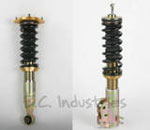
The standard lowering spring usually has a lower spring rate in comparison to a coilover spring is due to its overall static length.
A Eibach 500lb 7 inch coilover spring is only 6 inches under 500lbs of weight compression.
A aftermarket 336lb 12 inch spring is only 8.04 inches under the same 500 lbs weight compression.
If an aftermarket spring was 500lb/in given a 12 inch length, it would still be 11 inches in length under 500lbs of weight compression, thus not lowering the vehicle by much. They are softer to accomodate the drop whereas the coilover spring is short because the overall height can be altered via other adjustments
A Eibach 500lb 7 inch coilover spring is only 6 inches under 500lbs of weight compression.
A aftermarket 336lb 12 inch spring is only 8.04 inches under the same 500 lbs weight compression.
If an aftermarket spring was 500lb/in given a 12 inch length, it would still be 11 inches in length under 500lbs of weight compression, thus not lowering the vehicle by much. They are softer to accomodate the drop whereas the coilover spring is short because the overall height can be altered via other adjustments
Koni's are lifetime and excellent products. I believe Progress also released their coilovers for B15's earlier this year but those are more performance and less looks.
http://www.sentra.net/tech/garage/suspension.php
If you're mostly about looks & comfort go with the lower rear spring rates with a swaybar as opposed to just stiffer springs.
http://www.sentra.net/tech/garage/suspension.php
If you're mostly about looks & comfort go with the lower rear spring rates with a swaybar as opposed to just stiffer springs.
i owuld personally go for the NIsmo ones....1. i am a nismo ***** 2. they are designed and built by Nissan engineers specifcally for the B15 sentra....struts are valves perfectly for the springs.....and they are bolt in....new mounts new bumpstops new isolators....if u add up the cost of all that getting springs and separate struts ur gonna be up there anyway....I want to get them for my fiances Sentra but she wont let me

You lose about 1-2 inches of shock travel in comparison to the stock shocks. However since the spring rates are stiffer, the shock itself isn't compressed as much and therefore you have more travel.
Post #13 for additional details
PM me if you want a picture comparison for the rear shocks
Post #13 for additional details
PM me if you want a picture comparison for the rear shocks
Originally Posted by VQuick
Anybody know just how much travel you have with coilovers (e.g. TEIN Basics say...) versus a spring/strut combo with 1.5" drop? Anybody know what stock travel is for that matter?
A totally stock Max sitting on the ground has about 3" of downward travel remaining, IIRC. I'm not sure what the total piston stroke is.
Thanks, I did not know that most coilovers allow you to adjust height without affecting travel.
And if 3" of downward travel is right for stock, that means a 1.5" drop halves the total downward travel, right? No wonder the ride can be so bad with lowering springs.
And if 3" of downward travel is right for stock, that means a 1.5" drop halves the total downward travel, right? No wonder the ride can be so bad with lowering springs.
Originally Posted by d00df00d
Depends on the coilovers. Ksport, Boss Chen, and AFAIK D2, JIC, and Progress all have somewhere between 3.5" - 4" no matter how you set the ride height, since they let you adjust height without affecting travel. With Tein Basics, on the other hand, you adjust height by changing the position of the spring, so you will have less travel the lower you go. I have no idea what kind of travel they allow at any height.
A totally stock Max sitting on the ground has about 3" of downward travel remaining, IIRC. I'm not sure what the total piston stroke is.
A totally stock Max sitting on the ground has about 3" of downward travel remaining, IIRC. I'm not sure what the total piston stroke is.
Big oops, btw... Progress coilovers do not allow independent height and spring adjustment. But the rest do. Editing above post...
Yup.
Originally Posted by VQuick
And if 3" of downward travel is right for stock, that means a 1.5" drop halves the total downward travel, right? No wonder the ride can be so bad with lowering springs.

Thread
Thread Starter
Forum
Replies
Last Post
BPuff57
Advanced Suspension, Chassis, and Braking
33
Apr 16, 2020 05:15 AM
MaxLvr21
5th Generation Maxima (2000-2003)
14
Oct 17, 2015 12:11 PM
JakeOfAllTrades
7th Generation Maxima (2009-2015)
1
Sep 30, 2015 03:16 PM
followthadollar
4th Generation Maxima (1995-1999)
3
Sep 27, 2015 01:06 PM