


Good gas mileage

Guest
Posts: n/a
Good gas mileage
I don't know about you guys, but I feel like I'm getting a very good gas mileage when I put in 91 gas. Seems like the gas needle is going down slowly..
Come to think of it, 91 is more expensive then 87, guess that makes up for it.
Come to think of it, 91 is more expensive then 87, guess that makes up for it.

Re: Good gas mileage
Originally posted by seanqlee
I don't know about you guys, but I feel like I'm getting a very good gas mileage when I put in 91 gas. Seems like the gas needle is going down slowly..
Come to think of it, 91 is more expensive then 87, guess that makes up for it.
I don't know about you guys, but I feel like I'm getting a very good gas mileage when I put in 91 gas. Seems like the gas needle is going down slowly..
Come to think of it, 91 is more expensive then 87, guess that makes up for it.
thats because it was ment to use 91 and up

it's supposed to... the gas is a higher octane level and supposedly burns cleaner. Although 87 can be used, it's not advised by Nissan.. I put 89 in my car the other day, drove fine  really doesn't make a difference, not like you'll kill your engine or anything
really doesn't make a difference, not like you'll kill your engine or anything

Senior Member
Joined: Aug 2000
Posts: 2,835
Originally posted by NYCe MaXiMa
it's supposed to... the gas is a higher octane level and supposedly burns cleaner. Although 87 can be used, it's not advised by Nissan.. I put 89 in my car the other day, drove fine really doesn't make a difference, not like you'll kill your engine or anything
it's supposed to... the gas is a higher octane level and supposedly burns cleaner. Although 87 can be used, it's not advised by Nissan.. I put 89 in my car the other day, drove fine
really doesn't make a difference, not like you'll kill your engine or anything

Originally posted by Eric L.
Actually, I don't know of any gas station which claims that its premium unleaded has more detergents than its regular. This may have been the case ten years ago, but then the feds mandated that all gasolines have detergents in it. I notice at the Chevron where I fill up, the supreme grade has the word TECHRON in largecaps, whereas regular and plus have the word "Techron" in a smaller font. I think it just a trick to make you think super has more detergents.
Actually, I don't know of any gas station which claims that its premium unleaded has more detergents than its regular. This may have been the case ten years ago, but then the feds mandated that all gasolines have detergents in it. I notice at the Chevron where I fill up, the supreme grade has the word TECHRON in largecaps, whereas regular and plus have the word "Techron" in a smaller font. I think it just a trick to make you think super has more detergents.


Supporting Maxima.org Member

Joined: Oct 2000
Posts: 3,150
From: Rochester, NY
Originally posted by AznStevie
i really doubt you'll get much more from 91. i use 87, no problem hehe..
i really doubt you'll get much more from 91. i use 87, no problem hehe..
Dude, I also just noticed that you have performance mods on your car. Why would you PAY for mods to make you car faster, then turn around and retard the timing and lose the gains you paid a lot money to get
 you're not savng money with lower octane gas until you save more then you spent on the mods


Senior Member
Joined: Dec 2001
Posts: 175
From: Huntersville, NC
hey use 93 or you may blow your knock sensor.Higher grades prevent engine knocking and thus may prevent serious engine damage..
I always wonder...Do we really get a 93 grade fuel.. Is there any way to check it??
I always wonder...Do we really get a 93 grade fuel.. Is there any way to check it??
Supporting Maxima.org Member
Joined: Oct 2000
Posts: 3,150
From: Rochester, NY
Originally posted by AznStevie
used both 87 and 92 before..can't tell the difference in power wise.
used both 87 and 92 before..can't tell the difference in power wise.


Donating Maxima.org Member
Joined: Jan 2002
Posts: 1,078
when i first had my car i used 89 octane frequently, it could of just been me, but under 2k on the tach, it would severly struggle, when i finanly kept using 93 and got a pure tank, i noticed much more pull under 2k, it ran better, it wasnt a mental thing, becuz i used 89 for so long then switched, and i started getting +300 mile tanks, where with 89 i was getting 270 maybe, remember with a 5 speed u can tell much more how the car pulls and what not, i dont think it would be noticeable in an automatic, but u can feel every gear from 1 to the redline in a stick.
Supporting Maxima.org Member
Joined: Oct 2000
Posts: 3,150
From: Rochester, NY
Originally posted by NotNew!!NewSN!!
when i first had my car i used 89 octane frequently, it could of just been me, but under 2k on the tach, it would severly struggle, when i finanly kept using 93 and got a pure tank, i noticed much more pull under 2k, it ran better, it wasnt a mental thing, becuz i used 89 for so long then switched, and i started getting +300 mile tanks, where with 89 i was getting 270 maybe, remember with a 5 speed u can tell much more how the car pulls and what not, i dont think it would be noticeable in an automatic, but u can feel every gear from 1 to the redline in a stick.
when i first had my car i used 89 octane frequently, it could of just been me, but under 2k on the tach, it would severly struggle, when i finanly kept using 93 and got a pure tank, i noticed much more pull under 2k, it ran better, it wasnt a mental thing, becuz i used 89 for so long then switched, and i started getting +300 mile tanks, where with 89 i was getting 270 maybe, remember with a 5 speed u can tell much more how the car pulls and what not, i dont think it would be noticeable in an automatic, but u can feel every gear from 1 to the redline in a stick.


Originally posted by jayanth
hey use 93 or you may blow your knock sensor.Higher grades prevent engine knocking and thus may prevent serious engine damage..
I always wonder...Do we really get a 93 grade fuel.. Is there any way to check it??
hey use 93 or you may blow your knock sensor.Higher grades prevent engine knocking and thus may prevent serious engine damage..
I always wonder...Do we really get a 93 grade fuel.. Is there any way to check it??
Originally posted by NotNew!!NewSN!!
when i first had my car i used 89 octane frequently, it could of just been me, but under 2k on the tach, it would severly struggle, when i finanly kept using 93 and got a pure tank, i noticed much more pull under 2k, it ran better, it wasnt a mental thing, becuz i used 89 for so long then switched, and i started getting +300 mile tanks, where with 89 i was getting 270 maybe, remember with a 5 speed u can tell much more how the car pulls and what not, i dont think it would be noticeable in an automatic, but u can feel every gear from 1 to the redline in a stick.
when i first had my car i used 89 octane frequently, it could of just been me, but under 2k on the tach, it would severly struggle, when i finanly kept using 93 and got a pure tank, i noticed much more pull under 2k, it ran better, it wasnt a mental thing, becuz i used 89 for so long then switched, and i started getting +300 mile tanks, where with 89 i was getting 270 maybe, remember with a 5 speed u can tell much more how the car pulls and what not, i dont think it would be noticeable in an automatic, but u can feel every gear from 1 to the redline in a stick.
octane requirements should be determined by the altitude, climate, and driving conditions. if you live edit:[above] sea level during a cold, dry winter and you're carrying no load you probably can get by with 89-87. its cold in soCAL right now and i've used both 87 and 91 (whats offered in my area). i did not experience a change in performance or mileage so i'm sticking with 87 for right now. when it gets warmer i will revert to a higher grade if my motor requires it.
some good reading and to clarify any misconceptions:
http://www.faqs.org/faqs/autos/gasol...section-1.html

Senior Member
Joined: Feb 2001
Posts: 468
Originally posted by Smooth Operator
...if you live below sea level during a cold, dry winter and you're carrying no load you probably can get by with 89-87...
some good reading and to clarify any misconceptions:
http://www.faqs.org/faqs/autos/gasol...section-1.html
...if you live below sea level during a cold, dry winter and you're carrying no load you probably can get by with 89-87...
some good reading and to clarify any misconceptions:
http://www.faqs.org/faqs/autos/gasol...section-1.html
Originally posted by jiaxima96
But according to my 1996 Maxima owner's manual, page 9-3, in "Octane rating tips" section, it says "...Hoever you may use unleaded gasoline with an octane rating as low as 85 AKI number in these high altitude areas such as: Colorado, Montana,..." It seems the higher altitude the lower octane rating is OK. The higher altitude, the lower environment pressure, so the relatively easier for the same octane rated gas to explode therefore lower AKI is OK?...
But according to my 1996 Maxima owner's manual, page 9-3, in "Octane rating tips" section, it says "...Hoever you may use unleaded gasoline with an octane rating as low as 85 AKI number in these high altitude areas such as: Colorado, Montana,..." It seems the higher altitude the lower octane rating is OK. The higher altitude, the lower environment pressure, so the relatively easier for the same octane rated gas to explode therefore lower AKI is OK?...
 will edit now.

Member
Joined: Jan 2002
Posts: 77
My 96 maxi was fed 91/92 Octane from birth. I can tell you when I had to use less than 91 due to availability on trips through southwestern desert areas, there was a definite loss of MPG. Did not notice any significant difference in performance...but that gas gage went south fast.
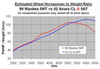
Dyno plot says I have the most area under the Administrator curve
Joined: Jul 2001
Posts: 7,064
Hey guys,
You absolutely need to put 91+ octane fuel in your cars, unless, as described in the manual, you live in a high altitude area. The higher octane is required to prevent pinging in the engine because it runs a relatively high compression ratio. However, in high altitude areas where the air is much thinner the compression ratio is naturally reduced because of the thinner air, and enough so that you could get away with a lesser octane.
You shouldn't need to reset the ECU or anything when switching between octane levels. The timing control reads directly off of the knock sensor. If everything is okay then it will operate fully advanced. But when the knock sensor detects the onset of knock it will send a signal to the ECU to retard timing until the engine is running smoothly again. The bad thing about this is you lose power because now the timing is non-optimal.
If you put in 87, you'll probably lose enough mileage and performance that it would have just been cheaper in the end to put 91 octane in anyways - the proper fuel - all while having better performance.
I test drove a lot of Maxima's just this past Sunday when I was looking for my car and one of them in particular just felt like absolute crap and didn't seem to have any power, and the delivery wasn't smooth at at all. When I got back from the test drive I asked them what kind of fuel they put in their cars. They said "oh just 87 is fine for them."
The very next place I went to was just the opposite. "The Maxima has a high-performance engine so we only fill it up with 93 for test drives." This car felt worlds better.
=========
Anyways, speaking of mileage, I've had my car just short of a week now and have been driving it relatively hard (but not abusively) and got 23 mpg!!! I would have been below the 20's in my Accord with the same driving so I'm really happy so far. This weekend: roadtrip. I'll get to test out highway mileage
You absolutely need to put 91+ octane fuel in your cars, unless, as described in the manual, you live in a high altitude area. The higher octane is required to prevent pinging in the engine because it runs a relatively high compression ratio. However, in high altitude areas where the air is much thinner the compression ratio is naturally reduced because of the thinner air, and enough so that you could get away with a lesser octane.
You shouldn't need to reset the ECU or anything when switching between octane levels. The timing control reads directly off of the knock sensor. If everything is okay then it will operate fully advanced. But when the knock sensor detects the onset of knock it will send a signal to the ECU to retard timing until the engine is running smoothly again. The bad thing about this is you lose power because now the timing is non-optimal.
If you put in 87, you'll probably lose enough mileage and performance that it would have just been cheaper in the end to put 91 octane in anyways - the proper fuel - all while having better performance.
I test drove a lot of Maxima's just this past Sunday when I was looking for my car and one of them in particular just felt like absolute crap and didn't seem to have any power, and the delivery wasn't smooth at at all. When I got back from the test drive I asked them what kind of fuel they put in their cars. They said "oh just 87 is fine for them."
The very next place I went to was just the opposite. "The Maxima has a high-performance engine so we only fill it up with 93 for test drives." This car felt worlds better.
=========
Anyways, speaking of mileage, I've had my car just short of a week now and have been driving it relatively hard (but not abusively) and got 23 mpg!!! I would have been below the 20's in my Accord with the same driving so I'm really happy so far. This weekend: roadtrip. I'll get to test out highway mileage

Member who somehow became The President of The SE-L Club
iTrader: (19)
Joined: Jun 2001
Posts: 16,024
Guys, some may not actually FEEL any difference in power or performance with 87 or 91-94 octain gas. But your engine will. A dyno may show some differences. Definately your MPG should show it. I'd guess about a 2 MPG drop should happen when you use octain rated gas that is not up to what your car is designed to run on. And on the other side, using octain rated gas that is to high may also cause you to actually lose power and performance. Remember the higher the octain the more resistance to burn the gas actually has. The correct octain gas should start to ignite at top dead center to push the piston down and get full force from the explosion. Low octain gas may explode before your piston reached TDC, thus causing ping and lack of performance. 94 octain gas may burn to slow and start maximum force a degree or 2 later in your power stroke. Hance..you lose a bit of performance there as well.
Bottom line, use the correct octain gas that your car is designed to run on.
Bottom line, use the correct octain gas that your car is designed to run on.

Talking about this gas mileage.....
..I did a road trip from Wisconsin to Colorado, then to California, then up to Washington and back to Wisconsin.
I can say that putting 93 vs 87 does make a lot of difference.
How?
Try this scenario.
You are in a Max, going up and down on I-70 from Denver to Grand Junction. For thos who know about this route, there are some "significant" climb in this road. I had both the 87 and 93 (filled up the gas somewhere near Highway 9 (coming from Estees Park)and I-70.
When I put the 87, the car knocks a lot and it losses its pull whenever it is climbing. The knocking, fortunately, was something in 2000 rpm, not something at 4000rpm and above (where it could blow a piston). When I put the 93, the car feel much better when it climbs.
MPG? I don't really think that there is a difference between the 87 vs 93. However, if you are taking a "challenging" road where you could find yourself pressing the throttle more, the 93 is better since it gives you better "pull" rather than 87. I bet you will find yourself flooring the car more with 87 rather than with 93 in this challenging roads (assuming that you travel from point A to point B in the same time period, ie., Denver to Grand Junction: 4 hours).
Hope this helps,
Armand
I can say that putting 93 vs 87 does make a lot of difference.
How?
Try this scenario.
You are in a Max, going up and down on I-70 from Denver to Grand Junction. For thos who know about this route, there are some "significant" climb in this road. I had both the 87 and 93 (filled up the gas somewhere near Highway 9 (coming from Estees Park)and I-70.
When I put the 87, the car knocks a lot and it losses its pull whenever it is climbing. The knocking, fortunately, was something in 2000 rpm, not something at 4000rpm and above (where it could blow a piston). When I put the 93, the car feel much better when it climbs.
MPG? I don't really think that there is a difference between the 87 vs 93. However, if you are taking a "challenging" road where you could find yourself pressing the throttle more, the 93 is better since it gives you better "pull" rather than 87. I bet you will find yourself flooring the car more with 87 rather than with 93 in this challenging roads (assuming that you travel from point A to point B in the same time period, ie., Denver to Grand Junction: 4 hours).
Hope this helps,
Armand

Thread
Thread Starter
Forum
Replies
Last Post
pkfinn
1st-3rd Generations Classifieds (1981-1994)
2
Jan 3, 2016 02:55 PM
Finkle
4th Generation Maxima (1995-1999)
13
Sep 27, 2015 09:53 PM
conansriver
5th Generation Maxima (2000-2003)
13
Sep 3, 2015 06:38 AM