


How does the Nitrous Pressure Regulator work?



How does the Nitrous Pressure Regulator work?
After reading everything here, talking to people, and researching elsewhere the one area of the setup I don't really understand is the nitrous pressure regulator. How exactly does the nitrous pressure regulator increase the fuel pressure?
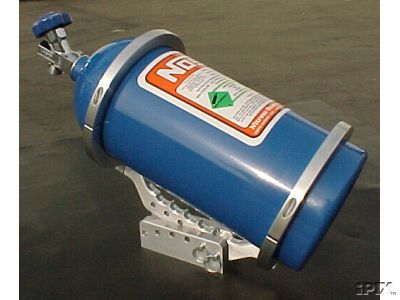
First and foremost I'd really like to understand how it works, and secondly I want to make sure my VI vacuum lines don't interfere with anything. All I have left to do is mount my bottle (bracket is in the mail) and install my solenoids and I'm good to go
-hype
First and foremost I'd really like to understand how it works, and secondly I want to make sure my VI vacuum lines don't interfere with anything. All I have left to do is mount my bottle (bracket is in the mail) and install my solenoids and I'm good to go
-hype

Guest
Posts: n/a
This is for the dry setup correct? Well, if so, this is how. When both solenoids have finally been activated, the nitrous regulator comes into direct contact with the nitrous. Well, as you know, the nitrous has pressure behind it, about 900 psi for our example. Now, when the pressure hits the regulator, it compresses the spring on the inside of the regulator, which is hooked up to the vacuum setup on the fuel pressure regulator. When the nitrous compresses the spring, it bypasses the one way low pressure valve and enters the FPR lines. And since the nitrous has some pressure behind it, it goes through the jet in the T, which also regulates the pressure as well, and "bumps" up the fuel pressure by "tricking" the FPR.
And to answer your second questions: No, this will NOT affect your VI setup.....
And to answer your second questions: No, this will NOT affect your VI setup.....

So based off of what you just said, the nitrous is actually flowing through the solenoids to the engine and through the NPR to the FPR. That seems strange, because don't you want an increase in vacuum to get the FP to go up (rather than providing positive "boost") 
BTW Iron Lung suggested another place to get manifold vacuum, so I'm cool on the VI setup.
-hype
BTW Iron Lung suggested another place to get manifold vacuum, so I'm cool on the VI setup.
-hype

The FPR operates normally by introducing intake manifold vacuum to the top of the FPR (control line) which is a diaphram held in position by a spring controlled valve. When there is no vacuum present (ie when you remove the vacuum line) it goes to WOT pressure or 43 psi. When vacuum is introduced it pulls up on the diaphram allowing more fuel to bypass through the return and reduces the pressure on the fuel rail. (ie at idle its approx 34 psi). The range in between is achieved depending on what the manifold vacuum is which is normally between 0-20" of vacuum.
When you hook the nitrous up it allows the bottle pressure to enter this same control line through a nozzle which regulates the pressure. Now this line is going to be operating under a pressure not a vacuum when the nitrous is activated. When pressure hits the top of the diaphram it does exactly the opposite of a vacuum, it allows less fuel to bypass through the return and fuel pressure increases. The size of the jet will determine how much pressure is put on the diaphram and how much the fuel pressure will increase.
The thing that a lot of people do not understand is that fuel injectors are designed to operate under the SAME pressure differential at all times. That is exactly the reason you need to vary the pressure from idle to WOT.
ie When the engine is at WOT there is 43 psi fuel pressure and 0 pressure in the intake, therefore pressure diff is 43 psi.
When the engine is at idle there is 34 psi fuel pressure and approx 20" of vacuum in the intake which is equivalent to approx -10 psi so you can see that the pressure constantly maintained across the injectors is still approx 43-44 psi.
The FPR is constantly trying to maintain this 43 PSI differential across the injectors by varying the amount of returned fuel.
When you hook the nitrous up it allows the bottle pressure to enter this same control line through a nozzle which regulates the pressure. Now this line is going to be operating under a pressure not a vacuum when the nitrous is activated. When pressure hits the top of the diaphram it does exactly the opposite of a vacuum, it allows less fuel to bypass through the return and fuel pressure increases. The size of the jet will determine how much pressure is put on the diaphram and how much the fuel pressure will increase.
The thing that a lot of people do not understand is that fuel injectors are designed to operate under the SAME pressure differential at all times. That is exactly the reason you need to vary the pressure from idle to WOT.
ie When the engine is at WOT there is 43 psi fuel pressure and 0 pressure in the intake, therefore pressure diff is 43 psi.
When the engine is at idle there is 34 psi fuel pressure and approx 20" of vacuum in the intake which is equivalent to approx -10 psi so you can see that the pressure constantly maintained across the injectors is still approx 43-44 psi.
The FPR is constantly trying to maintain this 43 PSI differential across the injectors by varying the amount of returned fuel.


Thread
Thread Starter
Forum
Replies
Last Post
jerrod99_se-l
4th Generation Classifieds (1995-1999)
2
Aug 27, 2015 08:27 PM
MaximaDrvr
7th Generation Maxima (2009-2015)
16
Aug 19, 2015 08:20 PM
Superbform
Audio and Electronics
1
Aug 11, 2015 08:10 PM