


Driveline loss question


Thread Starter
Donating Maxima.org Member

Joined: Aug 2000
Posts: 577
Driveline loss question
For losses in the driveline due to friction and moment of inertia of the rotating masses, are these losses always constant value or are they always a fixed percentage of input torque?
For example, a stock Maxima might make 150HP on the dyno with a 190HP at the engine. That is about 20% loss. So if for example the engine were modified to make around 300HP, would it still lose 20% through the driveline or would it lose the same 40HP?
I'm not sure -- I would guess the force to overcome friction at a given speed on the driveline shouldn't change just because more power is put into the driveline. And I would guess the moment of intertia for all the gears and driveshafts doesn't change just because there is more power put into the driveline. But maybe I am wrong.
Anybody know the definite answer?
For example, a stock Maxima might make 150HP on the dyno with a 190HP at the engine. That is about 20% loss. So if for example the engine were modified to make around 300HP, would it still lose 20% through the driveline or would it lose the same 40HP?
I'm not sure -- I would guess the force to overcome friction at a given speed on the driveline shouldn't change just because more power is put into the driveline. And I would guess the moment of intertia for all the gears and driveshafts doesn't change just because there is more power put into the driveline. But maybe I am wrong.
Anybody know the definite answer?


Senior Member
Joined: Jun 2002
Posts: 297
I don't think that the rate of loss is a constant value. I think that you would also have to calculate in a few other factors. Anyone a mechanical engineer?
http://www.mvs.chalmers.se/~thomson/...re_notes_X.pdf
http://www.mvs.chalmers.se/~thomson/...re_notes_X.pdf
Dyno plot says I have the most area under the Administrator curve
Joined: Jul 2001
Posts: 7,064
The universal standards for loss through drivelines seem to be about...
Manual: 17%
Automatic: 22%
Add another 8% to each for AWD.
Of course, it all depends on how a manufacturer rates the engine. BMW for example, has long "under-rated" their engines, meaning, the engine is really putting out more at the crank than the rating suggests.
For example, the 330i's 3.0L Inline-6 is "rated" at 225HP. However, it has been dynoed at 200 rwhp completely stock by more than a few people. If you assume the crank rating is accurate, that comes out to only 9% loss which is ridiculously low. Going by the 17% loss standard, the engine really performs more like it has 240HP!
Ford and GM also commonly under-rate their higher performance engines.
The VQ35DE in the Maxima is "rated" at 255HP. However, it only dynos at 205 fwhp, just 5 whp more than the 225HP BMW. Going by the 17% standard once again, the engine comes up a bit short, with the actual crank raing closer to 245-247 HP, not 255 HP

Manual: 17%
Automatic: 22%
Add another 8% to each for AWD.
Of course, it all depends on how a manufacturer rates the engine. BMW for example, has long "under-rated" their engines, meaning, the engine is really putting out more at the crank than the rating suggests.
For example, the 330i's 3.0L Inline-6 is "rated" at 225HP. However, it has been dynoed at 200 rwhp completely stock by more than a few people. If you assume the crank rating is accurate, that comes out to only 9% loss which is ridiculously low. Going by the 17% loss standard, the engine really performs more like it has 240HP!
Ford and GM also commonly under-rate their higher performance engines.
The VQ35DE in the Maxima is "rated" at 255HP. However, it only dynos at 205 fwhp, just 5 whp more than the 225HP BMW. Going by the 17% standard once again, the engine comes up a bit short, with the actual crank raing closer to 245-247 HP, not 255 HP

Originally posted by munji
I don't think that the rate of loss is a constant value. I think that you would also have to calculate in a few other factors. Anyone a mechanical engineer?
http://www.mvs.chalmers.se/~thomson/...re_notes_X.pdf
I don't think that the rate of loss is a constant value. I think that you would also have to calculate in a few other factors. Anyone a mechanical engineer?
http://www.mvs.chalmers.se/~thomson/...re_notes_X.pdf
Well, I r a injuneer, and an ME to boot.
I have almost always seen drivetrain loss stated as a percentage of power. This is in magazines and on forums such as this one, and it seems to be the common perception.
If we are talking about a manual transmission, then from an engineer's standpoint, I don't see how it could be a function of power developed and not a constant value. Drivetrain loss is due to friction in the transmission, CV joints and wheel bearings and hysteretic losses in the tires. These losses don't change when engine power is increased, rather they are a function of vehicle speed. The only caveat to my argument would be that losses in the transmission (and maybe CV joints) may increase with engine power if gear-to-gear friction increases with increasing contact pressures at the gear teeth. Gear teeth are cut so that there is very little sliding going on at the tooth contact surfaces, however, so I would expect transmission losses to be a very weak function of engine power.
In automatic transmissions, however, the losses may be very much a function of engine power due to the transmission of power through a viscous fluid in the torque convertor.
Interesting topic. Maybe I'll research it a bit.
Guest
Posts: n/a
Re: Driveline loss question
The dynamic coefficient of friction is a constant. Frictional force = coeff friction times the force applied. The more power you make, the more the applied force, but the coeff of friction stays the same. Therefore, the frictional force goes up directly with the force applied (1:1). If an engine making 190 HP has a 20% loss, than that same engine making 300 HP will also show a 20% loss.
Some PhD that has studied in detail the effects of applied forces on coefficients of friction may chime in here and disagree, but it is common engineering practice to assume the dynamic coefficient of friction is a constant...at very worst it's close enough that it can be considered a constant for a rather mild 50% increase in applied force.
This all assumes that no mechanical failures are occuring, ie the drivetrain can handle the additional stress (bearings are not galling/seizing due to overstress, etc).
Some PhD that has studied in detail the effects of applied forces on coefficients of friction may chime in here and disagree, but it is common engineering practice to assume the dynamic coefficient of friction is a constant...at very worst it's close enough that it can be considered a constant for a rather mild 50% increase in applied force.
This all assumes that no mechanical failures are occuring, ie the drivetrain can handle the additional stress (bearings are not galling/seizing due to overstress, etc).
Originally posted by chris j vurnis
For losses in the driveline due to friction and moment of inertia of the rotating masses, are these losses always constant value or are they always a fixed percentage of input torque?
For example, a stock Maxima might make 150HP on the dyno with a 190HP at the engine. That is about 20% loss. So if for example the engine were modified to make around 300HP, would it still lose 20% through the driveline or would it lose the same 40HP?
I'm not sure -- I would guess the force to overcome friction at a given speed on the driveline shouldn't change just because more power is put into the driveline. And I would guess the moment of intertia for all the gears and driveshafts doesn't change just because there is more power put into the driveline. But maybe I am wrong.
Anybody know the definite answer?
For losses in the driveline due to friction and moment of inertia of the rotating masses, are these losses always constant value or are they always a fixed percentage of input torque?
For example, a stock Maxima might make 150HP on the dyno with a 190HP at the engine. That is about 20% loss. So if for example the engine were modified to make around 300HP, would it still lose 20% through the driveline or would it lose the same 40HP?
I'm not sure -- I would guess the force to overcome friction at a given speed on the driveline shouldn't change just because more power is put into the driveline. And I would guess the moment of intertia for all the gears and driveshafts doesn't change just because there is more power put into the driveline. But maybe I am wrong.
Anybody know the definite answer?

All the while I've been thinking that the 6 speed tranny has a little more drivetrain loss than the 5 speed in the Altima V6. I still think that has something to do with it. Anyhow, that 255 hp is somewhat elusive.
DW
DW
Originally posted by SteVTEC
...The VQ35DE in the Maxima is "rated" at 255HP. However, it only dynos at 205 fwhp, just 5 whp more than the 225HP BMW. Going by the 17% standard once again, the engine comes up a bit short, with the actual crank raing closer to 245-247 HP, not 255 HP . .
...The VQ35DE in the Maxima is "rated" at 255HP. However, it only dynos at 205 fwhp, just 5 whp more than the 225HP BMW. Going by the 17% standard once again, the engine comes up a bit short, with the actual crank raing closer to 245-247 HP, not 255 HP . .
Dyno plot says I have the most area under the Administrator curve
Joined: Jul 2001
Posts: 7,064
Could be... 
But if you look at the torque figures, they dyno around 220 fwtq. Divide by .83 (17% loss) and you come out at 265 lb-ft, which is exactly where the Pathfinder is rated. If you assume 20% loss, you're at 275 lb-ft! Not likely.... It's more likey the engine just isn't putting out the power than it should be, IMHO.
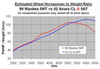
The CL-S 6spd dynos right at 217 whp / 260 bhp = 17% loss
http://mywebpages.comcast.net/stevte...k_Astroboy.jpg
Honda is not known for under/over-rating their engines for the most part, so if they say 260-crank, it's a good bet that the engine really is putting out about 260-crank.
But if you look at the torque figures, they dyno around 220 fwtq. Divide by .83 (17% loss) and you come out at 265 lb-ft, which is exactly where the Pathfinder is rated. If you assume 20% loss, you're at 275 lb-ft! Not likely.... It's more likey the engine just isn't putting out the power than it should be, IMHO.
The CL-S 6spd dynos right at 217 whp / 260 bhp = 17% loss
http://mywebpages.comcast.net/stevte...k_Astroboy.jpg
Honda is not known for under/over-rating their engines for the most part, so if they say 260-crank, it's a good bet that the engine really is putting out about 260-crank.
Originally posted by dwapenyi
All the while I've been thinking that the 6 speed tranny has a little more drivetrain loss than the 5 speed in the Altima V6. I still think that has something to do with it. Anyhow, that 255 hp is somewhat elusive.
DW
All the while I've been thinking that the 6 speed tranny has a little more drivetrain loss than the 5 speed in the Altima V6. I still think that has something to do with it. Anyhow, that 255 hp is somewhat elusive.
DW

Thread
Thread Starter
Forum
Replies
Last Post
TallTom
5th Generation Maxima (2000-2003)
57
Oct 14, 2025 05:16 PM
Unclejunebug
5th Generation Maxima (2000-2003)
10
Apr 2, 2016 05:42 AM
Stagnet04
4th Generation Classifieds (1995-1999)
2
Oct 11, 2015 08:16 PM