


Easy fix


Problem Codes, Easy Fix?
1995 SE is getting a lil fussy with me...
So i checked out the codes in the ECU and it gave me these :
1005
1005 is EGRC Solenoid valve
The majority of my information about Diagnostic Trouble Codes comes from my '99 Maxima factory service manual. Unfortunately, DTC 1005 is not in that book. Starting in '99 the Maxima engine uses a step-motor type of EGR valve and with that change, the DTCs changed.
The Chilton and Haynes manuals provide a little information about the EGR Solenoid Valve.
The test procedure for this part is found in the Chilton repair manual (page 4-11) and the Haynes repair manual (page 6-20). Test the valve and replace if necessary.
This malfunction is not an emergency but should be resolved fairly soon (7-10 days). An inoperative EGR valve may result in engine pinging and a variety of driveability complaints.
1008
The Evaporative Emission (EVAP) Canister Purge Volume Control Solenoid Valve uses an on/off duty cycle to control the flow of fuel vapor from the EVAP canister. Diagnostic Trouble Code 1008 is set when the Engine Control Module (the computer) detects an improper signal through the valve. The problem is likely to be in the electrical wiring, harness, or the valve itself.
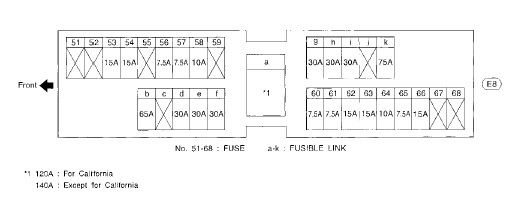
Check fuse #58 (10 amps) and replace if necessary.
The CPVCSV is easy to see and reach. It is located in the engine compartment, mounted to the top of the upper intake manifold. Notice the Vehicle Serial number stamped into the firewall. Put your finger on the third-from-last number. Move your finger three inches toward the radiator. That's the CPVCSV. It has one two-wire electrical connector and two vacuum hoses. It is directly above the ignition coil connector for cylinder #5 and has to be removed in order to replace the #5 coil or spark plug.
You may test the valve. This test procedure is performed with the engine off. Remove the electrical connector and both vacuum hoses. Fasten a length of clean rubber vacuum tubing to either nipple. Gently blow through the hose. The valve should be closed and it should be difficult or impossible to send air through the valve. Now use a pair of fused test leads to provide 12 volts to the electric terminals. The polarity doesn't matter. With the solenoid energized the valve should be open and it should be easy to send air through the valve.
http://www.jcn.net/mwest/evappage.htm
So i was searching these codes and there was similar problems about being able to fix the valve yourself with some wd40. It didnt really get much into detail so im looking for some specific help with this problem.
and where is this valve located?
Any help/suggestions with these codes is greatly appreciated, Thanks
So i checked out the codes in the ECU and it gave me these :
1005
1005 is EGRC Solenoid valve
The majority of my information about Diagnostic Trouble Codes comes from my '99 Maxima factory service manual. Unfortunately, DTC 1005 is not in that book. Starting in '99 the Maxima engine uses a step-motor type of EGR valve and with that change, the DTCs changed.
The Chilton and Haynes manuals provide a little information about the EGR Solenoid Valve.
The test procedure for this part is found in the Chilton repair manual (page 4-11) and the Haynes repair manual (page 6-20). Test the valve and replace if necessary.
This malfunction is not an emergency but should be resolved fairly soon (7-10 days). An inoperative EGR valve may result in engine pinging and a variety of driveability complaints.
1008
The Evaporative Emission (EVAP) Canister Purge Volume Control Solenoid Valve uses an on/off duty cycle to control the flow of fuel vapor from the EVAP canister. Diagnostic Trouble Code 1008 is set when the Engine Control Module (the computer) detects an improper signal through the valve. The problem is likely to be in the electrical wiring, harness, or the valve itself.
Check fuse #58 (10 amps) and replace if necessary.
The CPVCSV is easy to see and reach. It is located in the engine compartment, mounted to the top of the upper intake manifold. Notice the Vehicle Serial number stamped into the firewall. Put your finger on the third-from-last number. Move your finger three inches toward the radiator. That's the CPVCSV. It has one two-wire electrical connector and two vacuum hoses. It is directly above the ignition coil connector for cylinder #5 and has to be removed in order to replace the #5 coil or spark plug.
You may test the valve. This test procedure is performed with the engine off. Remove the electrical connector and both vacuum hoses. Fasten a length of clean rubber vacuum tubing to either nipple. Gently blow through the hose. The valve should be closed and it should be difficult or impossible to send air through the valve. Now use a pair of fused test leads to provide 12 volts to the electric terminals. The polarity doesn't matter. With the solenoid energized the valve should be open and it should be easy to send air through the valve.
http://www.jcn.net/mwest/evappage.htm
So i was searching these codes and there was similar problems about being able to fix the valve yourself with some wd40. It didnt really get much into detail so im looking for some specific help with this problem.
and where is this valve located?
Any help/suggestions with these codes is greatly appreciated, Thanks


Newbie - Just Registered
Joined: Mar 2006
Posts: 13
hey theres the link to where the valve is located http://smg.photobucket.com/albums/v1...gAnch=imgAnch2. Sorry if it doesnt help

Member
Joined: Dec 2005
Posts: 98
Originally Posted by shadyonedeath
Is it possible that this is the cause for my low mileage?
I swear to god my needle drops 1/4+ tank from a 20 min highway drive @ 65-75mph.
I swear to god my needle drops 1/4+ tank from a 20 min highway drive @ 65-75mph.
possibly, but highly unlikely. fast accelleration from a stop and fast brakeing from high speeds is numero uno for bad gas mileage. but in relation to the EVAP valve, all it does is detect the unburned vapors from your gas, so that they arent sent out into the atmosphere. the only thing that could affect your performance would be an unplugged vaccum line from the EVAP, and the only thing that would cause would be ROUGH IDLE. so i highly doubt its EVAP related.
chk. plugs,coils,airfilter,fuelfilter,pcv valve, the whole nine. see if they need replacing.

Thread
Thread Starter
Forum
Replies
Last Post
BPuff57
Advanced Suspension, Chassis, and Braking
33
Apr 16, 2020 05:15 AM