


gas leak - fuel tank sending unit


gas leak - fuel tank sending unit
I had a strong gasoline odor in my 97 after filling the gas tank. By the time the gas tank was 1/4 empty, the smell was gone. Looking at the gas tank from underneath the car didn't reveal anything. I finally took the back seat cushion out, removed the access cover and looked at the gas tank.
When I did that, I saw that the top of the gas gauge fuel tank sending unit was filled with gasoline (it serves as the cover to the gas tank opening). I mopped out the gas and saw that it was filling back up from a crack in the top piece of the sending unit. Dayamn...
I checked a couple of auto parts places but none of them had a sending unit. Nissan only part $$$. Best deal I found was nissanpartszone.com. List price for the sending unit is $160.18. I got the sending unit, the o-ring gasket and s&h for $144 and change.
The sending unit is part number 25060-4L700 and the o-ring seal is part number 17342-01A00.
It's not that difficult a job, 9 screws, 3 hoses and 3 wire connectors. I waited until the gas tank was almost empty but it didn't have to be that low. 1/4 down probably would be just fine. If I had to replace the fuel pump, I would definitely get the tank as empty as possible.
Here are some photos -
This is the top of the sending unit that you will see when you remove the access cover fron the car floor. On the right side is a depression where 2 electrical connectors attach. This area is where I saw the gas pooling. In my case, the V shape all the way at the bottom was cracked top to bottom. The lower hose connection is the output from the fuel pump. It has an arrow imprinted on it.

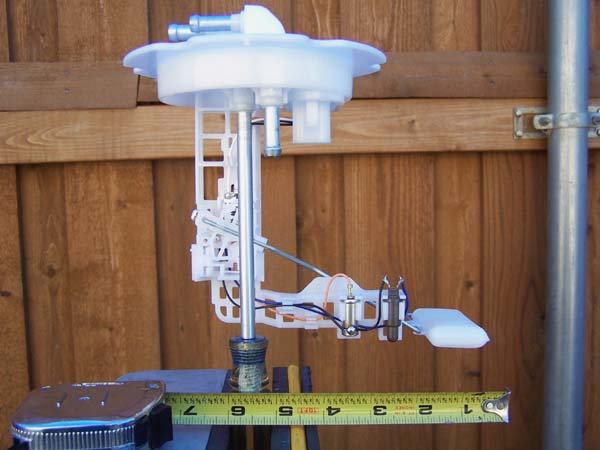
Two side views of the sending unit.

This is a close up of the end of the sending unit. The dark thing all the way an the right is the gasoline temperature sending unit. This can cause a P0180 check engine light if the temperature of the gasoline is too something.
The silver piece on the left of the temperature sensor is part unknown. It has little holes in it so the gasoline can get inside of it, but that's all I can tell you.
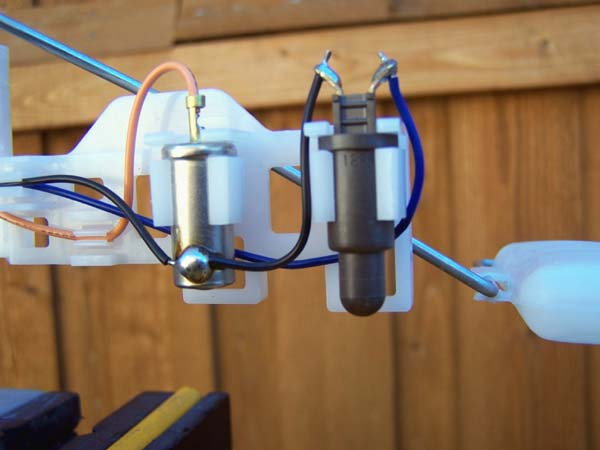
Here is the variable resistor that runs the fuel gauge in the dash. The float arm has a contact on it. the resistor is "buried" in the plastic and there is no way to get a good picture, it's even hard to see with the eye.

The gas tank with the sending unit removed. While I never thought about it, the fuel pump connects to the sending unit on the inside of the tank via a rubber hose and an electrical connector.

This is probably a VERY important gasket. It seals the fuel pump electrical connector inside the tank where it plugs into the bottom of the sending unit. Without this, I'm sure the gasoline would corrode the electrical contacts, preventing the fuel pump from working. I did not get a new one with the new sending unit. I was fortunate to have noticed it in the old sending unit before I put the new one in place.

Here is that connector seal installed in the bottom of the sending unit.

When I did that, I saw that the top of the gas gauge fuel tank sending unit was filled with gasoline (it serves as the cover to the gas tank opening). I mopped out the gas and saw that it was filling back up from a crack in the top piece of the sending unit. Dayamn...
I checked a couple of auto parts places but none of them had a sending unit. Nissan only part $$$. Best deal I found was nissanpartszone.com. List price for the sending unit is $160.18. I got the sending unit, the o-ring gasket and s&h for $144 and change.
The sending unit is part number 25060-4L700 and the o-ring seal is part number 17342-01A00.
It's not that difficult a job, 9 screws, 3 hoses and 3 wire connectors. I waited until the gas tank was almost empty but it didn't have to be that low. 1/4 down probably would be just fine. If I had to replace the fuel pump, I would definitely get the tank as empty as possible.
Here are some photos -
This is the top of the sending unit that you will see when you remove the access cover fron the car floor. On the right side is a depression where 2 electrical connectors attach. This area is where I saw the gas pooling. In my case, the V shape all the way at the bottom was cracked top to bottom. The lower hose connection is the output from the fuel pump. It has an arrow imprinted on it.
Two side views of the sending unit.
This is a close up of the end of the sending unit. The dark thing all the way an the right is the gasoline temperature sending unit. This can cause a P0180 check engine light if the temperature of the gasoline is too something.
The silver piece on the left of the temperature sensor is part unknown. It has little holes in it so the gasoline can get inside of it, but that's all I can tell you.
Here is the variable resistor that runs the fuel gauge in the dash. The float arm has a contact on it. the resistor is "buried" in the plastic and there is no way to get a good picture, it's even hard to see with the eye.
The gas tank with the sending unit removed. While I never thought about it, the fuel pump connects to the sending unit on the inside of the tank via a rubber hose and an electrical connector.
This is probably a VERY important gasket. It seals the fuel pump electrical connector inside the tank where it plugs into the bottom of the sending unit. Without this, I'm sure the gasoline would corrode the electrical contacts, preventing the fuel pump from working. I did not get a new one with the new sending unit. I was fortunate to have noticed it in the old sending unit before I put the new one in place.
Here is that connector seal installed in the bottom of the sending unit.
Last edited by DennisMik; Nov 18, 2011 at 11:23 PM. Reason: had duplicated a photo


The car started right up and ran fine. It has 142K miles and the low fuel light always worked before this. After putting in the new sending unit, I went and gassed up. The low fuel light was not on and the needle on the gas gauge was not on the E line, just above it. I put 14.9 gallons in. This is pretty much the same as with the old unit.

Newbie - Just Registered
Joined: Jan 2012
Posts: 2
In your picture you said the dark thing all the way to the right is the fuel temperature sending unit? I just replaced mine from a junkyard because im getting the P0180 code, Im going to have to try another one because the code still exists after i cleared it and my car temp. needle still rises, so i know its on the sending unit, not on the actual cylinder shaped pump right?
Here is what the FSM says about the P0180 code:
P0180
* An excessively high or low voltage is entered to ECM.
* Rationally incorrect voltage is entered to ECM, compared with the voltage signals from engine coolant temperature sensor and intake air temperature sensor.
Possible causes:
* Harness or connectors (The sensor circuit is open or shorted.)
* Tank fuel temperature sensor
The last sentence in your post confuses me. You said that the car temperature gauge needle still rises. Was it not working before this? Or was the car having cooling/ overheating problems?
I don't think the fuel pump has anything to do with the fuel temp sensor.
The fuel temperature sensor could always go bad. But 2 in a row? They are not a high failure item that I am aware of. The sensor is a thermistor, so it can be checked with an ohmmeter. 6.0K ohm at 32 degrees, 2.5K ohm at 68 degrees, .84K ohm at 122 degrees. Maybe you have a wiring problem as the signal has to go from the fuel tank to the ecu.
Download the FSM and look in the EC section for P0180 (page 232 in the 1998 manual).
http://boredmder.com/FSMs/Nissan/Maxima/
P0180
* An excessively high or low voltage is entered to ECM.
* Rationally incorrect voltage is entered to ECM, compared with the voltage signals from engine coolant temperature sensor and intake air temperature sensor.
Possible causes:
* Harness or connectors (The sensor circuit is open or shorted.)
* Tank fuel temperature sensor
The last sentence in your post confuses me. You said that the car temperature gauge needle still rises. Was it not working before this? Or was the car having cooling/ overheating problems?
I don't think the fuel pump has anything to do with the fuel temp sensor.
The fuel temperature sensor could always go bad. But 2 in a row? They are not a high failure item that I am aware of. The sensor is a thermistor, so it can be checked with an ohmmeter. 6.0K ohm at 32 degrees, 2.5K ohm at 68 degrees, .84K ohm at 122 degrees. Maybe you have a wiring problem as the signal has to go from the fuel tank to the ecu.
Download the FSM and look in the EC section for P0180 (page 232 in the 1998 manual).
http://boredmder.com/FSMs/Nissan/Maxima/

You know, everytime I fill up I get a gas smell too. I have to remove my rear seat again soon to install my new speaker grills. Might as well pull the cover while im there and see if this is my problem. Thanks so much for the write up!

Take a look at the filler neck for rust as well.
When I discovered my leak, I thought about trying to "fix" the crack by removing the sending unit and melting the plastic with something like a soldering iron. I decided against it because I felt that if it cracked, it might do it again in another spot or even the same spot. But if you want to be experimental and/or adventuresome...
When I discovered my leak, I thought about trying to "fix" the crack by removing the sending unit and melting the plastic with something like a soldering iron. I decided against it because I felt that if it cracked, it might do it again in another spot or even the same spot. But if you want to be experimental and/or adventuresome...

Thread
Thread Starter
Forum
Replies
Last Post
97_GXE
4th Generation Maxima (1995-1999)
5
Sep 15, 2015 06:47 AM
ag90fox
7th Generation Maxima (2009-2015)
6
Sep 9, 2015 12:22 PM