


So you want to raise the rev limiter on your non SSIM 3.5


Thread Starter
DO NOT DO BUSINESS WITH THIS MEMBER - OWES PEOPLE MONEY
iTrader: (7)
Joined: Jan 2008
Posts: 3,468
From: Greensboro, NC
So you want to raise the rev limiter on your non SSIM 3.5
This came up in a discussion in the hustle thread and IMO merited a thread of its own because it's good info for most of the 5th gen forum (5.5s).
For the past nearly 2 years, I've had a vias delete (BOP) IM and UTEC extending the rev limiter to 7200. All this time, I had assumed revving out was the best way to get good times and that is exactly what I did for all my old PB runs.
Now I finally have dyno graphs of my car with the vias deleted stock IM and realize the folly in this.
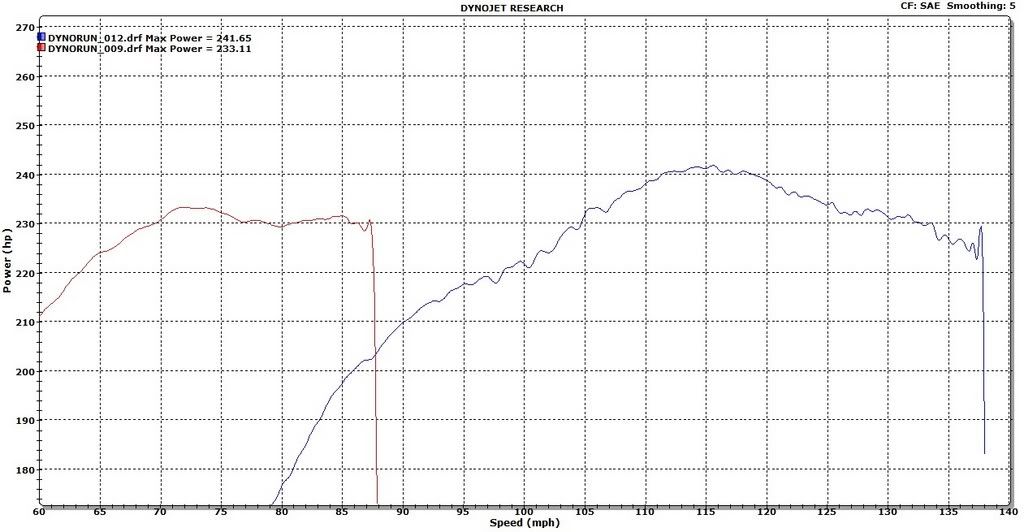
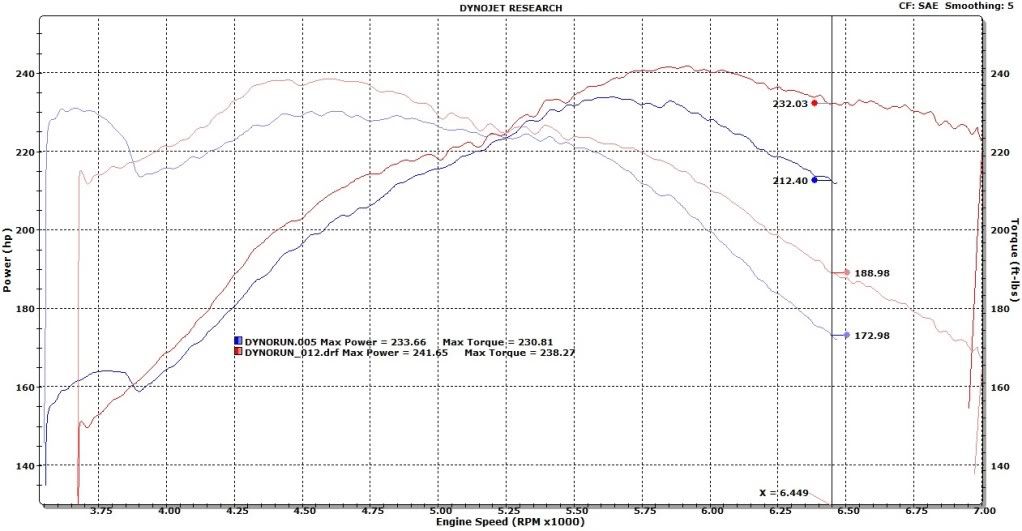
6 speeds shift roughly 1500 RPMs down on each shift, so you're looking at a 1500 RPM zone when determining where you want to shift... These are both taken from the same dyno graph.
Well this is what I've been doing all this time. 5500-7k

And this is what I should have been doing. 5000-6500

As you can see, it drops off like a rock after peak... and holding out to around 6400-6500 RPMs is probably a good thing, but anything beyond that you're just moving closer and closer to that <200hp DE-K territory. ( sorry, I had to).
Moral of the story, unless you have a SSIM... don't worry about shifting at high RPMs. Shift a little over 6k and enjoy your wonderful midrange power.
For the past nearly 2 years, I've had a vias delete (BOP) IM and UTEC extending the rev limiter to 7200. All this time, I had assumed revving out was the best way to get good times and that is exactly what I did for all my old PB runs.
Now I finally have dyno graphs of my car with the vias deleted stock IM and realize the folly in this.
6 speeds shift roughly 1500 RPMs down on each shift, so you're looking at a 1500 RPM zone when determining where you want to shift... These are both taken from the same dyno graph.
Well this is what I've been doing all this time. 5500-7k
And this is what I should have been doing. 5000-6500
As you can see, it drops off like a rock after peak... and holding out to around 6400-6500 RPMs is probably a good thing, but anything beyond that you're just moving closer and closer to that <200hp DE-K territory. (
sorry, I had to).Moral of the story, unless you have a SSIM... don't worry about shifting at high RPMs. Shift a little over 6k and enjoy your wonderful midrange power.


Thanks for the info! I think it's common place to assume that extending the rev will allow for greater times. It just feels like the 3.5 wants to keep running and running. I'm glad you discovered the actual relationship between engine speed/gearing and peak interval under the curves. It's nice to see paper.

4AT's have horridly longer gears, so this may or may not apply to the 4AT's, of course a personal dyno and further analysis should be required for quantitative proof.
I shift beyond stock redline because I can and because of this:
4AT w/my mods, 2nd gear vs 3rd gear.
I always put down less in 2nd But considering my cars mods, my HP @ 7100, you can see the downfall of the long AT gear. This graph shows shifts @ 7100, imagine a near stock AT shifting @ stock redline.
Also, for the elementary training for this:
http://forums.maxima.org/1-4-1-8-mil...nsmission.html
I shift beyond stock redline because I can and because of this:
4AT w/my mods, 2nd gear vs 3rd gear.
I always put down less in 2nd
But considering my cars mods, my HP @ 7100, you can see the downfall of the long AT gear. This graph shows shifts @ 7100, imagine a near stock AT shifting @ stock redline. Also, for the elementary training for this:
http://forums.maxima.org/1-4-1-8-mil...nsmission.html
Last edited by NmexMAX; Mar 16, 2011 at 06:48 AM.

My car definately feels like the power drops off after 6200ish but the TS flash allows for SSIM in the future, should I decide to go that route.
Sparks...your new IM kind of makes this irrelevant for you personally now doesn't it?
Sparks...your new IM kind of makes this irrelevant for you personally now doesn't it?
Thread Starter
DO NOT DO BUSINESS WITH THIS MEMBER - OWES PEOPLE MONEY
iTrader: (7)
Joined: Jan 2008
Posts: 3,468
From: Greensboro, NC
4AT's have horridly longer gears, so this may or may not apply to the 4AT's, of course a personal dyno and further analysis should be required for quantitative proof.
I shift beyond stock redline because I can and because of this:
4AT w/my mods, 2nd gear vs 3rd gear.
I always put down less in 2nd But considering my cars mods, my HP @ 7100, you can see the downfall of the long AT gear. This graph shows shifts @ 7100, imagine a near stock AT shifting @ stock redline.
I shift beyond stock redline because I can and because of this:
4AT w/my mods, 2nd gear vs 3rd gear.
I always put down less in 2nd
But considering my cars mods, my HP @ 7100, you can see the downfall of the long AT gear. This graph shows shifts @ 7100, imagine a near stock AT shifting @ stock redline.

Thread Starter
DO NOT DO BUSINESS WITH THIS MEMBER - OWES PEOPLE MONEY
iTrader: (7)
Joined: Jan 2008
Posts: 3,468
From: Greensboro, NC
Here's the whole thing from 4k to 7k. I'd still think an auto without SSIM would want to shift at stock redline around 6700, but admittedly I have not done any testing with one. I would definitely do whatever I could to get a big plateau like mine ended up with on an auto.


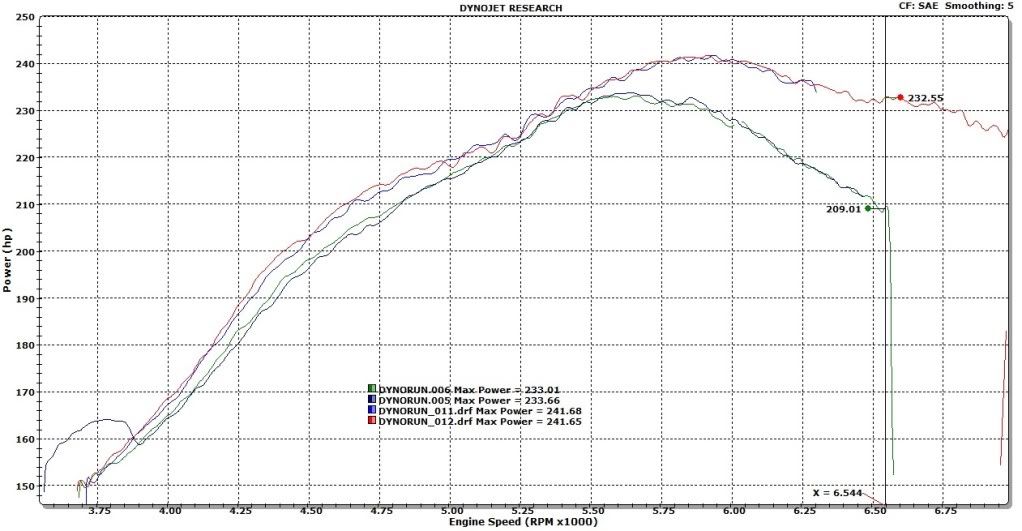

WOW, Sparks! That plateau is nuts, but does that plunging torque affect acceleration? 6500 rpm has 225 and it drops to 211 at 7000. I never truly grasped why/when horsepower "takes over" from torque to keep propelling the car forward.
An excellent brief, for sure. It provides hard evidence that the guys who wrote up the Optimal Shift Points FAQ knew what they were talking about.
Woah, just had a trippy brain thing: Is this where calculus comes into play, calculating the area under the curve? Figuring out which range has the peak power? At a glance, it would certainly appear that the 5->6.5K range dominates 5.5->7K, but for some builds, it might be close enough to demand actual calculations.
An excellent brief, for sure. It provides hard evidence that the guys who wrote up the Optimal Shift Points FAQ knew what they were talking about.
Woah, just had a trippy brain thing: Is this where calculus comes into play, calculating the area under the curve? Figuring out which range has the peak power? At a glance, it would certainly appear that the 5->6.5K range dominates 5.5->7K, but for some builds, it might be close enough to demand actual calculations.


Member
Joined: Sep 2010
Posts: 165
From: Baltimore,MD
I always thought you should shift a car at 6500 when racing at least. I race my father in laws 72 nova. This can be the difference in seconds at the drag strip.
Oh yeah the nova runs high 10's at capitol raceway. By far the scariest car I've driven
Oh yeah the nova runs high 10's at capitol raceway. By far the scariest car I've driven

so you have a TS or you "plan" on it in the future... if so, where and who are you contacting to get this reflash???
Thread Starter
DO NOT DO BUSINESS WITH THIS MEMBER - OWES PEOPLE MONEY
iTrader: (7)
Joined: Jan 2008
Posts: 3,468
From: Greensboro, NC
WOW, Sparks! That plateau is nuts, but does that plunging torque affect acceleration? 6500 rpm has 225 and it drops to 211 at 7000. I never truly grasped why/when horsepower "takes over" from torque to keep propelling the car forward.
An excellent brief, for sure. It provides hard evidence that the guys who wrote up the Optimal Shift Points FAQ knew what they were talking about.
Woah, just had a trippy brain thing: Is this where calculus comes into play, calculating the area under the curve? Figuring out which range has the peak power? At a glance, it would certainly appear that the 5->6.5K range dominates 5.5->7K, but for some builds, it might be close enough to demand actual calculations.
An excellent brief, for sure. It provides hard evidence that the guys who wrote up the Optimal Shift Points FAQ knew what they were talking about.
Woah, just had a trippy brain thing: Is this where calculus comes into play, calculating the area under the curve? Figuring out which range has the peak power? At a glance, it would certainly appear that the 5->6.5K range dominates 5.5->7K, but for some builds, it might be close enough to demand actual calculations.
"Regarding torque/horsepower:
Torque and horsepower have a defined relationship. If you know either torque or horsepower, and you know RPM, you will know the other variable.
To get more horsepower, you need either more torque, or more rpm.
So to summarize:
290 lb-ft of torque at 5000rpm is no where near as good as 230 lb-ft of torque at 7000rpm. The graph to display that relationship, is called horsepower.
(290lb-ft of torque @ 5000rpm = 276hp)
(230lb-ft of torque @ 7000rpm = 306hp)"
The SSIM line is the one that stays flatter and is much higher near redline.
Last edited by sparks03max; Mar 17, 2011 at 09:37 AM.

Thread Starter
DO NOT DO BUSINESS WITH THIS MEMBER - OWES PEOPLE MONEY
iTrader: (7)
Joined: Jan 2008
Posts: 3,468
From: Greensboro, NC
Not IMO. I think the vias delete gives enough gains in the 3000-4500 territory over SSIM to merit keeping it. I did make 270 whp with the vias delete, after all.
 this.
this.

We're missing an important link to this equation. Each shift point will actually change depending on which gear you are in.
I think it's safe to say that in 1st and 2nd gear it makes sense to shift at redline. while the HP is low the height of the gear makes up for that, still allowing for a strong pull and little or no loss.
I think you would need a 3rd gear dyno (or know how to make an accurate calculation of hp in 3rd based on dyno in 4th and gear height) to determine when the best time to shift would be.
Theorhetically you would want the HP where you shift to match from to match the HP of where you engage the next gear.
I think it's safe to say that in 1st and 2nd gear it makes sense to shift at redline. while the HP is low the height of the gear makes up for that, still allowing for a strong pull and little or no loss.
I think you would need a 3rd gear dyno (or know how to make an accurate calculation of hp in 3rd based on dyno in 4th and gear height) to determine when the best time to shift would be.
Theorhetically you would want the HP where you shift to match from to match the HP of where you engage the next gear.
Last edited by hacim105; Mar 17, 2011 at 12:48 PM.
Thread Starter
DO NOT DO BUSINESS WITH THIS MEMBER - OWES PEOPLE MONEY
iTrader: (7)
Joined: Jan 2008
Posts: 3,468
From: Greensboro, NC
We're missing an important link to this equation. Each shift point will actually change depending on which gear you are in.
I think it's safe to say that in 1st and 2nd gear it makes sense to shift at redline. while the HP is low the height of the gear makes up for that, still allowing for a strong pull and little or no loss.
I think you would need a 3rd gear dyno (or know how to make an accurate calculation of hp in 3rd based on dyno in 4th and gear height) to determine when the best time to shift would be.
Theorhetically you would want the HP where you shift to match from to match the HP of where you engage the next gear.
I think it's safe to say that in 1st and 2nd gear it makes sense to shift at redline. while the HP is low the height of the gear makes up for that, still allowing for a strong pull and little or no loss.
I think you would need a 3rd gear dyno (or know how to make an accurate calculation of hp in 3rd based on dyno in 4th and gear height) to determine when the best time to shift would be.
Theorhetically you would want the HP where you shift to match from to match the HP of where you engage the next gear.
And as NmexMAX has stated, the stock redline is around 6600, so I'm still advising people to shift near the stock redline. If you read the title of the thread again, it might sink in better.

Or short and sweet with formulas (for those interested):
P = M*2*pi*n
where P = power [W], M = torque [Nm], and n = engine speed (rpm/60) [1/s]
Looking at the SI units, it is easy to see that torque is energy (1 Nm = 1 J), and power is energy per time (1 W = 1 J/s). If you are not actually doing engineering problems, use imperial units in:
bhp = (lb-ft)*rpm/5252
Pertaining to the original post, although shifting higher may result in marginally lower torque+power, it might be necessary for quicker times with a shorter final drive (which btw increases the torque at the wheels, improving acceleration) as shifts cost a lot of time. Interesting thread nonetheless. Good info, Sparks!
P = M*2*pi*n
where P = power [W], M = torque [Nm], and n = engine speed (rpm/60) [1/s]
Looking at the SI units, it is easy to see that torque is energy (1 Nm = 1 J), and power is energy per time (1 W = 1 J/s). If you are not actually doing engineering problems, use imperial units in:
bhp = (lb-ft)*rpm/5252
Pertaining to the original post, although shifting higher may result in marginally lower torque+power, it might be necessary for quicker times with a shorter final drive (which btw increases the torque at the wheels, improving acceleration) as shifts cost a lot of time. Interesting thread nonetheless. Good info, Sparks!
Last edited by tcb_02_max; Mar 17, 2011 at 01:48 PM.
Thread Starter
DO NOT DO BUSINESS WITH THIS MEMBER - OWES PEOPLE MONEY
iTrader: (7)
Joined: Jan 2008
Posts: 3,468
From: Greensboro, NC
Pertaining to the original post, although shifting higher may result in marginally lower torque+power, it might be necessary for quicker times with a shorter final drive (which btw increases the torque at the wheels, improving acceleration) as shifts cost a lot of time. Interesting thread nonetheless. Good info, Sparks!
Now when it comes to a shorter final drive, it's a generally accepted fact that when shorter gearing does not necessitate an extra gear shift, it will improve track times, but it will also cause a decrease in measured power to the wheels. The reason for this is a reduction in efficiency (increased drivetrain loss) caused by the increased gearing down of the engine.
I believe I could see a benefit on the 1/4 mile track going to a spec V 4.1 FD, but could see a decrease in trap speed and dyno ***** numbers by as much as 2%.
Regardless, this thread is purely intended to illustrate that our intake manifolds in stock or nearly stock (deleted vias) form are midrange monsters and increasing the rev limiter could actually hurt performance.
In a roundabout way, it's also an argument for a SSIM to flatten/extend the powerband in conjunction with an extended limiter instead of having it plummet after peaking.
Last edited by sparks03max; Mar 17, 2011 at 01:56 PM.
Doesn't anyone('cept for sparks) ever read my dyno thread?
Here's SSIM vs stock (fully functioning VIAS) w/ stock rev limit.
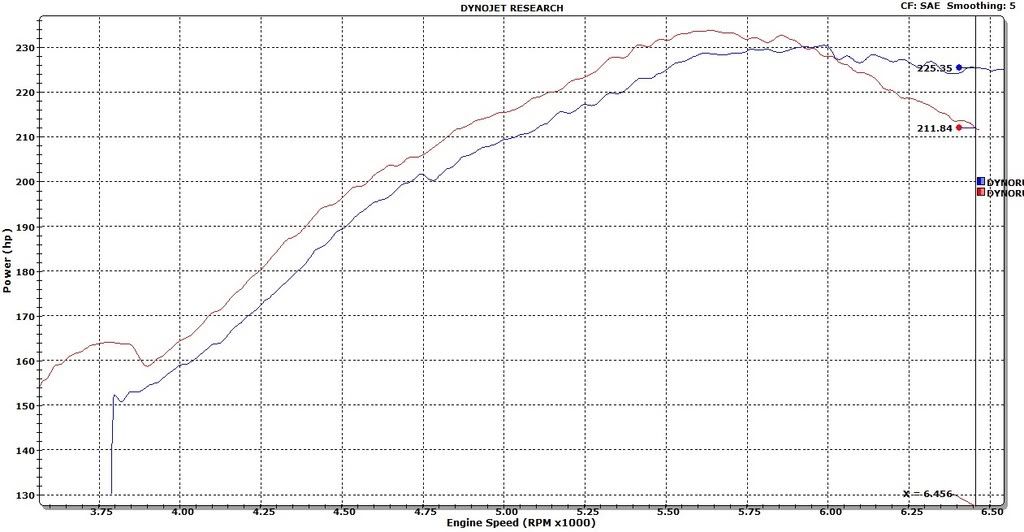
Only mod was the SSIM. It does lose power if you don't know how to rock it.
Here's SSIM vs stock (fully functioning VIAS) w/ stock rev limit.
Only mod was the SSIM. It does lose power if you don't know how to rock it.


If not, sell it, there are many on here with more ambitious plans, if you so do not choose to pursue what some of on here are.
Thread Starter
DO NOT DO BUSINESS WITH THIS MEMBER - OWES PEOPLE MONEY
iTrader: (7)
Joined: Jan 2008
Posts: 3,468
From: Greensboro, NC


I bought a Berk intake with it as well. My current plan is to go with a pop-charger for it. Am I on the right track?
Thread Starter
DO NOT DO BUSINESS WITH THIS MEMBER - OWES PEOPLE MONEY
iTrader: (7)
Joined: Jan 2008
Posts: 3,468
From: Greensboro, NC
Well my dynos help to evidence that one primary restriction of high RPM power is the intake manifold. Cams will help too, though.
Jay_pee99 made some solid gains going to 264/264 duration 10.8/10.8mm lift cams.
I'm going for something a little extreme like 282/272 11.5/11.0, but won't be sure on that for a few months yet.
Jay_pee99 made some solid gains going to 264/264 duration 10.8/10.8mm lift cams.
I'm going for something a little extreme like 282/272 11.5/11.0, but won't be sure on that for a few months yet.

Member
Joined: Apr 2005
Posts: 196
The most extreme cams I found were Brian Crower 272°/272°. sparks where are the 282's you are talking about at? The great thing about sharing a engine with a 350z is that there are plenty of internal engine goodies. I want that 4.1 stroker kit 
Thread Starter
DO NOT DO BUSINESS WITH THIS MEMBER - OWES PEOPLE MONEY
iTrader: (7)
Joined: Jan 2008
Posts: 3,468
From: Greensboro, NC
JWT also makes C9s and C10s (C8s are 272/272 and 12mm lift) that require major head and valve cover clearancing because the lift is so huge on them. You have to call JWT to order C9/C10s because they refuse to sell them without talking to you about your goals and try to convince you to pick smaller cams first.
I would love to go with a stroker kit, but that is giant baller money there. I'm estimating to spend <3000 dollars for an entire built bottom end 11.5:1 compression, all machine work, ported heads (done by me), cams, and my new high RPM intake manifold. Just the stroker cranks alone cost nearly my entire build budget!
Going with wiseco/eagle (Adam at Z1 said he could swap the Z gasket get for a maxima one NP) with this setup:
http://www.z1motorsports.com/350_g35...oducts_id=4265
Only need a few minor things on top of that, plus the cams, and the engine is done.

Thread Starter
DO NOT DO BUSINESS WITH THIS MEMBER - OWES PEOPLE MONEY
iTrader: (7)
Joined: Jan 2008
Posts: 3,468
From: Greensboro, NC
Thanks for the props! Yep that's exactly what my full custom UIM will be using is a RWD lower. Those ports are are very nearly round, and only need minor (1mmish) porting to be around 50MM completely round.
Last edited by sparks03max; Mar 18, 2011 at 06:14 PM.
I thought this was as good a place as any to post this.
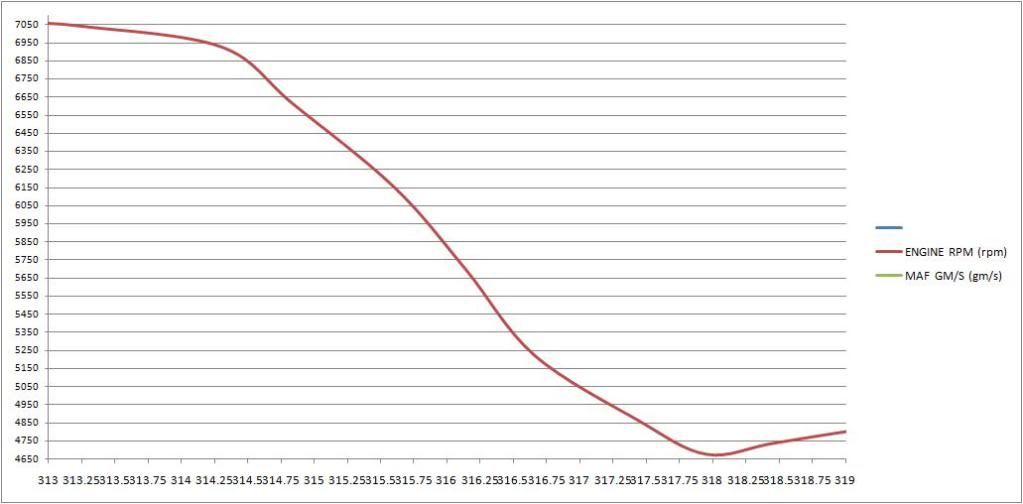
Here, you can see where the 4AT shifts at after the 1st gear shift. The RPM drop quantifies the shift from 7100 RPM. Of course, the RPM is a bit higher from the 2-3. And also, just for the hay of it, it also shows how long the actual shift takes w/ a II.5 VB mod. The X units are in hertz (0.1s).
Here, you can see where the 4AT shifts at after the 1st gear shift. The RPM drop quantifies the shift from 7100 RPM. Of course, the RPM is a bit higher from the 2-3. And also, just for the hay of it, it also shows how long the actual shift takes w/ a II.5 VB mod. The X units are in hertz (0.1s).
I thought this was as good a place as any to post this.
Here, you can see where the 4AT shifts at after the 1st gear shift. The RPM drop quantifies the shift from 7100 RPM. Of course, the RPM is a bit higher from the 2-3. And also, just for the hay of it, it also shows how long the actual shift takes w/ a II.5 VB mod. The X units are in hertz (0.1s).
Here, you can see where the 4AT shifts at after the 1st gear shift. The RPM drop quantifies the shift from 7100 RPM. Of course, the RPM is a bit higher from the 2-3. And also, just for the hay of it, it also shows how long the actual shift takes w/ a II.5 VB mod. The X units are in hertz (0.1s).
And yet another great reason to drive a 6-speed.
Member
Joined: Sep 2010
Posts: 165
From: Baltimore,MD
Alright sparks how much will it cost to have my IM all shinny and ****. Peformance wise of course.

