


Question for the guys with BBK's




well, the primay performance difference is......braking 
but yes, assuming the BBK weighs less than stock (my aluminum Z32 calipers are several lbs lighter than the stock calipers) it will improve handling and ride quality to some extent. Turning...only in terms of lateral weight. Acceleration...only in terms of pure weight unless you get lighter 2-pc rotors.
remember, 1lb of unsprung weight = 7lbs of sprung weight (or so).
So getting calipers that weigh 3lbs less than stock each is like taking 42lbs of sprung weight off the car....
but yes, assuming the BBK weighs less than stock (my aluminum Z32 calipers are several lbs lighter than the stock calipers) it will improve handling and ride quality to some extent. Turning...only in terms of lateral weight. Acceleration...only in terms of pure weight unless you get lighter 2-pc rotors.
remember, 1lb of unsprung weight = 7lbs of sprung weight (or so).
So getting calipers that weigh 3lbs less than stock each is like taking 42lbs of sprung weight off the car....

Originally Posted by irish44j
well, the primay performance difference is......braking
but yes, assuming the BBK weighs less than stock (my aluminum Z32 calipers are several lbs lighter than the stock calipers) it will improve handling and ride quality to some extent. Turning...only in terms of lateral weight. Acceleration...only in terms of pure weight unless you get lighter 2-pc rotors.
remember, 1lb of unsprung weight = 7lbs of sprung weight (or so).
So getting calipers that weigh 3lbs less than stock each is like taking 42lbs of sprung weight off the car....
but yes, assuming the BBK weighs less than stock (my aluminum Z32 calipers are several lbs lighter than the stock calipers) it will improve handling and ride quality to some extent. Turning...only in terms of lateral weight. Acceleration...only in terms of pure weight unless you get lighter 2-pc rotors.
remember, 1lb of unsprung weight = 7lbs of sprung weight (or so).
So getting calipers that weigh 3lbs less than stock each is like taking 42lbs of sprung weight off the car....
Originally Posted by JSutter
You have that wrong my man. Calipers dont spin with the wheels so they are just another part of the car. Rotors on the other hand are a different story. A heavier rotor *could* slow you down like a heavy wheel.
I meant to say "rotors" not "calipers" in terms of rotational mass ratio

My post should have read:
remember, 1lb of rotational weight reduction = 7lbs of sprung weight (or so).
So getting rotors (or wheels) that weigh 3lbs less than stock each is like taking 42lbs of sprung weight off the car....
So getting rotors (or wheels) that weigh 3lbs less than stock each is like taking 42lbs of sprung weight off the car....
In terms of calipers, I not talking rotational mass....i'm just talking pure weight of the car. 6 lbs lighter does affect acceleration, apart from the rotational mass of the wheel/rotor/hub assembly. Just like removing 6lbs anywhere else on the car...it has a tiny effect on acceleration, but nothing noticeable. Take 6 lbs off from several locations (i.e 6 + 6 + 6 + 6) and you're headed in the direction of weight reduction that DOES affect acceleration..
Unsprung weight reduction (including calipers and spindles) has a significant effect on handling, and you know that's all I care about

From one of many sites addressing handling:
The unsprung vs. sprung weight percentage greatly affects wheel control, but its importance is almost entirely limited to un-even surfaces, or conditions where the attitude of the vehicle changes (such as through G forces). This is most important in off-road and pavement road racing, somewhat less important in dirt track, and has almost no value in drag racing. As the importance of suspension travel for proper wheel control diminishes, the value of reducing the unsprung proportion of the total car weight is lessened, and becomes zero if the suspension travel is zero.
Cars requiring precise control of wheel movement, where a low percentage of unsprung weight is an advantage, will have faster lap times and higher top speeds, not because unsprung weight reduction improves acceleration or top speed, but because traction is improved.
The unsprung vs. sprung weight percentage also affects ride comfort, since lighter springs are needed to maintain traction and control with lighter unsprung components (alloy wheels, independent rear suspension, alloy calipers, composite springs, in-board brakes, etc.), the chassis is less disturbed by wheel movement and road surface irregularities.
Cars requiring precise control of wheel movement, where a low percentage of unsprung weight is an advantage, will have faster lap times and higher top speeds, not because unsprung weight reduction improves acceleration or top speed, but because traction is improved.
The unsprung vs. sprung weight percentage also affects ride comfort, since lighter springs are needed to maintain traction and control with lighter unsprung components (alloy wheels, independent rear suspension, alloy calipers, composite springs, in-board brakes, etc.), the chassis is less disturbed by wheel movement and road surface irregularities.
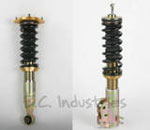
The lap times are a bit faster since you can brake later and more confidently with the extra torque from the larger pads and leverage of the BBK.
The braking is drasticallly reduced after repeated stops or stops from 85+ mph (compared to stock)
The braking is drasticallly reduced after repeated stops or stops from 85+ mph (compared to stock)

Thread
Thread Starter
Forum
Replies
Last Post
maxfever1987
4th Generation Classifieds (1995-1999)
6
Nov 19, 2016 08:01 PM
FlaMark
5th Generation Maxima (2000-2003)
25
Aug 28, 2015 10:15 AM
doobadoo
4th Generation Maxima (1995-1999)
2
Aug 15, 2015 06:43 PM