


96k mi on Fuel Filter observations

Guest
Posts: n/a
96k mi on Fuel Filter observations
There's been at least few threads on here where someone replaces a fuel filter and in the process catches some of the fuel spilled from the bottom of the filter. the fuel is dark & dirty, and this is used as evidence the filter needed changing, and the dirty fuel was plugging up the fuel injectors.
I found this curious, b/c the bottom of the filter is the *input* side, not the output. I wondered if anyone had observed the condition of the fuel coming out the output. That would seem like a better test of the filter's performance, and the potential risk of injector clogging.
so at 96k miles I finally decided to change my factory original fuel filter. I made a special effort to first collect fuel from the output side of the filter -- it was clean & fresh. typical light translucent amber color.
at this point I considered leaving the filter in place, but I wanted to know if I'd get the same dirty fuel spilling out the filter's input side like everyone else -- and sure enough, the fuel that came pouring out the bottom was indeed a dirty grey color.
so despite the dirt caught in the filter media, the filter was working well. and if you think about how a filter works, you'll see this makes perfect sense.
a filter is a porous media that has to allow some particulates to get through in order for the fuel to flow. the size of the pores determines the flow rate and filtration efficiency. bigger pores allow more flow, but filter less. as the filter gets dirty its pores become partially clogged, restricting the flow of both fuel and particulates. in other words, as a filter gets dirty it flows less but actually filters better (to a point).
I've seen this with air filters. When I first install a fresh air filter I get spikes of Silicon (airborne dirt) in my oil analyses -- the fresh filter has big open pores and lets more dirt get through. it lasts for about 10k-15k miles, and then settles down as the filter becomes dirty and more efficient.
Now consider this --- where does the dirt trapped in a fuel filter come from?... from the fuel tank and fuel lines, and ultimately from the pump. so when you put a fresh fuel filter in it stands to reason that it will let more of this dirt through than the one you just took out. so contrary to popular belief, changing the fuel filter will not necessarily save your injectors -- and it could actually make things worse for a short period of time, depending on what is in your tank.
of course there eventually is a point where flow is restricted too much and performance suffers (either insufficient air flow, or low fuel pressure). when this happens the filter must be changed. also, I think there must be a point where the pressure drop across the filter media becomes enough to just force the dirt through (unless the filter has a bypass valve, like oil filters do)
so the key question is - how long does a fuel filter last? when will it get so dirty that flow will be restricted??
well, in my experience, with the quality of gas pumps we have in the chicago area, a fuel filter will last longer than 96k miles. even though it will undoubtedly be dirty by that time, it will filter just fine, probably even better than a new one. no wonder Nissan doesn't list the fuel filter as a normal maintenance item.
I found this curious, b/c the bottom of the filter is the *input* side, not the output. I wondered if anyone had observed the condition of the fuel coming out the output. That would seem like a better test of the filter's performance, and the potential risk of injector clogging.
so at 96k miles I finally decided to change my factory original fuel filter. I made a special effort to first collect fuel from the output side of the filter -- it was clean & fresh. typical light translucent amber color.
at this point I considered leaving the filter in place, but I wanted to know if I'd get the same dirty fuel spilling out the filter's input side like everyone else -- and sure enough, the fuel that came pouring out the bottom was indeed a dirty grey color.
so despite the dirt caught in the filter media, the filter was working well. and if you think about how a filter works, you'll see this makes perfect sense.
a filter is a porous media that has to allow some particulates to get through in order for the fuel to flow. the size of the pores determines the flow rate and filtration efficiency. bigger pores allow more flow, but filter less. as the filter gets dirty its pores become partially clogged, restricting the flow of both fuel and particulates. in other words, as a filter gets dirty it flows less but actually filters better (to a point).
I've seen this with air filters. When I first install a fresh air filter I get spikes of Silicon (airborne dirt) in my oil analyses -- the fresh filter has big open pores and lets more dirt get through. it lasts for about 10k-15k miles, and then settles down as the filter becomes dirty and more efficient.
Now consider this --- where does the dirt trapped in a fuel filter come from?... from the fuel tank and fuel lines, and ultimately from the pump. so when you put a fresh fuel filter in it stands to reason that it will let more of this dirt through than the one you just took out. so contrary to popular belief, changing the fuel filter will not necessarily save your injectors -- and it could actually make things worse for a short period of time, depending on what is in your tank.
of course there eventually is a point where flow is restricted too much and performance suffers (either insufficient air flow, or low fuel pressure). when this happens the filter must be changed. also, I think there must be a point where the pressure drop across the filter media becomes enough to just force the dirt through (unless the filter has a bypass valve, like oil filters do)
so the key question is - how long does a fuel filter last? when will it get so dirty that flow will be restricted??
well, in my experience, with the quality of gas pumps we have in the chicago area, a fuel filter will last longer than 96k miles. even though it will undoubtedly be dirty by that time, it will filter just fine, probably even better than a new one. no wonder Nissan doesn't list the fuel filter as a normal maintenance item.

Supporting Maxima.org Member

Joined: Nov 2005
Posts: 305
From: New York
Thats a valid point. Personally, I would still prefer a new filter rather than run the risk of having some of the median disintegrate and get sucked into the fuel rail... new filter + a bottle of Chevron Techron FTW 

Senior Member
Joined: Nov 2006
Posts: 2,389
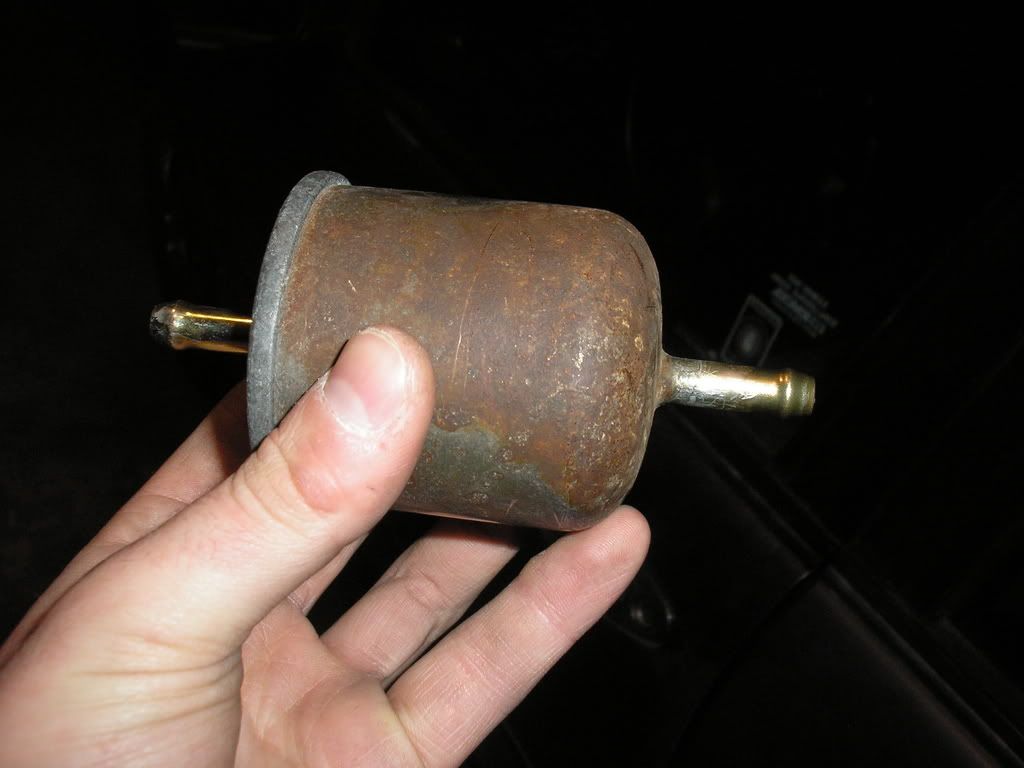
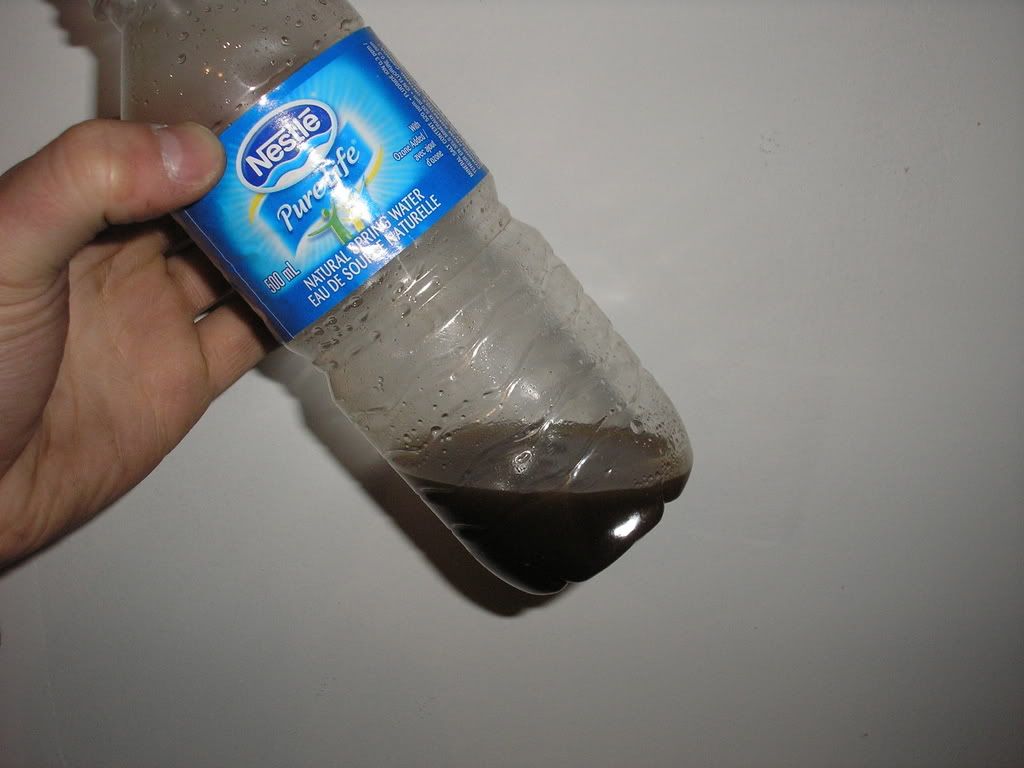
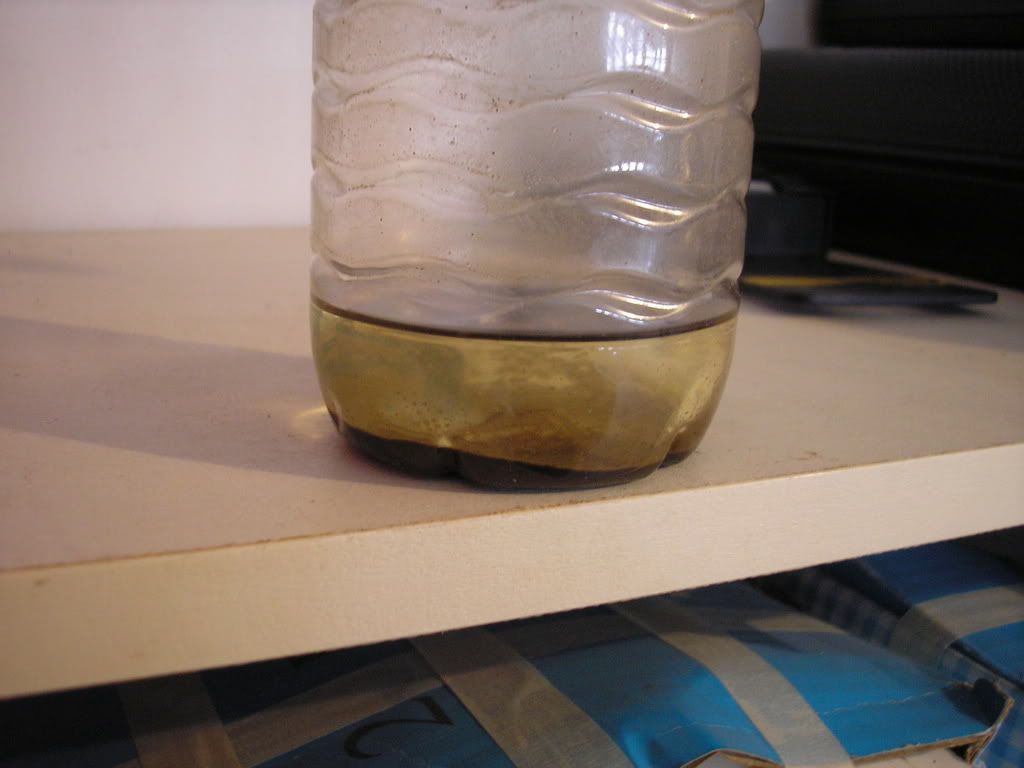
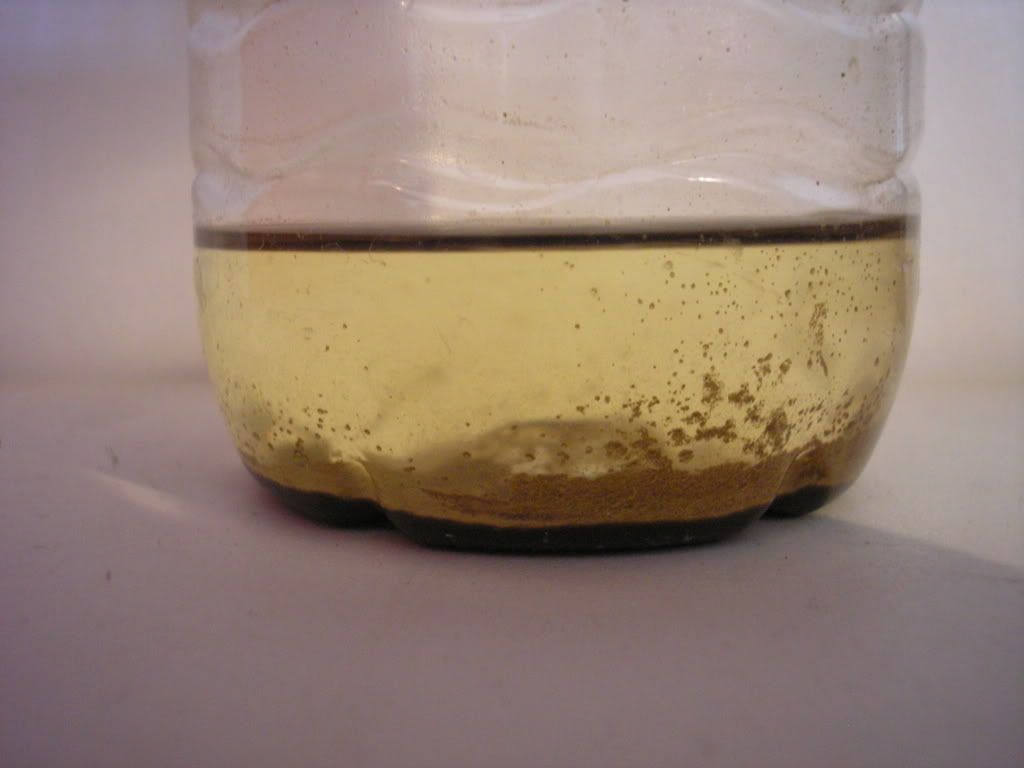
Thats a very valid point. I do not know the histiory of my car and cannot prove that my fuel filter was original, but the outside of the filter looked very rusted and old so i am assuming that it was original. I changed my filter just about one month ago at around 210.000 KM (130.000K Miles approx.) and the fuel that spilled onto my hands from the output of the filter seemed clean, where as you will see in the following pictures that input side of the filter contained very dirty fuel.
I think its safe to say that the fuel filter in 4th gen maximas should only be changed once every 100K miles and not any more often. I have yet to cut my filter open but i will do it this weekend to inspect the filtering media and will post pictures of course on this site.
I do not yet know what material the filtering media consists of, but my theory is that the filtering media breaks down over time due to the temperature extremes. I also wonder where this "dirt" on the input side of the filter comes from. Obviously from the station pump, but as well as the tank which i think rusts from the inside due to condensation in the winter. I do wonder if this "dirty" fuel affects the fuel pump itself since its located before the filter in the fuel system chain.
PS: Curious did you happen to put in the 300z filer or the oem max filter ? and what do u think about the use and properties of the 300z filter ?
here are some shot of the gasoline pulled out of my fuel filter:
The filter:
The "dirty" mix from the input of the filter:
The dirty solution after letting it set overnight:
I think its safe to say that the fuel filter in 4th gen maximas should only be changed once every 100K miles and not any more often. I have yet to cut my filter open but i will do it this weekend to inspect the filtering media and will post pictures of course on this site.
I do not yet know what material the filtering media consists of, but my theory is that the filtering media breaks down over time due to the temperature extremes. I also wonder where this "dirt" on the input side of the filter comes from. Obviously from the station pump, but as well as the tank which i think rusts from the inside due to condensation in the winter. I do wonder if this "dirty" fuel affects the fuel pump itself since its located before the filter in the fuel system chain.
PS: Curious did you happen to put in the 300z filer or the oem max filter ? and what do u think about the use and properties of the 300z filter ?
here are some shot of the gasoline pulled out of my fuel filter:
The filter:
The "dirty" mix from the input of the filter:
The dirty solution after letting it set overnight:

Senior Member
Joined: Oct 2003
Posts: 1,136
From: Pleasanton,CA
I changed my filter on a 2K maxima at around 100K too and it was dirty as hell$. You guys are lucky, take off both the clamps and stick a new one in... On the 5th and on maximas the damn$ filter is housed inside the tank and it is very elaborate to get it out and replace the filter..


Originally Posted by sky jumper
There's been at least few threads on here where someone replaces a fuel filter and in the process catches some of the fuel spilled from the bottom of the filter. the fuel is dark & dirty, and this is used as evidence the filter needed changing, and the dirty fuel was plugging up the fuel injectors.
I found this curious, b/c the bottom of the filter is the *input* side, not the output. I wondered if anyone had observed the condition of the fuel coming out the output. That would seem like a better test of the filter's performance, and the potential risk of injector clogging.
so at 96k miles I finally decided to change my factory original fuel filter. I made a special effort to first collect fuel from the output side of the filter -- it was clean & fresh. typical light translucent amber color.
at this point I considered leaving the filter in place, but I wanted to know if I'd get the same dirty fuel spilling out the filter's input side like everyone else -- and sure enough, the fuel that came pouring out the bottom was indeed a dirty grey color.
so despite the dirt caught in the filter media, the filter was working well. and if you think about how a filter works, you'll see this makes perfect sense.
a filter is a porous media that has to allow some particulates to get through in order for the fuel to flow. the size of the pores determines the flow rate and filtration efficiency. bigger pores allow more flow, but filter less. as the filter gets dirty its pores become partially clogged, restricting the flow of both fuel and particulates. in other words, as a filter gets dirty it flows less but actually filters better (to a point).
I've seen this with air filters. When I first install a fresh air filter I get spikes of Silicon (airborne dirt) in my oil analyses -- the fresh filter has big open pores and lets more dirt get through. it lasts for about 10k-15k miles, and then settles down as the filter becomes dirty and more efficient.
Now consider this --- where does the dirt trapped in a fuel filter come from?... from the fuel tank and fuel lines, and ultimately from the pump. so when you put a fresh fuel filter in it stands to reason that it will let more of this dirt through than the one you just took out. so contrary to popular belief, changing the fuel filter will not necessarily save your injectors -- and it could actually make things worse for a short period of time, depending on what is in your tank.
of course there eventually is a point where flow is restricted too much and performance suffers (either insufficient air flow, or low fuel pressure). when this happens the filter must be changed. also, I think there must be a point where the pressure drop across the filter media becomes enough to just force the dirt through (unless the filter has a bypass valve, like oil filters do)
so the key question is - how long does a fuel filter last? when will it get so dirty that flow will be restricted??
well, in my experience, with the quality of gas pumps we have in the chicago area, a fuel filter will last longer than 96k miles. even though it will undoubtedly be dirty by that time, it will filter just fine, probably even better than a new one. no wonder Nissan doesn't list the fuel filter as a normal maintenance item.
I found this curious, b/c the bottom of the filter is the *input* side, not the output. I wondered if anyone had observed the condition of the fuel coming out the output. That would seem like a better test of the filter's performance, and the potential risk of injector clogging.
so at 96k miles I finally decided to change my factory original fuel filter. I made a special effort to first collect fuel from the output side of the filter -- it was clean & fresh. typical light translucent amber color.
at this point I considered leaving the filter in place, but I wanted to know if I'd get the same dirty fuel spilling out the filter's input side like everyone else -- and sure enough, the fuel that came pouring out the bottom was indeed a dirty grey color.
so despite the dirt caught in the filter media, the filter was working well. and if you think about how a filter works, you'll see this makes perfect sense.
a filter is a porous media that has to allow some particulates to get through in order for the fuel to flow. the size of the pores determines the flow rate and filtration efficiency. bigger pores allow more flow, but filter less. as the filter gets dirty its pores become partially clogged, restricting the flow of both fuel and particulates. in other words, as a filter gets dirty it flows less but actually filters better (to a point).
I've seen this with air filters. When I first install a fresh air filter I get spikes of Silicon (airborne dirt) in my oil analyses -- the fresh filter has big open pores and lets more dirt get through. it lasts for about 10k-15k miles, and then settles down as the filter becomes dirty and more efficient.
Now consider this --- where does the dirt trapped in a fuel filter come from?... from the fuel tank and fuel lines, and ultimately from the pump. so when you put a fresh fuel filter in it stands to reason that it will let more of this dirt through than the one you just took out. so contrary to popular belief, changing the fuel filter will not necessarily save your injectors -- and it could actually make things worse for a short period of time, depending on what is in your tank.
of course there eventually is a point where flow is restricted too much and performance suffers (either insufficient air flow, or low fuel pressure). when this happens the filter must be changed. also, I think there must be a point where the pressure drop across the filter media becomes enough to just force the dirt through (unless the filter has a bypass valve, like oil filters do)
so the key question is - how long does a fuel filter last? when will it get so dirty that flow will be restricted??
well, in my experience, with the quality of gas pumps we have in the chicago area, a fuel filter will last longer than 96k miles. even though it will undoubtedly be dirty by that time, it will filter just fine, probably even better than a new one. no wonder Nissan doesn't list the fuel filter as a normal maintenance item.
Guest
Posts: n/a
Originally Posted by nlmaxima
Once you remove your fuel filter ... See if any dirt comes out and how much pressure is needed to blow through.
Say a filter media blocks particles the size of 5 microns when new then that is what is needed so how would there be an advantage of having it a bit dirty(restricted)?
How do you know the measurement of how dirty it is? If it is too dirty(restricted) then your fuel pump will have to work harder to push the fuel through the dirty(restricted) filter. With a fuel pump being able to produce 70-80 psi(the regulator is after the dirty filter(restriction) and will regulate the pressure at that point and not before the filter) of pressure it can rupture the filter media.
Do you think not changing a filter regularly is a good idea?
and like I said, my oil analyses indicate that changing the air filter too often does in fact let more dirt in. *if* the same holds true for fuel filters, then yes, it could in fact be better to leave it in longer (like Nissan says to) - because it will filter better, regardless of the design parameters. but I think we're splitting hairs at this point.
Originally Posted by sky jumper
if any excess dirt were getting through, it would be apparent in the fuel exiting the filter -- the observed exit fuel was subjected to pump pressure, so forcing more air through would not prove anything I don't think.
yes, fluid analysis would be a better test than visual appearance. but when the output fuel is clear, and the input fuel is dirty I think it's safe to say the filter is working fine.
well, that's a good point, and well thought-out (unlike some other opinions on here). There may be no real benefit to having a dirty filter, unless the manufacturer intentionally designs them to have larger than ideal pores when new, so they don't plug up as quickly (and can therefore "last" longer). I have no idea if that's the case or not - but it does seem to be the case with air filters. and most cars nowadays do not have a defined fuel filter change interval. hmm.
in my experience with other cars, fuel pressure will dip too low and cause the engine to quit before the media ruptures.
I've seen at least a dozen completely plugged fuel filters in my day, and none of them ruptured (of course, none of them were maximas either). Also, if there were a big risk of this, I'd think Nissan would specify a change interval, but they don't...
well, I certainly don't think it's necessary every 30k miles. I think a lot of people have the wrong impression about it, and post pictures of dirty gas proclaiming "bad fuel filter" when in fact it is doing its job just fine. my objective is to get clarity on the issue.
and like I said, my oil analyses indicate that changing the air filter too often does in fact let more dirt in.
*if* the same holds true for fuel filters, then yes, it could in fact be better to leave it in longer (like Nissan says to) - because it will filter better, regardless of the design parameters. but I think we're splitting hairs at this point.
Standing fuel will stand still and dirt can settle/stick to the filter material. It would be subjected to the same pressure that the fuel pump subjects it to. I have changed fuel filters in cars that when blowing through the inlet dirt would come out the outlet which suggest that a filter can rupture. I believe I have noticed this a few times in a GM vehicles.
well, that's a good point, and well thought-out (unlike some other opinions on here). There may be no real benefit to having a dirty filter, unless the manufacturer intentionally designs them to have larger than ideal pores when new, so they don't plug up as quickly (and can therefore "last" longer). I have no idea if that's the case or not - but it does seem to be the case with air filters. and most cars nowadays do not have a defined fuel filter change interval. hmm.
Most cars today has a huge filter in the tank, I don't like the idea of the filter in the tank.
The fuel pump will work as hard as possible to get the pressure to spec so if you could check the pressure before the filter you could be shocked at how high the pressure can get.
well, I certainly don't think it's necessary every 30k miles. I think a lot of people have the wrong impression about it, and post pictures of dirty gas proclaiming "bad fuel filter" when in fact it is doing its job just fine. my objective is to get clarity on the issue.
In your post you said the filter should last more than 98k, that I don't agree with, I do agree that 30K is a little over kill for about 98% of people but there are people who live in the snow belt and drive around most of the winter with less than half a tank of gas and gathering condensation in the tank which causes rust
I agree with the air filter and I was wondering if you used an OEM Nissan filter or aftermarket
Guest
Posts: n/a
so I cut open the filter today to inspect the media. it was intact, strong, & in no risk of disintegration. the input side was dirty, the output was clean, and there was no settled dirt in the output cavity or tube.
here are some pics of what I found.
Again -- this is the original filter w/ 96k. the output fuel was clean & clear, and fuel pressure was fine.
Complete dissection....

close-up of the dirty side...

Close up of the clean side -- the difference should be obvious...

Incase the difference is not obvious, I swabbed both the input and output side of the filter media with a clean paper towel. this should end the debate on whether or not dirt gets through these filters...
I did not feel the need to label the input swab -- but you can barely see the output...

here are some pics of what I found.
Again -- this is the original filter w/ 96k. the output fuel was clean & clear, and fuel pressure was fine.
Complete dissection....
close-up of the dirty side...
Close up of the clean side -- the difference should be obvious...
Incase the difference is not obvious, I swabbed both the input and output side of the filter media with a clean paper towel. this should end the debate on whether or not dirt gets through these filters...
I did not feel the need to label the input swab -- but you can barely see the output...
Guest
Posts: n/a
Originally Posted by andrei3333
how often do u suggest to change the fuel filter ?
which filter do u suggest to use oem max / 300z ?
which filter do u suggest to use oem max / 300z ?
but if the sight of the dirty input side of the filter makes your skin crawl, by all mean change it every 30k, 50k, or whatever mileage makes you rest easy.
I have no experience/opinion on the 300z filter. I expect it would would just fine.

Newbie - Just Registered
Joined: Jun 2008
Posts: 6
From: Chicago Western suburbs
97 SE fuel filter
I will be doing this with my mechanic for the 1st time at 103K. It still looks like the original filter. Dealer recommends it and it doesn't look very difficult to replace for a $13 oem filter.
Guest
Posts: n/a
2 CENTS
i recently had an injector die and figured i would pull fuel filter seeing i had never changed it and replace it b4 the injector job. needless too say @ 158,000 miles i doubt this filter had ever been changed lol i will def not make that mistake again.
PS you can get a filter @ wal-mart only product id recommend 4 purchase there lol
PS you can get a filter @ wal-mart only product id recommend 4 purchase there lol



the dirt is obviously from the input side - that's where it gets stopped by the filter. dirty fuel won't be coming from the output side because its been filtered to go into your engine.
100k on a fule filter? g/l with that dude. its called cheap maintenance. for ten bucks every 30-50k you are insuring no problems with your fuel system.
do you change your oil every 10-20k? probably not. i think bmw recommends oil changes @ 15k intervals. thats way too high imho. every 3-5k and your almost guaranteed to not have issues.
100k on a fule filter? g/l with that dude. its called cheap maintenance. for ten bucks every 30-50k you are insuring no problems with your fuel system.
do you change your oil every 10-20k? probably not. i think bmw recommends oil changes @ 15k intervals. thats way too high imho. every 3-5k and your almost guaranteed to not have issues.
Newbie - Just Registered
Joined: Jun 2008
Posts: 6
From: Chicago Western suburbs
Fuel filter
I just bought the car from a private owner who maintanined it well for the most part so I'm just doing some stuff he may have not done. Fuel filter was only $14 from Nissan and NGK plugs $10 a piece with dealer discount.

Thread
Thread Starter
Forum
Replies
Last Post
jmlee44
4th Generation Maxima (1995-1999)
8
Oct 2, 2022 02:13 PM
My Coffee
New Member Introductions
15
Jun 6, 2017 02:01 PM
Forge277
1st & 2nd Generation Maxima (1981-1984 and 1985-1988)
12
Jun 13, 2016 09:26 PM