


Car went under the knife this weekend - new intake path



Car went under the knife this weekend - new intake path
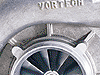
The Stillen SC kit is pretty good, in my opinion, but I never have liked the way the intake is routed right over the exhaust manifold and over the radiator, where it can pick up a lot of heat. I have seen steady state temperatures of up to 150 F in the air going into the throttle body, and boosted temperatures as high as 185 F.
This weekend I spent some time addressing the problem.


This weekend I spent some time addressing the problem.



Since I already had a left over prcai, I just reinstalled it and connected the driver's side piping to it.
Results?
Yesterday afternoon I drove around in the 95 degree weather and didn't see temperatures above 125 F, and that was sitting at a stop light where incoming air is minimal and has time to be heated up by the blower. Once I got rolling again the temperature would drop quickly to about 110 F. The drop in temperature was significantly faster than what I used to see before.
I did a boosted run to 7000 rpm, which I datalogged. The log showed a maf voltage of 4.39V, the highest I have ever recorded, at 12 psi of boost. The intake air temp got up to 160 F, a good 25 degrees lower than it would have boosting on a hot day.
Am I happy? Yes, but not completely. The wonderful howl that the stock piping gives at about 2500-3000 rpm is gone. I loved that howl because it sounded just like an F4 Phantom jet at low turbine speed. If you have lived near an air base that had Phantoms, you'll know what I mean.
Not only that, but I get a fairly loud chuffing noise in place of the howl. The chuffing noise is due to air oscillating back and forth in the piping. The longer piping distance allows for greater dynamic oscillations in the air flow. At low throttle, such as cruising at 2500 rpm, the blower is trying to pump much more air than the engine is taking in. There must be an acoustical resonance that produces the oscillations, and it results in air alternately being forced into the intake piping and then forced back out again, resulting in the chuffing noise. It was very apparent what was happening when I had the filter off the blower and could feel the oscillatory back flow from the blower inlet. I'm not sure how to rectify this. Maybe a larger blow off valve will dampen the oscillations. An intercooler may also dampen the flow sufficiently.
Results?
Yesterday afternoon I drove around in the 95 degree weather and didn't see temperatures above 125 F, and that was sitting at a stop light where incoming air is minimal and has time to be heated up by the blower. Once I got rolling again the temperature would drop quickly to about 110 F. The drop in temperature was significantly faster than what I used to see before.
I did a boosted run to 7000 rpm, which I datalogged. The log showed a maf voltage of 4.39V, the highest I have ever recorded, at 12 psi of boost. The intake air temp got up to 160 F, a good 25 degrees lower than it would have boosting on a hot day.
Am I happy? Yes, but not completely. The wonderful howl that the stock piping gives at about 2500-3000 rpm is gone. I loved that howl because it sounded just like an F4 Phantom jet at low turbine speed. If you have lived near an air base that had Phantoms, you'll know what I mean.
Not only that, but I get a fairly loud chuffing noise in place of the howl. The chuffing noise is due to air oscillating back and forth in the piping. The longer piping distance allows for greater dynamic oscillations in the air flow. At low throttle, such as cruising at 2500 rpm, the blower is trying to pump much more air than the engine is taking in. There must be an acoustical resonance that produces the oscillations, and it results in air alternately being forced into the intake piping and then forced back out again, resulting in the chuffing noise. It was very apparent what was happening when I had the filter off the blower and could feel the oscillatory back flow from the blower inlet. I'm not sure how to rectify this. Maybe a larger blow off valve will dampen the oscillations. An intercooler may also dampen the flow sufficiently.
Originally Posted by Bags
haha.. That looks pretty slick. Have you noticed any loss in PSI, since the pipe is longer?
VERY cool, IMO.
Thanks for sharing.
VERY cool, IMO.
Thanks for sharing.


Originally Posted by matty
Where did you relocate your blow off to ??
-matt
-matt

Originally Posted by hlh0501
Nice thinking.
What do you use to monitor intake temp? I'd like to put one before/after my IC
What do you use to monitor intake temp? I'd like to put one before/after my IC
Originally Posted by maxlinegtr
damnit Stephen....u just have to out do us all huh? prop to ya...are u gonna put an intercooler in between there too?
I'm not in any hurry to mount an intercooler, but if I find a good one for cheap I'll do it sooner rather than later. I'd like to see how much lower than 160 F I can get the intake air without a serious boost loss.
Originally Posted by Stephen Max
Boost loss was maybe on the order of tenths of a psi. I still hit 12 psi at 7000 rpm. I think I have recorded a maximum of 12.2 psi previously, but that was on a colder day, too.
I saw the post under mine, that's awesome

and is it just the noise? or does the car buck at all?
Is the noise that bad?
Originally Posted by Bags
I saw the post under mine, that's awesome
and is it just the noise? or does the car buck at all?
Is the noise that bad?
and is it just the noise? or does the car buck at all?
Is the noise that bad?
The noise is annoying and somewhat embarrassing. It isn't that loud, but it sounds like something weird is wrong with the car. At higher rpm it sounds kind of like a breathy rattlesnake.
My exhaust is really quiet, though, maybe it's time to get a 3" exhaust to mask it.

What you're describing is compressor surge. I didn't realize a SC could have this, but I don't see why not.
Basically, the back pressure after the compressor is exceeding the compressors' flow at that point, which causes the air to flow backwards into the compressor causing the wheels' blades to loose "grip" and slip on the air. This causes turbulance and the compressor flow to decrease. The decrease drops discharge pressure allowing the compressor to push air again until it reaches the "surge point" again.
I would think with your PF TB and matched IM is not contributing to the problem(usual suspect), however the increased backpressure from the addtional piping/bends is.
You might want to follow Corky Bells' advice(I know you have his book) and rig up a few pressure gauges to see what's the restriction that needs to be improved.
Basically, the back pressure after the compressor is exceeding the compressors' flow at that point, which causes the air to flow backwards into the compressor causing the wheels' blades to loose "grip" and slip on the air. This causes turbulance and the compressor flow to decrease. The decrease drops discharge pressure allowing the compressor to push air again until it reaches the "surge point" again.
I would think with your PF TB and matched IM is not contributing to the problem(usual suspect), however the increased backpressure from the addtional piping/bends is.
You might want to follow Corky Bells' advice(I know you have his book) and rig up a few pressure gauges to see what's the restriction that needs to be improved.
Originally Posted by Stephen Max
Not only that, but I get a fairly loud chuffing noise in place of the howl. The chuffing noise is due to air oscillating back and forth in the piping. The longer piping distance allows for greater dynamic oscillations in the air flow. At low throttle, such as cruising at 2500 rpm, the blower is trying to pump much more air than the engine is taking in. There must be an acoustical resonance that produces the oscillations, and it results in air alternately being forced into the intake piping and then forced back out again, resulting in the chuffing noise. It was very apparent what was happening when I had the filter off the blower and could feel the oscillatory back flow from the blower inlet. I'm not sure how to rectify this. Maybe a larger blow off valve will dampen the oscillations. An intercooler may also dampen the flow sufficiently.
Originally Posted by IceY2K1
What you're describing is compressor surge. I didn't realize a SC could have this, but I don't see why not.
Basically, the back pressure after the compressor is exceeding the compressors' flow at that point, which causes the air to flow backwards into the compressor causing the wheels' blades to loose "grip" and slip on the air. This causes turbulance and the compressor flow to decrease. The decrease drops discharge pressure allowing the compressor to push air again until it reaches the "surge point" again.
I would think with your PF TB and matched IM is not contributing to the problem(usual suspect), however the increased backpressure from the addtional piping/bends is.
You might want to follow Corky Bells' advice(I know you have his book) and rig up a few pressure gauges to see what's the restriction that needs to be improved.
Basically, the back pressure after the compressor is exceeding the compressors' flow at that point, which causes the air to flow backwards into the compressor causing the wheels' blades to loose "grip" and slip on the air. This causes turbulance and the compressor flow to decrease. The decrease drops discharge pressure allowing the compressor to push air again until it reaches the "surge point" again.
I would think with your PF TB and matched IM is not contributing to the problem(usual suspect), however the increased backpressure from the addtional piping/bends is.
You might want to follow Corky Bells' advice(I know you have his book) and rig up a few pressure gauges to see what's the restriction that needs to be improved.
That will most likely solve it.
If you wouldn't be considering a FMIC or incase the BOV doesn't work, I'd have chose another route to your original dilema...lowering intake temps. First, I would have sent the discharge pipe to SwainTech and had them ceramic coat the inside and outside of the pipe. Then I'd have used some kind of heat shield like Thermo Tec to wrap the pipe and header.
I *THINK* you could have achieved that 20-degree or so drop in temps without the added piping restriction and lag. IMO, although it may only be noticeable on a dyno, you've added lag to the system by increasing the internal volume of the intake tract that must be pressurized before boost can enter the IM. I have no idea how much, but shorter piping has to be better.
If you wouldn't be considering a FMIC or incase the BOV doesn't work, I'd have chose another route to your original dilema...lowering intake temps. First, I would have sent the discharge pipe to SwainTech and had them ceramic coat the inside and outside of the pipe. Then I'd have used some kind of heat shield like Thermo Tec to wrap the pipe and header.
I *THINK* you could have achieved that 20-degree or so drop in temps without the added piping restriction and lag. IMO, although it may only be noticeable on a dyno, you've added lag to the system by increasing the internal volume of the intake tract that must be pressurized before boost can enter the IM. I have no idea how much, but shorter piping has to be better.
Originally Posted by IceY2K1
That will most likely solve it.
If you wouldn't be considering a FMIC or incase the BOV doesn't work, I'd have chose another route to your original dilema...lowering intake temps. First, I would have sent the discharge pipe to SwainTech and had them ceramic coat the inside and outside of the pipe. Then I'd have used some kind of heat shield like Thermo Tec to wrap the pipe and header.
I *THINK* you could have achieved that 20-degree or so drop in temps without the added piping restriction and lag. IMO, although it may only be noticeable on a dyno, you've added lag to the system by increasing the internal volume of the intake tract that must be pressurized before boost can enter the IM. I have no idea how much, but shorter piping has to be better.
If you wouldn't be considering a FMIC or incase the BOV doesn't work, I'd have chose another route to your original dilema...lowering intake temps. First, I would have sent the discharge pipe to SwainTech and had them ceramic coat the inside and outside of the pipe. Then I'd have used some kind of heat shield like Thermo Tec to wrap the pipe and header.
I *THINK* you could have achieved that 20-degree or so drop in temps without the added piping restriction and lag. IMO, although it may only be noticeable on a dyno, you've added lag to the system by increasing the internal volume of the intake tract that must be pressurized before boost can enter the IM. I have no idea how much, but shorter piping has to be better.
I backed off on the bov preload spring last night, which helped a lot in reducing the chuffing noise. Now it only does it when decelerating with the throttle closed.
I guess I am doing this because I am sneaking up to a turbo. The immediate goal was to lower intake temps (and I'm very pleased at how well this has worked), but after all is said and done, subconsciously I'm wanting that fmic and turbo.
Good...I'd love to see what you could do with a turbo, since you've eeked out pretty much everything that SC can give.
What effect does backing off the BOV preload spring have under boost? None?
What effect does backing off the BOV preload spring have under boost? None?

edit: Not sure what I was really thinking in the original post but it seems as though if you go too tight there might not be enough vacuum to open the valve. I e-mailed TurboXS to see if they agree but I'm almost positive that would be the case. You would definitely have a bad idle and lose some boost if the spring is too loose though. The boost would overpower the spring's tension and allow it to open a little.
I know maxioverdose and others that wanted faster boost from a smaller pulley withOUT too much peak boost would loosen the BOV to bleed off boost.
I'm just not sure whether the preload spring is what they are "loosening" vs. Stephen Max.
I'm just not sure whether the preload spring is what they are "loosening" vs. Stephen Max.
I'm not sure what bov he's using nor what style but in my TurboXS RFL there is only one spring that can be adjusted. I would think most of the others would be similar (except for maybe the HKS SSQV) but I could be wrong.
Letting it bleed boost should allow it to spool faster but it would probably decrease maximum boost and probably make it idle weird or run a bit rich since metered air is being released.
Letting it bleed boost should allow it to spool faster but it would probably decrease maximum boost and probably make it idle weird or run a bit rich since metered air is being released.
Originally Posted by IceY2K1
I know maxioverdose and others that wanted faster boost from a smaller pulley withOUT too much peak boost would loosen the BOV to bleed off boost.
I'm just not sure whether the preload spring is what they are "loosening" vs. Stephen Max.
I'm just not sure whether the preload spring is what they are "loosening" vs. Stephen Max.
At WOT, the vacuum line delivers boost pressure to the back side of the plunger to help keep the bov closed (along with the spring force) when boosting. If you have zero boost loss between the charge pipe where the bov is situated and the intake manifold, then the pressure on both sides of the plunger is equalized and the spring keeps the bov shut. In actuality there is always at least a little bit of difference between the pressure in the charge pipe and the pressure in the intake manifold, so there can be enough of a pressure differential acting on the plunger to work against the spring and eventually open it, resulting in boost loss. This also depends on how stiff the spring is.
To answer your original question, I don't know if I loosened it to the point where I will leak boost. I suspect so. My Vortech Mondo bov will rectify that situation and still allow sufficient release of air at partial throttle driving. I think. If not, then I'm going to see if a fmic will provide sufficient baffling to suppress air oscillation under surge conditions.
Auuugh...that makes sense.
Maxidose was bleeding off peak pressure through the BOV at higher RPM by increasing the difference in pressure to the spring causing the spring to be overpowered and open. Gotcha...thanks.
Maxidose was bleeding off peak pressure through the BOV at higher RPM by increasing the difference in pressure to the spring causing the spring to be overpowered and open. Gotcha...thanks.

Senior Member
Joined: Nov 2002
Posts: 576
From: indiana
Not Sold
Originally Posted by IceY2K1
Good...I'd love to see what you could do with a turbo, since you've eeked out pretty much everything that SC can give.
What effect does backing off the BOV preload spring have under boost? None?
What effect does backing off the BOV preload spring have under boost? None?
I don't think he has! Call Me crazy but the 3psi I lost with the intercooler was significant But my intake temp (good guess) is close to ambient if not at it and with 6-7 psi boost although I do notice some lag as compared with the 3.33 before the fmic was installed. So my next step I think is to upgrade to better trim blower- the T Trim and possibly the v-1 gearing also. Of course after I can get some type of good feeling (from you guys) on ecu tuning options <please pm your thoughts on ecu tuning and what is best I am planning 500 or greater cc injectors as 370cc is too small>.


Senior Member
Joined: Apr 2004
Posts: 747
Some intresting reading!!!!
http://www.autospeed.com/cms/article.html?&A=0629
http://www.autospeed.com/cms/article.html?&A=0629


I know that the hks makes terrible surge for the blower. I have the blitz now and have it tightend down to where it releases at 3k and gives a faint hum when shifting at cruising speeds. Shifting from 1st to 2nd at wot creates a healthy shutter sound. I messed with the bov constantly untill I felt it was perfect. I feel its just right and has smooth drivability. Too tight seems to create a bogging feel . 
Originally Posted by IceY2K1
Yeah, that you can figure out how to squeeze out more power.
Just hoping...
Just hoping...
I think you know what I mean...I'm not interested in max power....just efficiency and safety.
You've MAXimized the airflow by minimizing the restriction and pushed the SC to the relatively safe max IMO.
I'm sure there is a little more, but I think you've done about everything reasonable except headers/catback exhaust. Cams/nitrous is a different level of complexity.
You've MAXimized the airflow by minimizing the restriction and pushed the SC to the relatively safe max IMO.
I'm sure there is a little more, but I think you've done about everything reasonable except headers/catback exhaust. Cams/nitrous is a different level of complexity.
Originally Posted by Stephen Max
Well, I know I can get good gains by improving my exhaust. And there is always nitrous.

Thread
Thread Starter
Forum
Replies
Last Post
Lakersallday24
6th Generation Maxima (2004-2008)
10
Jun 16, 2019 01:35 AM
MAXSE5SPD
Other For Sale/Wanted
2
Aug 23, 2015 12:06 PM
MaximaDrvr
7th Generation Maxima (2009-2015)
16
Aug 19, 2015 08:20 PM
Maxboy23
5th Generation Maxima (2000-2003)
7
Aug 11, 2015 11:59 AM