


270 mA current leak through alternator B terminal


Thread Starter
Junior Member
Joined: May 2003
Posts: 74
From: East Greenwich, Rhode Island
270 mA current leak through alternator B terminal
Working with the local dealer to cure a nasty parasitic battery drain problem.
I say that the re-manufactured Nissan alternator they just installed less than 8 miles ago is causing the same kind of leak that two previous replacements were causing. With the ALT.S wire connected to the alternator's S Terminal, there will be a 270 mA leak through the B terminal (the main charge wire); and if the ALT.S wire is disconnected from the alternator, the leak through the B Terminal drops to 0.13 amps.
You can read the analysis in the attached PDF file. Let me know if my logic is screwed up. If you have had similar experiences, I would like to know.
I say that the re-manufactured Nissan alternator they just installed less than 8 miles ago is causing the same kind of leak that two previous replacements were causing. With the ALT.S wire connected to the alternator's S Terminal, there will be a 270 mA leak through the B terminal (the main charge wire); and if the ALT.S wire is disconnected from the alternator, the leak through the B Terminal drops to 0.13 amps.
You can read the analysis in the attached PDF file. Let me know if my logic is screwed up. If you have had similar experiences, I would like to know.

Have you checked the 120a fusible link for terminal s?
Also, voltage output through terminal b is controlled by the ic regulator on terminal s. Are there any lights on your dash; i.e. charge light?
Also, voltage output through terminal b is controlled by the ic regulator on terminal s. Are there any lights on your dash; i.e. charge light?
Thread Starter
Junior Member
Joined: May 2003
Posts: 74
From: East Greenwich, Rhode Island
This is a voltage leak that occurs even when the car is off and the key is out of the ignition. No warning lights come on in that situation. Terminal L (not Terminal S) holds the ground wire to the combination gauge and the ignition switch, and the leak occurs through Terminal B whether or not the Terminal L wire is disconnected.
The 120 amp fusible link is new, and terminal B connects to one of its legs.
Terminal S usually connects to the 7.5 amp ALT.S fuse; but the leak through Terminal B occurs if the wire to Terminal S is connected to any "hot" power source.
The 120 amp fusible link is new, and terminal B connects to one of its legs.
Terminal S usually connects to the 7.5 amp ALT.S fuse; but the leak through Terminal B occurs if the wire to Terminal S is connected to any "hot" power source.

I just don't understand how a properly functioning alternator could possibly CONSUME current through B. The current would have to flow through at least one diode in the reverse direction to get to ground. Typical peak reverse current are in the single digit micro amp range. That puts you five orders or magnitude too high.
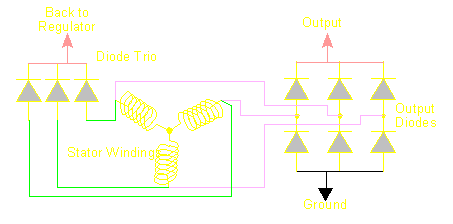
If one of the three diodes on the top right were damaged, current could follow a return path to ground through the regulator. Which in your case makes sense because you only see the 270mA when S is connected.
I know you said you are on your third alternator with this problem. Is it possible that the shop used the same alternator all three times. I could see this alternator passing the charge test if the faulty diode was only leaking 270mA. If you know the alternators are different, are they the same brand? Maybe it's time to switch. Still though, I have a hard time believing three differernt alternators, even from the same line, would have this problem.
If one of the three diodes on the top right were damaged, current could follow a return path to ground through the regulator. Which in your case makes sense because you only see the 270mA when S is connected.
I know you said you are on your third alternator with this problem. Is it possible that the shop used the same alternator all three times. I could see this alternator passing the charge test if the faulty diode was only leaking 270mA. If you know the alternators are different, are they the same brand? Maybe it's time to switch. Still though, I have a hard time believing three differernt alternators, even from the same line, would have this problem.

Supporting Maxima.org Member

Joined: Nov 2005
Posts: 305
From: New York
Keep us updated on this situation, I recently acquired the same problem just after a radiator support replacement at a body shop. I went through all the fuses and narrowed it down to the BCM circuit... problem is the whole damn car is on that circuit, so I can't exactly pull components in a systematic order... I have to park my car with the battery cable off and its really pissing me off, so maybe (if I'm lucky) we have the same issue!

Thread
Thread Starter
Forum
Replies
Last Post
hez8813
5th Generation Maxima (2000-2003)
11
Mar 12, 2020 12:06 AM
ag90fox
7th Generation Maxima (2009-2015)
6
Sep 9, 2015 12:22 PM