


Timing Mating Marks - Colored Chain Links


Thread Starter
Senior Member
Joined: Jan 2011
Posts: 3,037
From: Central AR
Timing Mating Marks - Colored Chain Links
Before I started tearing down my 1st VQ30DE, I wanted to line up the timing marks and compare the chain's colored links to some pictures from the FSM.
Right off I noticed some coloring differences for the silver links as indicated with the red arrows. I was able to get the chain marks line up with the intake cam dowel positions and the sprocket marks. I think have the timing marks and cam dowels lined up for TDC.
Hopefully these pictures will help someone who will be tackling a timing chain issue or head replacement job.
To enlarge the following picture, just give it an extra click.
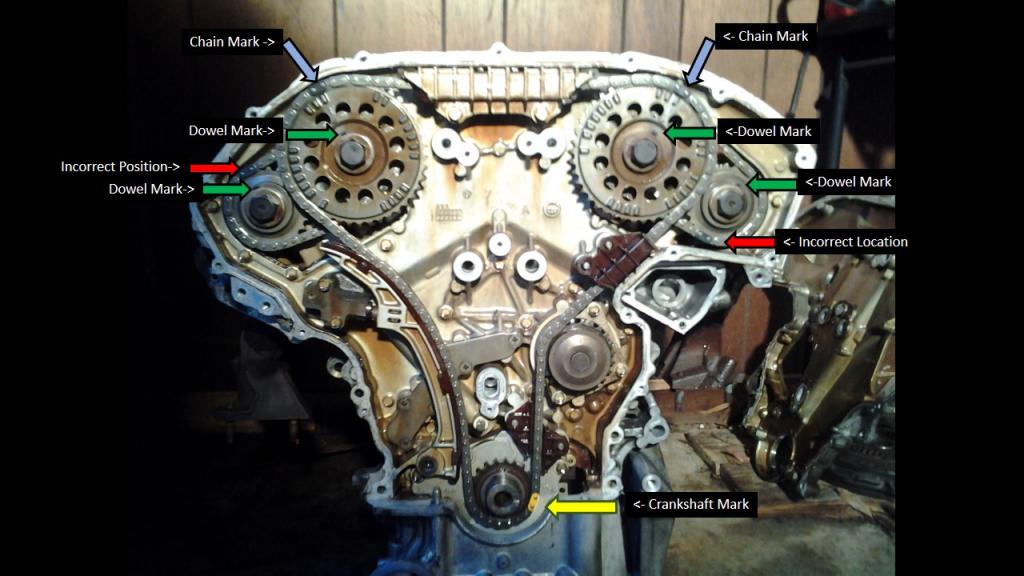
I'm comparing the cam chain the following diagram that is like the FSM.

and the following timing chain mating marks.
 [/quote]
Right off I noticed some coloring differences for the silver links as indicated with the red arrows. I was able to get the chain marks line up with the intake cam dowel positions and the sprocket marks. I think have the timing marks and cam dowels lined up for TDC.
Hopefully these pictures will help someone who will be tackling a timing chain issue or head replacement job.
To enlarge the following picture, just give it an extra click.
I'm comparing the cam chain the following diagram that is like the FSM.
and the following timing chain mating marks.
[/quote]

Crankshaft sprocket is retarded by 1 tooth you're is at 3:30 and the illustration appears to be at like 5 O'clock.....As long as the all the camshaft dowel pins are in their noted upright perpindicular location to the head it's all good the painted is for the unexperienced!

The positioning of the chain(s) makes no difference.
It's the positioning of the mating marks that matter as they tell you the position(s) of your cams and crank.
Thread Starter
Senior Member
Joined: Jan 2011
Posts: 3,037
From: Central AR
Thanks CMAX and Turbo for the clarification and information. Based on the picture, can I go with the following assumptions?
1) At some point in the past, the timing chains were removed and reinstalled with the cam chain marks located in a different position than the original Nissan factory setup as shown in the FSM.
2) The engine timing was correctly positioned at the time of failure.
I'm still scratching my head and trying to determine why the engine had such a high number of leaking intake valves that showed up during a leak down test.
Thanks again,
Craig
1) At some point in the past, the timing chains were removed and reinstalled with the cam chain marks located in a different position than the original Nissan factory setup as shown in the FSM.
2) The engine timing was correctly positioned at the time of failure.
I'm still scratching my head and trying to determine why the engine had such a high number of leaking intake valves that showed up during a leak down test.
Thanks again,
Craig
Thanks CMAX and Turbo for the clarification and information. Based on the picture, can I go with the following assumptions?
1) At some point in the past, the timing chains were removed and reinstalled with the cam chain marks located in a different position than the original Nissan factory setup as shown in the FSM.
2) The engine timing was correctly positioned at the time of failure.
I'm still scratching my head and trying to determine why the engine had such a high number of leaking intake valves that showed up during a leak down test.
Thanks again,
Craig
1) At some point in the past, the timing chains were removed and reinstalled with the cam chain marks located in a different position than the original Nissan factory setup as shown in the FSM.
2) The engine timing was correctly positioned at the time of failure.
I'm still scratching my head and trying to determine why the engine had such a high number of leaking intake valves that showed up during a leak down test.
Thanks again,
Craig
Assumption #2 ... maybe not so much.
As CMax pointed out and as is evidenced in your photo, the crank shaft does not appear to be correctly positioned.
The other thing(s) that aren't evident are the positions of the primary (inner) camshaft intake sprockets.
Thread Starter
Senior Member
Joined: Jan 2011
Posts: 3,037
From: Central AR
I think your assumption #1 is accurate.
Assumption #2 ... maybe not so much.
As CMax pointed out and as is evidenced in your photo, the crank shaft does not appear to be correctly positioned.
The other thing(s) that aren't evident are the positions of the primary (inner) camshaft intake sprockets.
Assumption #2 ... maybe not so much.
As CMax pointed out and as is evidenced in your photo, the crank shaft does not appear to be correctly positioned.
The other thing(s) that aren't evident are the positions of the primary (inner) camshaft intake sprockets.
One telltale sign that a major repair was performed by someone who "didn't have a clue" about working on a Nissan is every sensor and coil plug connected to the engine had the plug release triggers broken off to expose the green sliding lock.


Thread
Thread Starter
Forum
Replies
Last Post