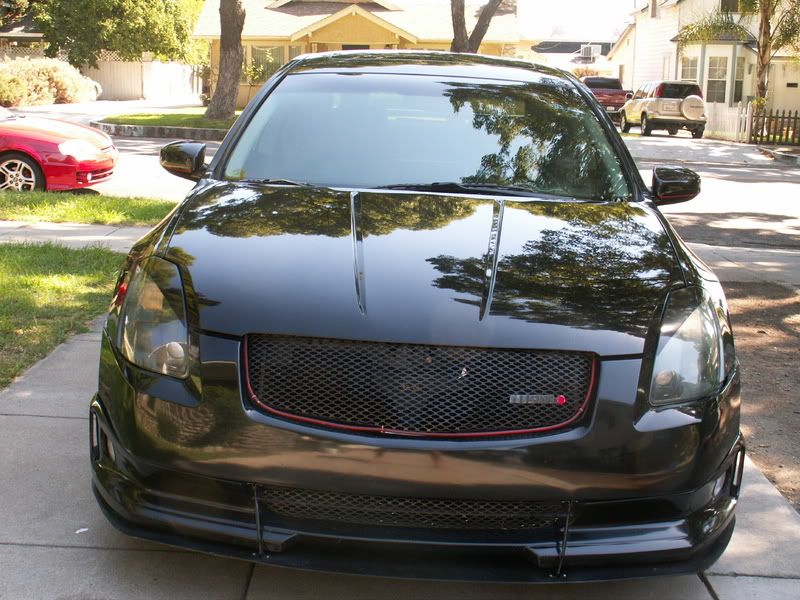
Splitter - Final Pics!



Senior Member
Joined: Feb 2007
Posts: 634
From: Pittsburgh, PA
Well, let's just take a look at this then.
First of all, let's dispel the myth that the splitter creates downforce. It does not. The purpose of a splitter is to channel the air into two paths, one low pressure (under the car) and one high pressure (over the car). Thus, the car isn't forced towards the ground, its sucked down from below, much like an inverse plane wing (as they use a low pressure area above the wing to provide lift). You are, in essence, providing reverse lift to the vehicle.
Now that we've dispelled the myth of "downforce", lets talk about its functionality.
I do believe splitters are very effective. I don't believe yours is, for a variety of reasons. But before we get into those, let me just say that it LOOKS very good (now that you've done various cosmetic additions to it). However, I doubt it functions well at all. Why? Splitters are usual additions to race cars, very light cars that need to be glued down to the ground. Your Maxima is VERY heavy. A lighter car might benefit, but yours will not.
Now, lets look at the equation Force= Pressure x Area. The more area at the front of the splitter, the more force you'll have pulling the car down. However, your also going to be decreasing the pressure under the car substantially. Let's just assume that you are in fact generating high pressure in the front. Unlike a race car, you have a FWD car. What does that do? It creates a dangerous condition of oversteer. (I don't believe this will happen to you because I don't believe your splitter really functions, but I'll get to that). This is what happens with a functioning splitter in a FWD car:
Not taking the hint, I continued to drive my car around with the splitter extended for a few weeks until my appointment to have my LTW and wing extensions painted and installed. While driving at some pretty aggressive speeds through a nice sweeper on my way home from a friend's house, I encountered a road hazard of the large live animal variety. I quickly tried to bring my speed down but I was still in the turn. I thought I was ok, I had been in a similar situation on this road at even greater speeds and the car should respond just like normal. The car exhibited some very intense oversteer characteristics, more than any car I had ever driven, and I wound up backwards in a ditch. Not the most nerve calming incident in my life.. heh. Had the ditch been much deeper or the velocity any greater, I can tell you for sure, I might not be here right now.
Since that point, the wing has been on my car, and the splitter is Never fully extended unless the LTW wing extensions are in place.
Notice his splitter was at full extension, bumping up the area, effectively increasing the pressure. This is why FWD cars don't generally use splitters.
Now, for the functionality.
The funny thing about splitters is called "deflection". A front splitter must be EXTREMELY strong to handle the pressure created while driving at high speeds. So strong in fact, that most use plywood or high yield fiberglass. Hence the turnbuckles, which help keep the splitter in place. If the splitter bends, even just a little, it creates deflection, which simply means it destroys the low pressure area under the car and causes it to lose functionality completely.
Lets go back to the equation "Force = Pressure x Area". You need to have a lot of area to give you the force and drop the pressure under the car. You get your force, but at a price - the splitter absorbs the force. Your ABS plastic is nowhere near the strength needed to absorb 200-300lbs of force. I mean, you had to shim it to get the bends out of it. Let me repeat that, you had to shim it to get it straight. Most people are using plywood.
These people have tested splitters at the track and many are using Lexan. Lexan. It's like low weight concrete. No bends, no shifting, no pulsing. From above you see that this is a science. Much more than just attaching a piece of plastic to the front of the car. I'll admit, it looks much better than it first time around and it did give it an air of aggressiveness. However, it is no where near strong enough to do anything but look nice. (to some).
(I did research this long before this thread when I has an IS300, I don't make claims without proof).
A Not-so-Genuine Hater,
Joshua
First of all, let's dispel the myth that the splitter creates downforce. It does not. The purpose of a splitter is to channel the air into two paths, one low pressure (under the car) and one high pressure (over the car). Thus, the car isn't forced towards the ground, its sucked down from below, much like an inverse plane wing (as they use a low pressure area above the wing to provide lift). You are, in essence, providing reverse lift to the vehicle.
Now that we've dispelled the myth of "downforce", lets talk about its functionality.
I do believe splitters are very effective. I don't believe yours is, for a variety of reasons. But before we get into those, let me just say that it LOOKS very good (now that you've done various cosmetic additions to it). However, I doubt it functions well at all. Why? Splitters are usual additions to race cars, very light cars that need to be glued down to the ground. Your Maxima is VERY heavy. A lighter car might benefit, but yours will not.
Now, lets look at the equation Force= Pressure x Area. The more area at the front of the splitter, the more force you'll have pulling the car down. However, your also going to be decreasing the pressure under the car substantially. Let's just assume that you are in fact generating high pressure in the front. Unlike a race car, you have a FWD car. What does that do? It creates a dangerous condition of oversteer. (I don't believe this will happen to you because I don't believe your splitter really functions, but I'll get to that). This is what happens with a functioning splitter in a FWD car:
Originally Posted by guy from E36 boards
Not taking the hint, I continued to drive my car around with the splitter extended for a few weeks until my appointment to have my LTW and wing extensions painted and installed. While driving at some pretty aggressive speeds through a nice sweeper on my way home from a friend's house, I encountered a road hazard of the large live animal variety. I quickly tried to bring my speed down but I was still in the turn. I thought I was ok, I had been in a similar situation on this road at even greater speeds and the car should respond just like normal. The car exhibited some very intense oversteer characteristics, more than any car I had ever driven, and I wound up backwards in a ditch. Not the most nerve calming incident in my life.. heh. Had the ditch been much deeper or the velocity any greater, I can tell you for sure, I might not be here right now.
Since that point, the wing has been on my car, and the splitter is Never fully extended unless the LTW wing extensions are in place.
Now, for the functionality.
The funny thing about splitters is called "deflection". A front splitter must be EXTREMELY strong to handle the pressure created while driving at high speeds. So strong in fact, that most use plywood or high yield fiberglass. Hence the turnbuckles, which help keep the splitter in place. If the splitter bends, even just a little, it creates deflection, which simply means it destroys the low pressure area under the car and causes it to lose functionality completely.
Lets go back to the equation "Force = Pressure x Area". You need to have a lot of area to give you the force and drop the pressure under the car. You get your force, but at a price - the splitter absorbs the force. Your ABS plastic is nowhere near the strength needed to absorb 200-300lbs of force. I mean, you had to shim it to get the bends out of it. Let me repeat that, you had to shim it to get it straight. Most people are using plywood.
Originally Posted by tentenths.com
Rob, the splitter on kit car which balances out a 100lb of downforce at 100MPH rear wing was originally made out of ply coated in green Cuprinol to match the cars colour. It extended fowarded about 3 inches at the front and an inch round the sides to help stop the displaced air slipping back under the car.
Coupled with a two inch 'step' at the front to form a simple venturi this is producing more downforce than the rear wing and is going to require a venturi at the rear to balance out.
The steering is also now so heavy due to downforce in fast corners that the car can be difficult to steer. Hopefully the forthcoming baby lifting exercise will fix that!
The splitter is now fiberglass and slightly lighter as a result but works the same.
Note that a real working splitter MUST have supports or it either isn't working or it will vibrate, reduce efficiency and break after a while.
I tried a splitter on the Corolla and it wasn't really deep enough to have a massive effect. The 40mm allowed by the regs was too little for a car with such poor underbody aerodynamics.
Coupled with a two inch 'step' at the front to form a simple venturi this is producing more downforce than the rear wing and is going to require a venturi at the rear to balance out.
The steering is also now so heavy due to downforce in fast corners that the car can be difficult to steer. Hopefully the forthcoming baby lifting exercise will fix that!
The splitter is now fiberglass and slightly lighter as a result but works the same.
Note that a real working splitter MUST have supports or it either isn't working or it will vibrate, reduce efficiency and break after a while.
I tried a splitter on the Corolla and it wasn't really deep enough to have a massive effect. The 40mm allowed by the regs was too little for a car with such poor underbody aerodynamics.
Originally Posted by tentenths.com
I am in the sign business and we use a very versatile material called Foamulux, which is similar to the white cladding used in building and is a plastic close cell struture material with a finished outer skin, This stuff can be cut, planed, heat bent and retains its shape and I have sold sheets of it in the past to car prep companies, it comes in 8 x 4 sheets or 10 x 5 feet. I have used it to make up internal door pannels including bending over the top and shaped foot wells, cut to size then apply heat with a heat gun and push into the well, great. It is available in different colours. I don't know where you are but I always have a few scraps lying about you could use. Another great material although not so workable but a lot strionger is 3mm Raynobond which is an ally faced composite material with a resin core, light and strong.
Originally Posted by tentenths.com
I am not forgetting anything; I asked IS Lexan as stiff as plywood; If a lexan splitter has to be thicker that a plywood one to get the same stiffness then it may end up weighing more than a plywood one. If someone has the stiffness figures for each material we can work it out. We use lexan windows 4mm thick and I believe plywood 5mm thick is stiffer, so a plywood splitter would be stiffer, weight for weight, than lexan.
Originally Posted by tentenths.com
Ridgidity of the splitter is very important; it generates a lot of downforce but if it becomes deformed under pressure a significant amount of downforce can be lost. I am sure lexan is stronger weight for weight than plywood i.e. it has a higher strength under bending loads and will not break so easily, but I think this is largely because it is a more flexible material and it will be deflected easier than plywood; the laminations make plywood very stiff. Properly layed up carbon would be the stiffest I am sure, weight for weight, I have seen carbon splitters and wing endplates shatter on impact.
Originally Posted by tentenths.com
I have first hand experience in playing around with splitters. I ran an OW autocross car and after totalling a wing once I decided to build a splitter for an upcoming event.
I used 5mm Meranti mahogany plywood (real cheap) I found in the garage cut to 22 inch and 48 inch wide. My front track was 56 inches so I had to notch out a bit to clear the inside on the tires. The leading edge was 15 inches from the front tires.
I bent a 50thou Al channel 1.5"x1"and epoxied and rivetted it halfway across the span.
For the venturi I bent up a 50thou Al angle to provide an exit height of 1.75inches (I couldn't get the angle to hold more than that).
I mounted the whole thing with .125 Al plate to the nose box.
The thing was NOT fragile.
You know what....it produced more downforce at lower speed than the front wing. Enough that I had to increase the rear wing flap(s) angle....and it looked ugly....
So much so my kids told me to build a new wing !!!!
Total weight was 10.5 pounds. Weight for the wing (Aluminum, foam and FG) 18 pounds. The splitter has a lower CG too...
I used 5mm Meranti mahogany plywood (real cheap) I found in the garage cut to 22 inch and 48 inch wide. My front track was 56 inches so I had to notch out a bit to clear the inside on the tires. The leading edge was 15 inches from the front tires.
I bent a 50thou Al channel 1.5"x1"and epoxied and rivetted it halfway across the span.
For the venturi I bent up a 50thou Al angle to provide an exit height of 1.75inches (I couldn't get the angle to hold more than that).
I mounted the whole thing with .125 Al plate to the nose box.
The thing was NOT fragile.
You know what....it produced more downforce at lower speed than the front wing. Enough that I had to increase the rear wing flap(s) angle....and it looked ugly....
So much so my kids told me to build a new wing !!!!
Total weight was 10.5 pounds. Weight for the wing (Aluminum, foam and FG) 18 pounds. The splitter has a lower CG too...
(I did research this long before this thread when I has an IS300, I don't make claims without proof).
A Not-so-Genuine Hater,
Joshua


Well, let's just take a look at this then.
First of all, let's dispel the myth that the splitter creates downforce. It does not. The purpose of a splitter is to channel the air into two paths, one low pressure (under the car) and one high pressure (over the car). Thus, the car isn't forced towards the ground, its sucked down from below, much like an inverse plane wing (as they use a low pressure area above the wing to provide lift). You are, in essence, providing reverse lift to the vehicle.
..............
A Not-so-Genuine Hater,
Joshua
First of all, let's dispel the myth that the splitter creates downforce. It does not. The purpose of a splitter is to channel the air into two paths, one low pressure (under the car) and one high pressure (over the car). Thus, the car isn't forced towards the ground, its sucked down from below, much like an inverse plane wing (as they use a low pressure area above the wing to provide lift). You are, in essence, providing reverse lift to the vehicle.
..............
A Not-so-Genuine Hater,
Joshua

Thread Starter
Joined: Nov 2004
Posts: 7,353
From: Upland CA
Well, let's just take a look at this then.
First of all, let's dispel the myth that the splitter creates downforce. It does not. The purpose of a splitter is to channel the air into two paths, one low pressure (under the car) and one high pressure (over the car). Thus, the car isn't forced towards the ground, its sucked down from below, much like an inverse plane wing (as they use a low pressure area above the wing to provide lift). You are, in essence, providing reverse lift to the vehicle.
Silly statement. Downforce or reverse lift IS THE SAME THING!!!
Now that we've dispelled the myth of "downforce", lets talk about its functionality.
No we have NOT dispelled shzit, lol
I do believe splitters are very effective. I don't believe yours is, for a variety of reasons. But before we get into those, let me just say that it LOOKS very good (now that you've done various cosmetic additions to it). However, I doubt it functions well at all. Why? Splitters are usual additions to race cars, very light cars that need to be glued down to the ground. Your Maxima is VERY heavy. A lighter car might benefit, but yours will not.
Also not true. What is the relevance of wieght. Downforce is downforce irrespective of HOW MUCH THE CAR WEIGHS
Now, lets look at the equation Force= Pressure x Area. Yes, lets look at that The more area at the front of the splitter, the more force you'll have pulling the car down. However, your also going to be decreasing the pressure under the car substantially. Let's just assume that you are in fact generating high pressure in the front. Unlike a race car, you have a FWD car. What does that do? It creates a dangerous condition of oversteer.Dangerous????? Nothing dangerous about it if you know how to drive (like I do, hehe) Oversteer is not good for people who dont know how to drive, or are not expecting it. But for performance cars, slight oversteer is GOOD. In fact, if you can dial in oversteer on ur FWD car, "u done good." (I don't believe this will happen to you because I don't believe your splitter really functions, but I'll get to that). This is what happens with a functioning splitter in a FWD car:
Notice his splitter was at full extension, bumping up the area, effectively increasing the pressure. This is why FWD cars don't generally use splitters.
Now, for the functionality.
The funny thing about splitters is called "deflection". A front splitter must be EXTREMELY strong to handle the pressure created while driving at high speeds. So strong in fact, that most use plywood or high yield fiberglass. Hence the turnbuckles, which help keep the splitter in place. If the splitter bends, even just a little, it creates deflection, which simply means it destroys the low pressure area under the car and causes it to lose functionality completely.
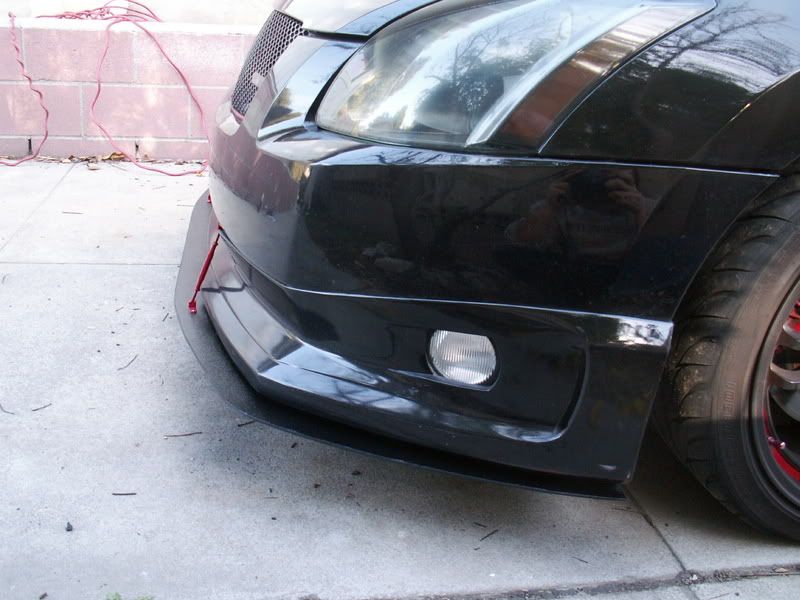
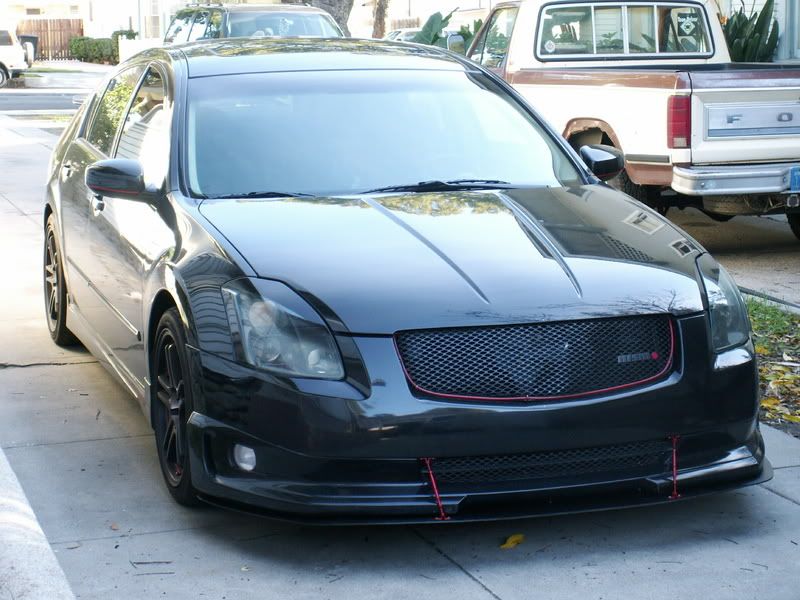
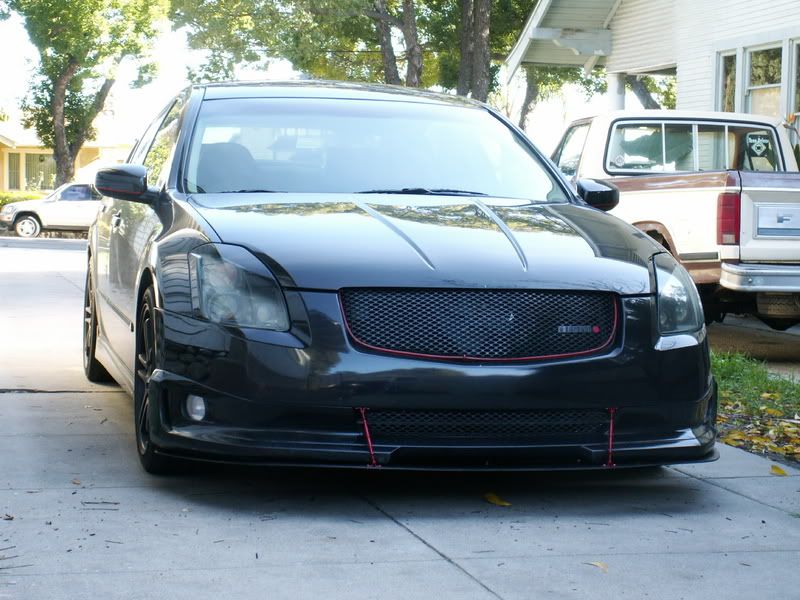
I have 3/8" ABS plastic securely bolted WITH Stillen turnbuckles securely bolted.
Lets go back to the equation "Force = Pressure x Area". You need to have a lot of area to give you the force and drop the pressure under the car. HOw much is "a lot" The length of the splitter is over SIX FEET long averaging about 3 inches or more in width which is about 220 square inches. Ur hand is about 18 square inches which means the splitter is about 12 times bigger. U ever stick ur hand out of the window at 60 mph and can barely control it due to the force. Now increase that force 12 TIMES!! You get your force, but at a price - the splitter absorbs the force. Your ABS plastic is nowhere near the strength needed to absorb 200-300lbs of force.3/8" thick with turnbuckles, so not true I mean, you had to shim it to get the bends out of it. Let me repeat that, you had to shim it to get it straight. Yeah, so? I shimmed it cuz I used 5/16" BOLTS to bolt it down so it did bend. What kind of force do u think THOSE BOLTS generated?? LOTS Most people are using plywood.
These people have tested splitters at the track and many are using Lexan. Lexan. It's like low weight concrete. No bends, no shifting, no pulsing. From above you see that this is a science. Much more than just attaching a piece of plastic to the front of the car. I'll admit, it looks much better than it first time around and it did give it an air of aggressiveness. However, it is no where near strong enough to do anything but look nice. (to some).
(I did research this long before this thread when I has an IS300, I don't make claims without proof).
NOt sure what ur proof is since i dont know who these people are, and where they got their info from specifically. Did they measure it? Did someone else measure it. Im not saying I am right, but I am saying that there is uncertainty as to whether or not they are significantly effective. Like a dyno is to an engine, the only true way to test it is to test it on and off the car, use a high speed wind generator and a scale, right??
A Not-so-Genuine Hater,
Joshua
First of all, let's dispel the myth that the splitter creates downforce. It does not. The purpose of a splitter is to channel the air into two paths, one low pressure (under the car) and one high pressure (over the car). Thus, the car isn't forced towards the ground, its sucked down from below, much like an inverse plane wing (as they use a low pressure area above the wing to provide lift). You are, in essence, providing reverse lift to the vehicle.
Silly statement. Downforce or reverse lift IS THE SAME THING!!!
Now that we've dispelled the myth of "downforce", lets talk about its functionality.
No we have NOT dispelled shzit, lol
I do believe splitters are very effective. I don't believe yours is, for a variety of reasons. But before we get into those, let me just say that it LOOKS very good (now that you've done various cosmetic additions to it). However, I doubt it functions well at all. Why? Splitters are usual additions to race cars, very light cars that need to be glued down to the ground. Your Maxima is VERY heavy. A lighter car might benefit, but yours will not.
Also not true. What is the relevance of wieght. Downforce is downforce irrespective of HOW MUCH THE CAR WEIGHS
Now, lets look at the equation Force= Pressure x Area. Yes, lets look at that The more area at the front of the splitter, the more force you'll have pulling the car down. However, your also going to be decreasing the pressure under the car substantially. Let's just assume that you are in fact generating high pressure in the front. Unlike a race car, you have a FWD car. What does that do? It creates a dangerous condition of oversteer.Dangerous????? Nothing dangerous about it if you know how to drive (like I do, hehe) Oversteer is not good for people who dont know how to drive, or are not expecting it. But for performance cars, slight oversteer is GOOD. In fact, if you can dial in oversteer on ur FWD car, "u done good." (I don't believe this will happen to you because I don't believe your splitter really functions, but I'll get to that). This is what happens with a functioning splitter in a FWD car:
Notice his splitter was at full extension, bumping up the area, effectively increasing the pressure. This is why FWD cars don't generally use splitters.
Now, for the functionality.
The funny thing about splitters is called "deflection". A front splitter must be EXTREMELY strong to handle the pressure created while driving at high speeds. So strong in fact, that most use plywood or high yield fiberglass. Hence the turnbuckles, which help keep the splitter in place. If the splitter bends, even just a little, it creates deflection, which simply means it destroys the low pressure area under the car and causes it to lose functionality completely.
I have 3/8" ABS plastic securely bolted WITH Stillen turnbuckles securely bolted.
Lets go back to the equation "Force = Pressure x Area". You need to have a lot of area to give you the force and drop the pressure under the car. HOw much is "a lot" The length of the splitter is over SIX FEET long averaging about 3 inches or more in width which is about 220 square inches. Ur hand is about 18 square inches which means the splitter is about 12 times bigger. U ever stick ur hand out of the window at 60 mph and can barely control it due to the force. Now increase that force 12 TIMES!!
You get your force, but at a price - the splitter absorbs the force. Your ABS plastic is nowhere near the strength needed to absorb 200-300lbs of force.3/8" thick with turnbuckles, so not true I mean, you had to shim it to get the bends out of it. Let me repeat that, you had to shim it to get it straight. Yeah, so? I shimmed it cuz I used 5/16" BOLTS to bolt it down so it did bend. What kind of force do u think THOSE BOLTS generated?? LOTS Most people are using plywood.These people have tested splitters at the track and many are using Lexan. Lexan. It's like low weight concrete. No bends, no shifting, no pulsing. From above you see that this is a science. Much more than just attaching a piece of plastic to the front of the car. I'll admit, it looks much better than it first time around and it did give it an air of aggressiveness. However, it is no where near strong enough to do anything but look nice. (to some).
(I did research this long before this thread when I has an IS300, I don't make claims without proof).
NOt sure what ur proof is since i dont know who these people are, and where they got their info from specifically. Did they measure it? Did someone else measure it. Im not saying I am right, but I am saying that there is uncertainty as to whether or not they are significantly effective. Like a dyno is to an engine, the only true way to test it is to test it on and off the car, use a high speed wind generator and a scale, right??
A Not-so-Genuine Hater,
Joshua

Senior Member
Joined: Feb 2007
Posts: 634
From: Pittsburgh, PA
Dude if you so concerned about his car and train of thought, then you must lead a stressful life. Just let it be, it makes him happy and thats how it should be. You may not like it, so here's a novel idea don't do it on your car so we all can go oooooo and aaaaaaaah at it later.
I won't waste the time responding. Posting on a message board does not lead to a stressful life. More like an exchange of ideas. Here's a novel idea, posting factual information is what this forum needs more than anything else.
Have a swell day,
Joshua
Senior Member
Joined: Feb 2007
Posts: 634
From: Pittsburgh, PA

Thread Starter
Joined: Nov 2004
Posts: 7,353
From: Upland CA
U may be right. Just like most spoilers dont function either.

Thread Starter
Joined: Nov 2004
Posts: 7,353
From: Upland CA

Senior Member
Joined: Aug 2007
Posts: 607
From: Florida
I have always wondered about the function of spoilers in our everyday cars. The 07-08 max has a aerodynamic drag coefficient of .31 without spoiler and .30 with rear spoiler. Now does that .01 make any difference in day to day driving even in highways? At what situation does it really make a difference?
I have seen some spoilers that look like bison's horns or even wierder. Some have multiple spoilers. Some spoilers seem to inhibit performance rather than enhancing it. But I am no spoiler expert.
I have seen some spoilers that look like bison's horns or even wierder. Some have multiple spoilers. Some spoilers seem to inhibit performance rather than enhancing it. But I am no spoiler expert.
Last edited by bb700092; Dec 31, 2007 at 08:32 AM.
Thread Starter
Joined: Nov 2004
Posts: 7,353
From: Upland CA
I have always wondered about the function of spoilers in our everyday cars. The 07-08 max has a aerodynamic drag coefficient of .31 without spoiler and .30 with rear spoiler. Now does that .01 make any difference in day to day driving even in highways? At what situation does it really make a difference?
I have seen some spoilers that look like bison's horns or even wierder. Some have multiple spoilers. Some spoilers seem to inhibit performance rather than enhancing it. But I am no spoiler expert.
I have seen some spoilers that look like bison's horns or even wierder. Some have multiple spoilers. Some spoilers seem to inhibit performance rather than enhancing it. But I am no spoiler expert.
The difference between .31 and .30 is negligible. There are many ways to get better gas mileage other than aerodynamic aids.



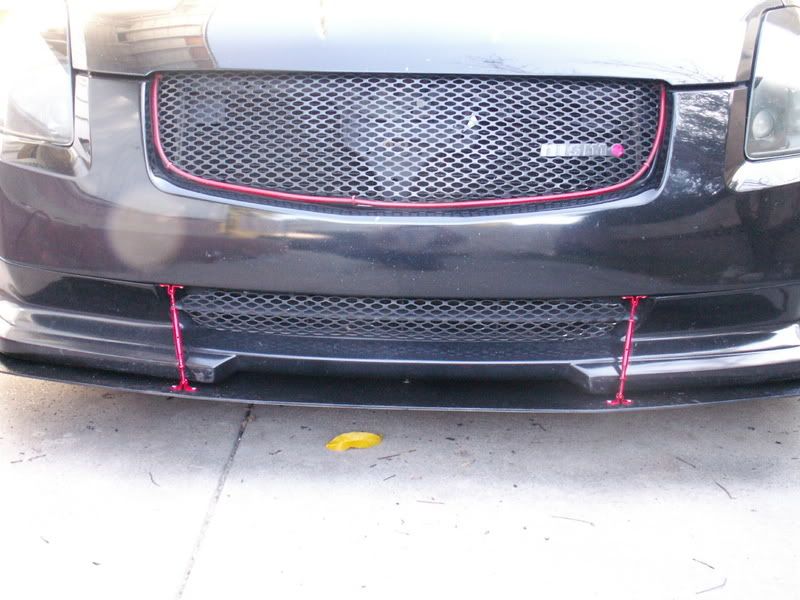
Wow. Excellent work. Looks like a professional job. I think the red turnbuckles match well with the red details of the car.
The splitter may or may not work but it will surely make the other racer nervous. SportCompact has a good article on aerodynamics of cars, dams, splitters, etc:
http://www.sportcompactcarweb.com/te...t_1/index.html
http://www.sportcompactcarweb.com/te...t_2/index.html
The splitter may or may not work but it will surely make the other racer nervous. SportCompact has a good article on aerodynamics of cars, dams, splitters, etc:
http://www.sportcompactcarweb.com/te...t_1/index.html
http://www.sportcompactcarweb.com/te...t_2/index.html

Member
Joined: Nov 2006
Posts: 47

Deus, saw this while trolling ebay. Thought you might want to take a gander just for S&G's.
CF Splitter
CF Splitter

Thread Starter
Joined: Nov 2004
Posts: 7,353
From: Upland CA
Mack: I already checked it out. Its too small for our wide car. My splitter measures 72" wide; the one on ebay is 65". But thanks. I do want CF overlay cuz I like the look. If I get a CF hood and I put a CF overlay on my GTR rear valence that I'm building, I think that will look pretty nice.
Classmax: Thanks!! The red turnbuckles a different than what I have seen out there but they dont stand out too much in person.
Classmax: Thanks!! The red turnbuckles a different than what I have seen out there but they dont stand out too much in person.

Thread Starter
Joined: Nov 2004
Posts: 7,353
From: Upland CA

Thread Starter
Joined: Nov 2004
Posts: 7,353
From: Upland CA
Update: As much as I love the look of the splitter, I keep hitting curbs. The ABS plastic does a great job of resisting breakage. The problem is that the turnbuckles resist flexibility and I hit a sharp dip in the road and a chunk of the splitter broke off (a small triangle shape about 2 inches on each side. I fixed it by grafting a piece of the original plastic into the opening of the break and epoxy gluing it, sanding it and painting. It looked ok (better than before). Then I nudged a curb again this morning and it cracked again. Ill glue it again. Its all worth it.