


Let's be analytical - horsepower loss and long intake...


Let's be analytical - horsepower loss and long intake...
There is a commonly accepted idea on this forum that long intake tubing creates too much friction and therefore hinders the performance on our cars, so it is preferable to have a short ram intake.
Let’s be analytical about this:
Our 3.5L engines at 6000rpm suck in roughly 370 cubic feet of air every minute…
Here is the calc: [(3.5 liters x 6000 rpm) / 2 ] x (1 Ft³ / 28.317 Liters) = 371 CFM
Data used for the calculations:
- Injen Intake length: 4 ft
- Intake diameter: 3”
- Roughness: 0.000006 ft
- Viscosity: 0.018 cP
- Temperature: 70°F
- Gas Molecular Weight: 29
- Specific Heat Ratio: 1.4
- Compressibility Factor: 1
- Inlet Pressure: 0 psig
- One 90 degree elbow
Using the Darcy Weisbach equation to calculate the friction losses, the resulting friction losses + loss due to the elbow in the intake tubing is approximately 0.073 psi… That’s a 0.04hp loss due to less air pressure…
Here is where I got my info from: http://www.freecalc.com/gasfric.htm
This is all theory of course...
Let’s be analytical about this:
Our 3.5L engines at 6000rpm suck in roughly 370 cubic feet of air every minute…
Here is the calc: [(3.5 liters x 6000 rpm) / 2 ] x (1 Ft³ / 28.317 Liters) = 371 CFM
Data used for the calculations:
- Injen Intake length: 4 ft
- Intake diameter: 3”
- Roughness: 0.000006 ft
- Viscosity: 0.018 cP
- Temperature: 70°F
- Gas Molecular Weight: 29
- Specific Heat Ratio: 1.4
- Compressibility Factor: 1
- Inlet Pressure: 0 psig
- One 90 degree elbow
Using the Darcy Weisbach equation to calculate the friction losses, the resulting friction losses + loss due to the elbow in the intake tubing is approximately 0.073 psi… That’s a 0.04hp loss due to less air pressure…
Here is where I got my info from: http://www.freecalc.com/gasfric.htm
This is all theory of course...


No, but the fact that you used non-SI units has me scratching my head. I mean, seriously, that ish is confusing... yes, I realize those are the units of the site you referenced. And, speaking of which, where did you find this site?


Last edited by CMax03; Aug 20, 2011 at 11:23 PM.


www.freecalc.com and I verified the numbers and results with the software I use on a daily basis at my job. http://www.kypipe.com/
If you bend the injen bracket and move the filter under the battery, rather leaving it directly behind the radiator it won't be sucking hot air from the radiator fans.
I drove for about a year with a short ram, and couldn't take the heat soak anymore, it was killing performance, so I switched to an Injen and wrapped it with insulating tape and it performs so much better now...
One of my co-workers and I went to a drag strip a few weeks ago, he has a 2005 dodge magnum RT (340hp stock) with CAI, tune and high flow cat back. At the end of the 1/4 mile, I was a car length ahead of him.
I think it's more so the placement of the filter than the friction.
I drove for about a year with a short ram, and couldn't take the heat soak anymore, it was killing performance, so I switched to an Injen and wrapped it with insulating tape and it performs so much better now...
One of my co-workers and I went to a drag strip a few weeks ago, he has a 2005 dodge magnum RT (340hp stock) with CAI, tune and high flow cat back. At the end of the 1/4 mile, I was a car length ahead of him.

Yeah I am not sure on your numbers. I have always just read what peoples experiences are at the track with a SRI or LTI. I am running stock till I figure out how to build a heat shield for my Stillen.



Then there's the 5200 RPM camels hump when a straight pipe is used vs the Helomholtz, which is also a lean spot,
 .
.
Ok, you're a smart guy, so do some research on calculating ideal intake length. There are formulas there but they do differ. You need to enter variables and information on the engine, the vast majority of which can be found in the FSM specs.
I will give you the short and sticky for the 5th gen and 5.5 gen,without getting technical at all:
5th gen - Most ideal intake is 28-32", this puts us into the fender. An injen is actually a good length for the DE-K, but it's poorly designed, stepping up/down in size, vacuum lines hook up in poor locations causing unwanted turbulance, and the filter location limits Velocity stacks and other filter types.
In short, the DE-K is best with a long intake
5.5 Gen- Most ideal intake is 20" roughly, this differs depending on where you want the power of course, but this puts your filter about halfway into the stock battery location. The best thing is to turn the battery 90* and tuck in close to the fender. One step farther would be to cut a hole to allow air in from the fenderwell (NOT the wheelwell). To me, this is one of the best intake setups for the 5.5 without getting too crazy with 'iceboxes' or BBMAF, etc.
The Super short SRI is too short, plain and simple it's been logged and proven. But, it's still better than stock, and on the 5.5, better than the injen.
As for the 'friction' theory, friction really has little to do with the reasoning behind long/short intake calculations and theories.
Last edited by TunerMaxima3000; Aug 22, 2011 at 06:55 PM.
Although, for someone who will likely never track their car, I should admit that I've calculated the ideal length for my DE-K for my driving purposes, the available airflow, and entry angles so that when I make my CAI It'll be worth every pony I can pull out of it in the RPM ranges I want.
So I guess it makes sense to think about going 'all out' with the intake for some people...
Last edited by TunerMaxima3000; Aug 22, 2011 at 08:18 PM.
Yeah for sure ID is a relevant part, and of course, part of the calculations. For most of us though, BB intakes are not necessary or worth the hassle. The best setup for those of us not trying to pull every fractionof a second in the 1/4 mile is running that filter as close as possible to the corner of the engine bay, and getting as much cold air at the filter as possible to reduce ambient engine temps.
Although, for someone who will likely never track their car, I should admit that I've calculated the ideal length for my DE-K for my driving purposes, the available airflow, and entry angles so that when I make my CAI It'll be worth every pony I can pull out of it in the RPM ranges I want.
So I guess it makes sense to think about going 'all out' with the intake for some people...
Although, for someone who will likely never track their car, I should admit that I've calculated the ideal length for my DE-K for my driving purposes, the available airflow, and entry angles so that when I make my CAI It'll be worth every pony I can pull out of it in the RPM ranges I want.
So I guess it makes sense to think about going 'all out' with the intake for some people...
Last edited by NmexMAX; Aug 23, 2011 at 07:31 AM.
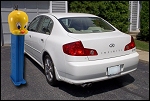
See Thread - " I put a cheap plastic AutoZone scoop on my 2001 Maxima! "
Last edited by BobPezz; Aug 23, 2011 at 04:18 PM.

Let’s be analytical about this:
Our 3.5L engines at 6000rpm suck in roughly 370 cubic feet of air every minute…
Here is the calc: [(3.5 liters x 6000 rpm) / 2 ] x (1 Ft³ / 28.317 Liters) = 371 CFM
Data used for the calculations:
- Injen Intake length: 4 ft
- Intake diameter: 3”
- Roughness: 0.000006 ft
- Viscosity: 0.018 cP
- Temperature: 70°F
- Gas Molecular Weight: 29
- Specific Heat Ratio: 1.4
- Compressibility Factor: 1
- Inlet Pressure: 0 psig
- One 90 degree elbow
Using the Darcy Weisbach equation to calculate the friction losses, the resulting friction losses + loss due to the elbow in the intake tubing is approximately 0.073 psi… That’s a 0.04hp loss due to less air pressure…
Here is where I got my info from: http://www.freecalc.com/gasfric.htm
This is all theory of course...
Our 3.5L engines at 6000rpm suck in roughly 370 cubic feet of air every minute…
Here is the calc: [(3.5 liters x 6000 rpm) / 2 ] x (1 Ft³ / 28.317 Liters) = 371 CFM
Data used for the calculations:
- Injen Intake length: 4 ft
- Intake diameter: 3”
- Roughness: 0.000006 ft
- Viscosity: 0.018 cP
- Temperature: 70°F
- Gas Molecular Weight: 29
- Specific Heat Ratio: 1.4
- Compressibility Factor: 1
- Inlet Pressure: 0 psig
- One 90 degree elbow
Using the Darcy Weisbach equation to calculate the friction losses, the resulting friction losses + loss due to the elbow in the intake tubing is approximately 0.073 psi… That’s a 0.04hp loss due to less air pressure…
Here is where I got my info from: http://www.freecalc.com/gasfric.htm
This is all theory of course...
its good to be analytical but why when the gains are slim to none? an intake itself doesnt free much power if any at all. even if it did give you 5hp, the buttdyno wouldnt even feel it. so why bother with getting into so much details over a gain or loss of half hp. people in the FI section should more concerned with this.

Thread
Thread Starter
Forum
Replies
Last Post
TallTom
5th Generation Maxima (2000-2003)
57
Oct 14, 2025 05:16 PM
MaxLvr21
5th Generation Maxima (2000-2003)
14
Oct 17, 2015 12:11 PM