


Rear Valve Cover Bolt Broke


Thread Starter
Senior Member
Joined: Apr 2015
Posts: 665
Rear Valve Cover Bolt Broke
Was changing leaky rear valve cover gasket, thinking ladidadida I'm gonna follow the torque specs and never have a rear valve cover leak again! Set my new torque wrench to 20in-pounds, first bolt snapped. Second bolt snapped.
-20in pounds is the lowest my wrench goes
-Am i gonna have to wait for a dealer to ship me these (and some spares...) or can I get these somewhere local?
-removal of the snapped bolts
-20in pounds is the lowest my wrench goes
-Am i gonna have to wait for a dealer to ship me these (and some spares...) or can I get these somewhere local?
-removal of the snapped bolts
Last edited by Violator; Feb 26, 2017 at 02:22 PM.

Senior Member
Joined: Jan 2011
Posts: 3,037
From: Central AR
I usually collect some from a salvage yard. I had a bolt break on the rear VC on one of my first gasket jobs. Fortunately, I had a spare. I may have had a kit that came with the bolts. I was able to retrieve the broken bolt because a metal shard that was left that allowed me to use a small screwdriver to back it out of the head without needing to drill/tape out the broken bolt.
One thing that I learned from that ordeal is, regardless of the torque spec, you can only tighten the VC bolts until the shoulder on the bolt makes contact with the head. After that, you risk snapping off the bolt in the head. I use a small 1/4 drive ratchet (that I can hold in the palm of my hand) with a 10mm socket and a 3" extension. Then I tighten the bolt until it stops. So that's as far is the bolt can be tightened.
When I want to tighten the gasket bolt more than the bolt with its shoulder will allow, then I use a stainless flat washer on top of the gasket kit grommet/washer to all an additional 1.5mm of pressure on the gasket.
The stainless flat washers that you see under the bolt heads in the picture are not for looks. The washers provide a rigid flat surface under the bolt head that increases the pressure on the gasket.
I tried this 3 years ago on a rear VC gasket job. I did not use it on the front VC gasket so that I could make a comparison. Today the rear VC gasket area is dry as a bone. The front does have some oil residue along the bottom from oil that is apparently starting to seep under or over the gasket. After seeing that difference, I started using the washers on all gasket bolts going forward.
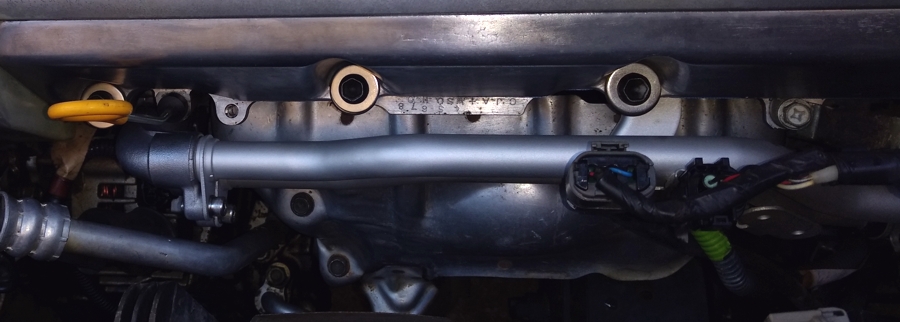
One thing that I learned from that ordeal is, regardless of the torque spec, you can only tighten the VC bolts until the shoulder on the bolt makes contact with the head. After that, you risk snapping off the bolt in the head. I use a small 1/4 drive ratchet (that I can hold in the palm of my hand) with a 10mm socket and a 3" extension. Then I tighten the bolt until it stops. So that's as far is the bolt can be tightened.
When I want to tighten the gasket bolt more than the bolt with its shoulder will allow, then I use a stainless flat washer on top of the gasket kit grommet/washer to all an additional 1.5mm of pressure on the gasket.
The stainless flat washers that you see under the bolt heads in the picture are not for looks. The washers provide a rigid flat surface under the bolt head that increases the pressure on the gasket.
I tried this 3 years ago on a rear VC gasket job. I did not use it on the front VC gasket so that I could make a comparison. Today the rear VC gasket area is dry as a bone. The front does have some oil residue along the bottom from oil that is apparently starting to seep under or over the gasket. After seeing that difference, I started using the washers on all gasket bolts going forward.


Thread Starter
Senior Member
Joined: Apr 2015
Posts: 665
I usually collect some from a salvage yard. I had a bolt break on the rear VC on one of my first gasket jobs. Fortunately, I had a spare. I may have had a kit that came with the bolts. I was able to retrieve the broken bolt because a metal shard that was left that allowed me to use a small screwdriver to back it out of the head without needing to drill/tape out the broken bolt.
One thing that I learned from that ordeal is, regardless of the torque spec, you can only tighten the VC bolts until the shoulder on the bolt makes contact with the head. After that, you risk snapping off the bolt in the head. I use a small 1/4 drive ratchet (that I can hold in the palm of my hand) with a 10mm socket and a 3" extension. Then I tighten the bolt until it stops. So that's as far is the bolt can be tightened.
When I want to tighten the gasket bolt more than the bolt with its shoulder will allow, then I use a stainless flat washer on top of the gasket kit grommet/washer to all an additional 1.5mm of pressure on the gasket.
The stainless flat washers that you see under the bolt heads in the picture are not for looks. The washers provide a rigid flat surface under the bolt head that increases the pressure on the gasket.
I tried this 3 years ago on a rear VC gasket job. I did not use it on the front VC gasket so that I could make a comparison. Today the rear VC gasket area is dry as a bone. The front does have some oil residue along the bottom from oil that is apparently starting to seep under or over the gasket. After seeing that difference, I started using the washers on all gasket bolts going forward.

One thing that I learned from that ordeal is, regardless of the torque spec, you can only tighten the VC bolts until the shoulder on the bolt makes contact with the head. After that, you risk snapping off the bolt in the head. I use a small 1/4 drive ratchet (that I can hold in the palm of my hand) with a 10mm socket and a 3" extension. Then I tighten the bolt until it stops. So that's as far is the bolt can be tightened.
When I want to tighten the gasket bolt more than the bolt with its shoulder will allow, then I use a stainless flat washer on top of the gasket kit grommet/washer to all an additional 1.5mm of pressure on the gasket.
The stainless flat washers that you see under the bolt heads in the picture are not for looks. The washers provide a rigid flat surface under the bolt head that increases the pressure on the gasket.
I tried this 3 years ago on a rear VC gasket job. I did not use it on the front VC gasket so that I could make a comparison. Today the rear VC gasket area is dry as a bone. The front does have some oil residue along the bottom from oil that is apparently starting to seep under or over the gasket. After seeing that difference, I started using the washers on all gasket bolts going forward.
Good idea with the washers btw I'll pickup some for when i can actually put this back on
Thread Starter
Senior Member
Joined: Apr 2015
Posts: 665
positive, this wrench doesn't even have ft pounds on it just measures in inch pounds. Saw a warning about this while looking for the torque spec


Why do you keep deleting every thread you create?
I think this is a good thread. If you're positive that you're using an inch-pound torque wrench, and it's calibrated correctly, I think the take away from this thread and your misfortune is that when replacing valve cover gaskets, it may be a good idea to purchase new bolts from the factory as these appear to get brittle over time.
Note, I've changed valve cover gaskets on several Maximas, and have never snapped a bolt.
I think this is a good thread. If you're positive that you're using an inch-pound torque wrench, and it's calibrated correctly, I think the take away from this thread and your misfortune is that when replacing valve cover gaskets, it may be a good idea to purchase new bolts from the factory as these appear to get brittle over time.
Note, I've changed valve cover gaskets on several Maximas, and have never snapped a bolt.
Thread Starter
Senior Member
Joined: Apr 2015
Posts: 665
Why do you keep deleting every thread you create?
I think this is a good thread. If you're positive that you're using an inch-pound torque wrench, and it's calibrated correctly, I think the take away from this thread and your misfortune is that when replacing valve cover gaskets, it may be a good idea to purchase new bolts from the factory as these appear to get brittle over time.
Note, I've changed valve cover gaskets on several Maximas, and have never snapped a bolt.
I think this is a good thread. If you're positive that you're using an inch-pound torque wrench, and it's calibrated correctly, I think the take away from this thread and your misfortune is that when replacing valve cover gaskets, it may be a good idea to purchase new bolts from the factory as these appear to get brittle over time.
Note, I've changed valve cover gaskets on several Maximas, and have never snapped a bolt.
I wouldn't worry about it. We are all here to learn and help each other.  Many could benefit from the solution to any of your problems/questions, especially those too timid to ask.
Many could benefit from the solution to any of your problems/questions, especially those too timid to ask.

Newbie - Just Registered
Joined: Mar 2017
Posts: 2
This may be a bit off topic, but as I'm new and I need to find this out quickly, this seemed the most relevant 'live' thread for this question. When doing the valve covers, does the timing cover need to come off? I have the 'cops' cover off the valve cover and it looks like there are two spots for bolts to thread in from under the timing cover. I"m asking because I don't want to proceed until I know whether or not I'm going to need to pull the engine mount. and timing cover.
Regarding the thread's actual topic, I'd have to say I find it unlikely that the bolts in the valve cover are becoming so brittle as to break with the specced torque. I'm not meaning to call anyone out, but even though these are not hardened bolts, 20 inch pounds shouldn't snap virtually any bolt. I've used and reused bolts for unstressed sections of engines from junkyards and parts cars many, many times. Unless there is corrosion involved, they always do just fine.
This isn't a head bolt we're talking about that is taking a beating and getting stretched and thinned out. The valve covers are a low stress point and aren't even the hottest point on the engine, so becoming brittle is very unlikely. If old, corroded, exhaust bolts can come out without breaking them(all the time at least), I have a hard time believing the valve cover bolts are the issue here.
I also agree with CS AR about how he determines they are snug(when the shoulder meets). Again, these bolts are not hardened and the valve covers are not iron and the cover just needs to be snug enough to 'crush' the gasket down to create a seal. Honestly, I don't even use torque wrenches at that small a spec for things like this. The rule of 'tighten to snug, then give it a 1/4-1/2 turn' has always served me well. Essentially, when you finally NEED the ratchet to put some *** into the bolt, you don't need much past that. A 1/4 turn is enough, at that point, to 'crush' the gasket and seal it.
As I see it, there are 3 options for what's going on,
1. You're not at 20inlb.
2. You're pushing past 20inlb(not stopping at the click or pulling past the 'release' of the torque wrench, you CAN apply more torque past what you have set).
3. Your wrench is faulty.
Just my opinion.
Regarding the thread's actual topic, I'd have to say I find it unlikely that the bolts in the valve cover are becoming so brittle as to break with the specced torque. I'm not meaning to call anyone out, but even though these are not hardened bolts, 20 inch pounds shouldn't snap virtually any bolt. I've used and reused bolts for unstressed sections of engines from junkyards and parts cars many, many times. Unless there is corrosion involved, they always do just fine.
This isn't a head bolt we're talking about that is taking a beating and getting stretched and thinned out. The valve covers are a low stress point and aren't even the hottest point on the engine, so becoming brittle is very unlikely. If old, corroded, exhaust bolts can come out without breaking them(all the time at least), I have a hard time believing the valve cover bolts are the issue here.
I also agree with CS AR about how he determines they are snug(when the shoulder meets). Again, these bolts are not hardened and the valve covers are not iron and the cover just needs to be snug enough to 'crush' the gasket down to create a seal. Honestly, I don't even use torque wrenches at that small a spec for things like this. The rule of 'tighten to snug, then give it a 1/4-1/2 turn' has always served me well. Essentially, when you finally NEED the ratchet to put some *** into the bolt, you don't need much past that. A 1/4 turn is enough, at that point, to 'crush' the gasket and seal it.
As I see it, there are 3 options for what's going on,
1. You're not at 20inlb.
2. You're pushing past 20inlb(not stopping at the click or pulling past the 'release' of the torque wrench, you CAN apply more torque past what you have set).
3. Your wrench is faulty.
Just my opinion.
Thread Starter
Senior Member
Joined: Apr 2015
Posts: 665
This may be a bit off topic, but as I'm new and I need to find this out quickly, this seemed the most relevant 'live' thread for this question. When doing the valve covers, does the timing cover need to come off? I have the 'cops' cover off the valve cover and it looks like there are two spots for bolts to thread in from under the timing cover. I"m asking because I don't want to proceed until I know whether or not I'm going to need to pull the engine mount. and timing cover.
Regarding the thread's actual topic, I'd have to say I find it unlikely that the bolts in the valve cover are becoming so brittle as to break with the specced torque. I'm not meaning to call anyone out, but even though these are not hardened bolts, 20 inch pounds shouldn't snap virtually any bolt. I've used and reused bolts for unstressed sections of engines from junkyards and parts cars many, many times. Unless there is corrosion involved, they always do just fine.
This isn't a head bolt we're talking about that is taking a beating and getting stretched and thinned out. The valve covers are a low stress point and aren't even the hottest point on the engine, so becoming brittle is very unlikely. If old, corroded, exhaust bolts can come out without breaking them(all the time at least), I have a hard time believing the valve cover bolts are the issue here.
I also agree with CS AR about how he determines they are snug(when the shoulder meets). Again, these bolts are not hardened and the valve covers are not iron and the cover just needs to be snug enough to 'crush' the gasket down to create a seal. Honestly, I don't even use torque wrenches at that small a spec for things like this. The rule of 'tighten to snug, then give it a 1/4-1/2 turn' has always served me well. Essentially, when you finally NEED the ratchet to put some *** into the bolt, you don't need much past that. A 1/4 turn is enough, at that point, to 'crush' the gasket and seal it.
As I see it, there are 3 options for what's going on,
1. You're not at 20inlb.
2. You're pushing past 20inlb(not stopping at the click or pulling past the 'release' of the torque wrench, you CAN apply more torque past what you have set).
3. Your wrench is faulty.
Just my opinion.
Regarding the thread's actual topic, I'd have to say I find it unlikely that the bolts in the valve cover are becoming so brittle as to break with the specced torque. I'm not meaning to call anyone out, but even though these are not hardened bolts, 20 inch pounds shouldn't snap virtually any bolt. I've used and reused bolts for unstressed sections of engines from junkyards and parts cars many, many times. Unless there is corrosion involved, they always do just fine.
This isn't a head bolt we're talking about that is taking a beating and getting stretched and thinned out. The valve covers are a low stress point and aren't even the hottest point on the engine, so becoming brittle is very unlikely. If old, corroded, exhaust bolts can come out without breaking them(all the time at least), I have a hard time believing the valve cover bolts are the issue here.
I also agree with CS AR about how he determines they are snug(when the shoulder meets). Again, these bolts are not hardened and the valve covers are not iron and the cover just needs to be snug enough to 'crush' the gasket down to create a seal. Honestly, I don't even use torque wrenches at that small a spec for things like this. The rule of 'tighten to snug, then give it a 1/4-1/2 turn' has always served me well. Essentially, when you finally NEED the ratchet to put some *** into the bolt, you don't need much past that. A 1/4 turn is enough, at that point, to 'crush' the gasket and seal it.
As I see it, there are 3 options for what's going on,
1. You're not at 20inlb.
2. You're pushing past 20inlb(not stopping at the click or pulling past the 'release' of the torque wrench, you CAN apply more torque past what you have set).
3. Your wrench is faulty.
Just my opinion.
I would chalk it up mostly to user error, might of had it set slightly higher than 20inch pounds because I just realized the single digit rotating scale on the wrench but visually it looked like it was set to 20. I just got the broken bolts removed and made a trip to the junkyard to get plenty of spares. Also picked up some washers, they only had zinc no stainless
 and I'm probably gonna go with the hand tighten method this time around
Newbie - Just Registered
Joined: Mar 2017
Posts: 2
Yeah, Pittsburgh is alright as budget impact sockets and that, but I wouldn't trust it for precise tools.
Out of curiosity, could you tell me if the gen4's have to have the timing cover removed to do the VC gaskets? I have a 98/99 3.0 but I can't find a clear answer on this. My timing cover is a solid piece with the engine mount attached to it and it looks like there might be bolts coming in from under it to the right VC but I'm not sure.
Out of curiosity, could you tell me if the gen4's have to have the timing cover removed to do the VC gaskets? I have a 98/99 3.0 but I can't find a clear answer on this. My timing cover is a solid piece with the engine mount attached to it and it looks like there might be bolts coming in from under it to the right VC but I'm not sure.
Senior Member
Joined: Jan 2011
Posts: 3,037
From: Central AR
Yeah, Pittsburgh is alright as budget impact sockets and that, but I wouldn't trust it for precise tools.
Out of curiosity, could you tell me if the gen4's have to have the timing cover removed to do the VC gaskets? I have a 98/99 3.0 but I can't find a clear answer on this. My timing cover is a solid piece with the engine mount attached to it and it looks like there might be bolts coming in from under it to the right VC but I'm not sure.
Out of curiosity, could you tell me if the gen4's have to have the timing cover removed to do the VC gaskets? I have a 98/99 3.0 but I can't find a clear answer on this. My timing cover is a solid piece with the engine mount attached to it and it looks like there might be bolts coming in from under it to the right VC but I'm not sure.

Thread
Thread Starter
Forum
Replies
Last Post
Jeremiah Zampetti
4th Generation Maxima (1995-1999)
4
Aug 23, 2016 03:44 AM
worldwiderecognized
6th Generation Maxima (2004-2008)
0
Aug 18, 2016 02:51 PM
L_U_D_I_AMaxima
5th Generation Maxima (2000-2003)
1
Aug 11, 2016 06:43 AM
BobMax
4th Generation Maxima (1995-1999)
4
Aug 1, 2016 07:50 AM