


Need help deciding on a Flywheel


Thread Starter
Joined: Feb 2014
Posts: 19
From: Tampa, FL
Need help deciding on a Flywheel
I have been looking at the lightweight Fidanza flywheels. I started reading reviews and explanations on lightweight flywheels and it seems they have their pros and cons. Such as more available hp and this and that. But everyone said they are harder to drive, such as accelerating off of a stop and weird things while cruising.
My maxima is my daily. I drive it as a commuter but I also want some performance out of it just in case I ever pull up to another red light next to a dammed mustang.
I want comfort out of the clutch and ease of drive-ability. But I also want something that will help me off the line and what not. So do any of you have the Fidanza, or any lightweight flywheel? If so how do you like it?
My maxima is my daily. I drive it as a commuter but I also want some performance out of it just in case I ever pull up to another red light next to a dammed mustang.
I want comfort out of the clutch and ease of drive-ability. But I also want something that will help me off the line and what not. So do any of you have the Fidanza, or any lightweight flywheel? If so how do you like it?
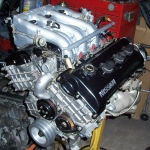

I swear I cannot tell a difference between my Fidanza lightweight flywheel in my blue VE and my stock setup in the black VE. I've never thought a lightened flywheel was difficult to drive or noticed any difference at all on the Maxima. I have always noticed inspection and alignment techs kill it when moving it up onto the lift, so apparently there is some difference to it though.
My brother has an ultra light flywheel in his Civic and the first few times I drove it I killed it and it was a little bit of work to get used to. But even at that, after just a few hours you adjust and it becomes natural. It's not like you'll still be struggling with it a year or two from now. Even if the driving dynamic changes you will quickly adjust unless you are just inordinately bad at working a clutch.
So I say go for it.
My brother has an ultra light flywheel in his Civic and the first few times I drove it I killed it and it was a little bit of work to get used to. But even at that, after just a few hours you adjust and it becomes natural. It's not like you'll still be struggling with it a year or two from now. Even if the driving dynamic changes you will quickly adjust unless you are just inordinately bad at working a clutch.
So I say go for it.
Last edited by James92SE; Feb 23, 2014 at 01:00 PM.

Now, the reason a lightweight flywheel is felt by the driver is because of inertia. A heavier flywheel has more mass (duh) and as we know a heavier object is harder to stop than a light one. So in first gear, starting from a dead stop takes more throttle with a lighter flywheel, or to look at it from another perspective, it is less able to maintain engine speed if the clutch is let out too quickly (ie stall). Naturally, the reduced weight helps the engine rev faster, but it also mean the engine will loose revs faster wheel you let off the throttle or shift gears. Really all a driver needs to know is the engine may require a little more gas when letting the clutch out, as James pointed you will quickly adjust. If you learned to drive with a lightweight flywheel, you would be just as proficient as with a heavier one and consider that to be the norm.
My point is there is absolutely no concerns on engine wear or longevity with a lightweight flywheel, just a slight adjustment in driving style.
I would also highly recommend a performance y-pipe as it's the best bang for you buck in terms of power.
 so youre saying flywheels have zero to do with power pulses?
http://www.lunaticfringe.org/vwfox/mod/flywheel.html
designed to prevent the RPMs from dropping too quickly, to dampen the power pulses from the engine and make life easier for the differential, and to make driving the car smoother
lightened flywheels do not smooth out the power pulses and help with smoothness as much as stock flywheels. i know many people that went from lightened flywheel to stock because they didnt like the feeling of them
Correct. Just because "someone" made a website stating something doesn't make it true. Edit: I guess the same applies to what I said, however unlike the author of that page, I majored in mechanical engineering and have almost a decade of experience in engine design. While a flywheel may have an effect on "power pulses" that is only a side effect and has absolutely nothing to do with its design or intention, nor is it nessesary as you had implied.
A change of 10lbs (your typical reduction in weight from a lightweight flywheel) (or even 20lbs) from the reciprocating weight on an engine making 182ft lbs of torque would NOT make a difference in "power pulses" that you could feel. Only sensitive vibrational equipment would be able to measure such a change. Smoother driving, less stress on a diff, TOTAL hog wash. Faster revs, quicker drop in RPM, that's the only thing you would notice.
A change of 10lbs (your typical reduction in weight from a lightweight flywheel) (or even 20lbs) from the reciprocating weight on an engine making 182ft lbs of torque would NOT make a difference in "power pulses" that you could feel. Only sensitive vibrational equipment would be able to measure such a change. Smoother driving, less stress on a diff, TOTAL hog wash. Faster revs, quicker drop in RPM, that's the only thing you would notice.
Last edited by Maxpwer; Feb 24, 2014 at 06:17 PM.

They're made to transfer engine torque into transmission and carry inertia bewteen shifts (OEM), and Lighten flywheels loose their RPM quickly due too this lack of weight and absence of this inertia.....But benefit with quicker accelerations again due to their lack of weight! I would only be interested in either a light weight steel billet flywheel or aluminum with an iron inserted friction surface....
Last edited by CMax03; Feb 25, 2014 at 01:09 PM.
 so youre saying flywheels have zero to do with power pulses?
http://www.lunaticfringe.org/vwfox/mod/flywheel.html
designed to prevent the RPMs from dropping too quickly, to dampen the power pulses from the engine and make life easier for the differential, and to make driving the car smoother
lightened flywheels do not smooth out the power pulses and help with smoothness as much as stock flywheels. i know many people that went from lightened flywheel to stock because they didnt like the feeling of them
larger dense mass can absorb pulses/vibrations better than light mass can. so yeah if you call that dampening...so be it.
i know a lot of guys here would trade in that smoothness with a little more power.
i can attest that i'm not a great manual driver...i do ok...but i really haven't hone in my skill in it for my car. personally i think i would benefit with the larger mass and being able to hold the RPMs a little higher...i'm going to say it's a little more forgiving for a rookie like me.
 i went to technical school, instructors all said that flywheels are for dampening power pulses as well. lightened flywheels you lose the dampening ability and you can feel the difference
To the OP, if you have any concerns about vibrations with a lightweight flywheel, PM me and I'll show you vibrational measurements of a VG engine with and without a flywheel and you can decide for yourself.
Ding ding ding, you win the prize. A harmonic damper or balancer IS specifically design for and tuned to a specific engine's harmonics and resonant frequencies. Despite it's smaller size and weight, it plays a much larger role than a flywheel in reducing vibrations. Thus why all cars have balancers while only manual transmission vehicles have flywheels.
Ding ding ding, you win the prize. A harmonic damper or balancer IS specifically design for and tuned to a specific engine's harmonics and resonant frequencies. Despite it's smaller size and weight, it plays a much larger role than a flywheel in reducing vibrations. Thus why all cars have balancers while only manual transmission vehicles have flywheels.
i think what chrome is getting at is that the heavier flywheel adds to the dampening powers compared to the alum flywheel. IMO unless you have some lab equipment no one would really feel the difference. it's just sheer mass at the end of the crank shaft. heavier mass tends to keep the revs up due to inertia and with the heavier mass it has more dampening...again the amount is very little.
so both of you guys are right.
let's go grab a drink.

Thread
Thread Starter
Forum
Replies
Last Post
TallTom
5th Generation Maxima (2000-2003)
57
Oct 14, 2025 05:16 PM
tarun900
4th Generation Maxima (1995-1999)
19
Dec 20, 2021 06:57 PM
My Coffee
New Member Introductions
15
Jun 6, 2017 02:01 PM