


Short ram intake????


Short ram intake????
I was thinking about installing a short ram intake in my 2000 max. I have a couple of questions though. I was looking around and had seen a few people made their own instead of buying one for $200. Does anybody know the materials needed to make one and the steps to install it? Also, is it worth it? Thanks!

Yes it's worth it.....If you have headers it's really worth it!!!!!!
1. Go to BPI or Vibrant performance....bellmouth intake
2. Measure your distance from TB to the fender....My was 23-24"
3.You'll need one (1) MAF adapter
4. (2) 3" silicon couplings or rubber....or use the resonator(Helmholtz)
5. 6" air filter... AEM, K&N, etc....
6. Cost approx-$100-120
1. Go to BPI or Vibrant performance....bellmouth intake
2. Measure your distance from TB to the fender....My was 23-24"
3.You'll need one (1) MAF adapter
4. (2) 3" silicon couplings or rubber....or use the resonator(Helmholtz)
5. 6" air filter... AEM, K&N, etc....
6. Cost approx-$100-120


This only happens when people do not properly clean/oil their filters. Go with a dryflow filter and you won't have any problems.


Stick with the dry filter though and you will be happy
B

Senior Member
Joined: Jan 2010
Posts: 339
From: Stone Mountain, Georgia
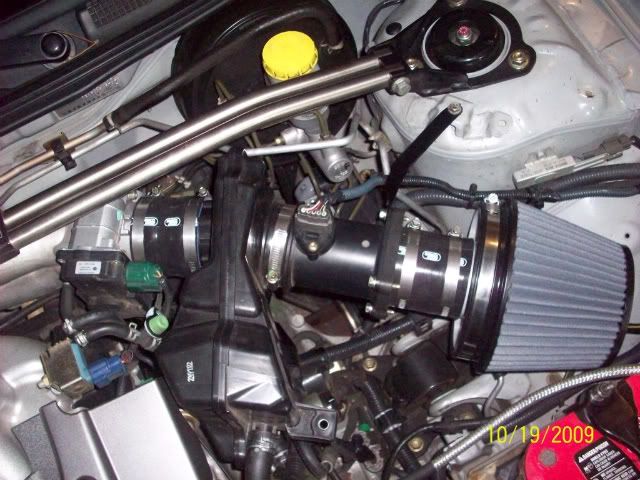
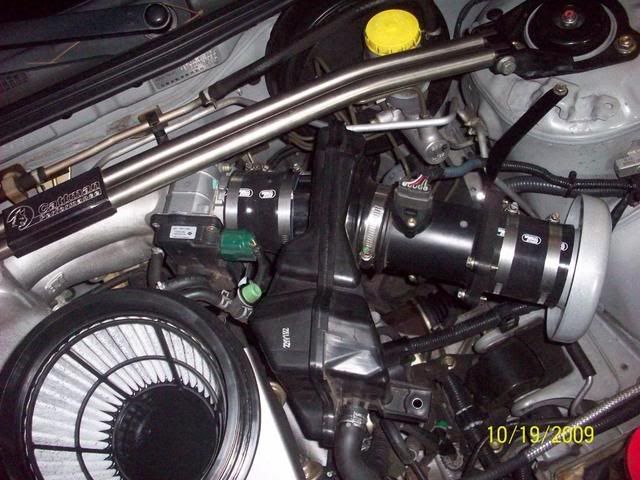
Ok sorry for being a newb, im just a little confused. So i looked at the stock intake and it splits off into two sections. One part goes down underneath the battery and the other piece goes into the air filter and through the maf into the TB. What exactly is the part of the intake that is under the battery. Also, if I am going to put in a SRI should i go directly from the TB or just connect it right to the MAF which is connected to the TB already? Thanks guys!

You say, "as I was told"... Would you please elaborate on that?



Ok, I can agree that the helmoltz is "tuned" to increase capacity. But I doubt it is tuned for an SRI. If you think about it the tune and the air speed etc are completely different between stock setup and an SRI . If it makes it quiet, I think it reduces horsepower.

That is the point of the VIAS, to change the intake manifold geometry as the RPM's change, maintaing a better "tune" for a given RPM range.
BUT, this is after the throttle body, and I have no idea if it works the same way before the throttle body, but considering at WOT, the throttle body is "non existent", it just may.
And you're probably right on the fact that it will not be measurable.
Ok....I doubt it....but that's proven that the midpipe vs the helmhotz resonator there's no gain using a midpipe...just sound....too much sound, mines too much turbulence.....This setup pulls constantly strong without flatspots like the previous INJEN intake....
By the way the Oem intake is basically a SRI with a cold airbox attached....the actual intake starts @ the miniture bellmouth...
By the way the Oem intake is basically a SRI with a cold airbox attached....the actual intake starts @ the miniture bellmouth...
Senior Member
Joined: Jan 2010
Posts: 339
From: Stone Mountain, Georgia

"Helmholtz resonance finds application in internal combustion engines (see airbox), subwoofers and acoustics. In stringed instruments, such as the guitar and violin, the resonance curve of the instrument has the Helmholtz resonance as one of its peaks, along with other peaks coming from resonances of the vibration of the wood. An ocarina is essentially a Helmholtz resonator where the area of the neck can be easily varied to produce different tones. The West African djembe has a relatively small neck area, giving it a deep bass tone."
Fascinating insights into the West African djembe.
Last edited by Rochester; Feb 27, 2010 at 02:37 PM.
going back from a sri to the resonator with a filter you will feel a nice bump in tq in the low to mid range and it will feel about just as strong on top. with A LOT less noise  . thats my experience, and ive kept the mid pipe off so far.
it depends on your setup but one of you guys should try it and you will be very surprised...
. thats my experience, and ive kept the mid pipe off so far. it depends on your setup but one of you guys should try it and you will be very surprised...
Anybody interested in running this test? I'm curious, but I'm also deep in winter misery, and doubt how attuned I am to the car running in freezing temperatures on snow tires..

The OEM intake source is colder air, I'll agree to that and the obvious. But there's no "cold airbox", just chambers designed to reduce noise and house a common filter panel. I think you're over-engineering this whole thing, and giving more credit than is due the OEM design. Can you provide any more information regarding the benefits of the "Helmholtz Resonator" being in the mix?
As evidence of what? Where in that Wikipedia entry is your take away for this application? The only thing I read about combustion engines is this:
As evidence of what? Where in that Wikipedia entry is your take away for this application? The only thing I read about combustion engines is this:
"Helmholtz resonance finds application in internal combustion engines (see airbox), subwoofers and acoustics. In stringed instruments, such as the guitar and violin, the resonance curve of the instrument has the Helmholtz resonance as one of its peaks, along with other peaks coming from resonances of the vibration of the wood. An ocarina is essentially a Helmholtz resonator where the area of the neck can be easily varied to produce different tones. The West African djembe has a relatively small neck area, giving it a deep bass tone."
Fascinating insights into the West African djembe.Can you state the penalty/penalties of using a helmhotz resonator? Mine works great and for me that's all that matters.....Folks have proved that there is no power loss using this when compared to the custom midpipe....the custom made midpipe is a cosmetic enhancements only!
My reasons for pursuing this is to determine what the benefits are other than lower customization cost and reducing the volume of air intake noise. I don't think there are any performance benefits, or that if there are, they would be more theoretical than measurable.
Don't get me wrong, I'm curious about this, and may very well see what comes of replacing my Frankencar midpipe with the resonator. But like I said... Winter. Ug.
In the meantime, let's see if anyone has any supporting information regarding supposed performance benefits.
Actually, it is quite true. Changing the effective length of the runners is infact "tuning" the resonant frequency of the manifold, thus improving it's pressurizing effect for the RPM range that it is tuned for.
"A tuned intake path can have a light pressurizing effect similar to a low-pressure supercharger - due to Helmholtz resonance. However, this effect occurs only over a narrow engine speed band. A variable intake can create two or more pressurized "hot spots", increasing engine output. When the intake air speed is higher, the dynamic pressure pushing the air (and/or mixture) inside the engine is increased. The dynamic pressure is proportional to the square of the inlet air speed, so by making the passage narrower or longer the speed/dynamic pressure is increased." -Wikipedia
If anyone wants to do some more reading:
http://en.wikipedia.org/wiki/Variabl...ntake_manifold
Edit: I'm not sure on this, but I wouldn't be surprised of those "two or more pressurized hot spots" were just harmonics of the base resonant frequency that the manifold is tuned to.
Edit #2: "Modern intake manifolds usually employ runners, individual tubes extending to each intake port on the cylinder head which emanate from a central volume or "plenum" beneath the carburetor. The purpose of the runner is to take advantage of the Helmholtz resonance property of air. Air flows at considerable speed through the open valve. When the valve closes, the air that has not yet entered the valve still has a lot of momentum and compresses against the valve, creating a pocket of high pressure. This high-pressure air begins to equalize with lower-pressure air in the manifold. Due to the air's inertia, the equalization will tend to oscillate: At first the air in the runner will be at a lower pressure than the manifold. The air in the manifold then tries to equalize back into the runner, and the oscillation repeats. This process occurs at the speed of sound, and in most manifold travels up and down the runner many times before the valve opens again." - wikipedia
"A tuned intake path can have a light pressurizing effect similar to a low-pressure supercharger - due to Helmholtz resonance. However, this effect occurs only over a narrow engine speed band. A variable intake can create two or more pressurized "hot spots", increasing engine output. When the intake air speed is higher, the dynamic pressure pushing the air (and/or mixture) inside the engine is increased. The dynamic pressure is proportional to the square of the inlet air speed, so by making the passage narrower or longer the speed/dynamic pressure is increased." -Wikipedia
If anyone wants to do some more reading:
http://en.wikipedia.org/wiki/Variabl...ntake_manifold
Edit: I'm not sure on this, but I wouldn't be surprised of those "two or more pressurized hot spots" were just harmonics of the base resonant frequency that the manifold is tuned to.
Edit #2: "Modern intake manifolds usually employ runners, individual tubes extending to each intake port on the cylinder head which emanate from a central volume or "plenum" beneath the carburetor. The purpose of the runner is to take advantage of the Helmholtz resonance property of air. Air flows at considerable speed through the open valve. When the valve closes, the air that has not yet entered the valve still has a lot of momentum and compresses against the valve, creating a pocket of high pressure. This high-pressure air begins to equalize with lower-pressure air in the manifold. Due to the air's inertia, the equalization will tend to oscillate: At first the air in the runner will be at a lower pressure than the manifold. The air in the manifold then tries to equalize back into the runner, and the oscillation repeats. This process occurs at the speed of sound, and in most manifold travels up and down the runner many times before the valve opens again." - wikipedia
Last edited by Unklejoe; Feb 28, 2010 at 08:17 AM.
Sideways off-topic, this thread is funky. Knight and Unklejoe are arguing mechanical theory and looking at this with respect to efficiency. Myself, Cmax and QNO are debating aesthetics and perception. All this because a brand new Org member asked if he should install a short-ram intake. It's kind of funny. Carry on. 

Sideways off-topic, this thread is funky. Knight and Unklejoe are arguing mechanical theory and looking at this with respect to efficiency. Myself, Cmax and QNO are debating aesthetics and perception. All this because a brand new Org member asked if he should install a short-ram intake. It's kind of funny. Carry on.
1. Will this mod give me added performance? and why.
2. Will this mod give me the better aesthetic look of efficiency and performance? and why
I for one am enjoying the interesting reading and different points of few.
and by the way I think the helmholtz is ugly as sin...
Yeah it is ugly.
I personally would have rather had a mid pipe, just for the sound
But I was just trying to argue the theory behind the resonator and show that it doesn't necessarily hurt power like an exhaust resonator could.
I personally would have rather had a mid pipe, just for the sound
But I was just trying to argue the theory behind the resonator and show that it doesn't necessarily hurt power like an exhaust resonator could.
The reason that the longer intake runners are better for torque is because of helmholtz resonance.
If resonance had nothing to do with it, how come they just don't use the shortest runners possible for the least amount of air resistance?
"Modern intake manifolds usually employ runners, individual tubes extending to each intake port on the cylinder head which emanate from a central volume or "plenum" beneath the carburetor. The purpose of the runner is to take advantage of the Helmholtz resonance property of air."
This is similar to the way that people tune sub woofer enclosures and acoustic instruments.
Senior Member
Joined: Jan 2010
Posts: 339
From: Stone Mountain, Georgia
This effect is akin to that of a bungee-jumper bouncing on the end of a bungee rope, or a mass attached to a spring. Air trapped in the chamber acts as a spring. Changes in the dimensions of the chamber adjust the properties of the spring: a larger chamber would make for a weaker spring, and vice-versa.
The air in the port (the neck of the chamber) has mass. Since it is in motion, it possesses some momentum. A longer port would make for a larger mass, and vice-versa. The diameter of the port is related to the mass of air and the volume of the chamber. A port that is too small in area for the chamber volume will "choke" the flow while one that is too large in area for the chamber volume tends to reduce the momentum of the air in the port."
Kind of a stretch, but I can see how this would work in an intake.

Just buy a mid pipe from Knight_yyz and be done with it. if he still has any left.
http://forums.maxima.org/5th-generat...akes-00-a.html
I bought one from him 2 weeks ago. The metal is thick n strong and the welds are nicely done. This mid pipe looks good n feels good. I recomend these to any one who is interested in making their on intake.
http://forums.maxima.org/5th-generat...akes-00-a.html
I bought one from him 2 weeks ago. The metal is thick n strong and the welds are nicely done. This mid pipe looks good n feels good. I recomend these to any one who is interested in making their on intake.
Just buy a mid pipe from Knight_yyz and be done with it. if he still has any left.
http://forums.maxima.org/5th-generat...akes-00-a.html
I bought one from him 2 weeks ago. The metal is thick n strong and the welds are nicely done. This mid pipe looks good n feels good. I recomend these to any one who is interested in making their on intake.
http://forums.maxima.org/5th-generat...akes-00-a.html
I bought one from him 2 weeks ago. The metal is thick n strong and the welds are nicely done. This mid pipe looks good n feels good. I recomend these to any one who is interested in making their on intake.
Read this....I believe it still applies
http://forums.maxima.org/4th-generat...no-inside.html
http://forums.maxima.org/4th-generat...no-inside.html
I am talking about helmholtz resonance inside the intake manifold.
The reason that the longer intake runners are better for torque is because of helmholtz resonance.
If resonance had nothing to do with it, how come they just don't use the shortest runners possible for the least amount of air resistance?
The reason that the longer intake runners are better for torque is because of helmholtz resonance.
If resonance had nothing to do with it, how come they just don't use the shortest runners possible for the least amount of air resistance?
Because the way I see it, if resonance had nothing to do with it, the engine would perform best with the smallest intake runners possible.
Why do longer runners give more torque?
And exhaust and intake are slightly different in the respect that the combustion has already occurred by the time the exhaust gets to the header's runner.
But, high quality headers are in fact "tuned" for an optimum rpm range. It involved using the low pressure zones left behind by the previous exhaust gas pulse to create a vacuum to sort of "pull out" the next exhaust pulse.
I agree with the tube length theory...that's right on.....that's why my Hybrid SRI is roughly 20" -24" in length instead of the normal SRI length of 14"-16", or the Injen intake length of 39". I wanted to keep the air entrance at least 8" upstream of the MAF sensor, where as a JWT/Stillen popcharger is about 3"-4" upstream......Aiming for straight airflow at the MAF sensor, Air entrance ease utilizing the bellmouth and large AEM dryflow filter, and both will result in a high velocity intake charge to fill the cylinders as fast as the headers can evacuate them and minimum turbulance/noise on the intake side utilizing the Helmholtz resonator chamber no matter how ugly it is....it works for me!
The explanation is in the diagram of how the VIAS works.
Long runners result in increased intake air volume which increases suction which increases torque.
Short runners reduce the suction resistance of the air and therefore increase horsepower.
And this is why my BBMAF is 17" long with the MAF built in plus the length of the coupler and the bell mouth velocity stack. The bell mouth smooths the air flow, the longer intake increase amount of air but the larger diameter reduces suction, so I will get a bit of both worlds if my math is correct.
here's a vid of the setup I am going for this spring. I was not tuned for the larger diameter so I didn't punch it too hard in the driveway. This was just a test mockup to test for fitment.
http://www.youtube.com/watch?v=P90VnjMh5EQ
Long runners result in increased intake air volume which increases suction which increases torque.
Short runners reduce the suction resistance of the air and therefore increase horsepower.
And this is why my BBMAF is 17" long with the MAF built in plus the length of the coupler and the bell mouth velocity stack. The bell mouth smooths the air flow, the longer intake increase amount of air but the larger diameter reduces suction, so I will get a bit of both worlds if my math is correct.
here's a vid of the setup I am going for this spring. I was not tuned for the larger diameter so I didn't punch it too hard in the driveway. This was just a test mockup to test for fitment.
http://www.youtube.com/watch?v=P90VnjMh5EQ

Thread
Thread Starter
Forum
Replies
Last Post
jmlee44
4th Generation Maxima (1995-1999)
8
Oct 2, 2022 02:13 PM